Aim- To maintain the temperature of the polyhouse at 30-32 0C and humidity at 60-65%
Objective-
- Collect data with different combinations of FAN, PAD, and FOGGER.
- Interpret data based on changes that have been made
- Look after calculations and modifications to maintain the desired temperature and Humidity.
Key Findings-
- As the temperature is based on the sunlight, with the change between the Earth and the sun as light intensity goes down, the inside temperature decreases while outside temperature remains constant as earlier readings.
26/4/2026-
First experiment starts at 11 AM as Dixit sir suggests conducting trials on 11-2 PM for poluhouse data collection. This time span is crucial from a data collection perspective.
Combinations are as follows: first Fan, then Pad, then Fogger.
We began with only the polyhouse data of temperature and humidity. Start the fan, then record the next data as no change happened by the fan. We start the pad system promptly with minimal water on the pad as the speed increases, resulting in water loss on the ground.
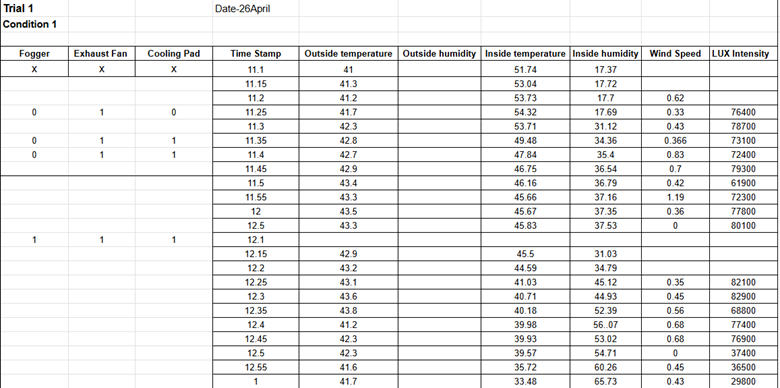
As the cloud closes the sun, the light intensity decreases, and as a result, the inside temperature decreases suddenly.
This is the best interpretation we got from this experiment.
27/4/2026-
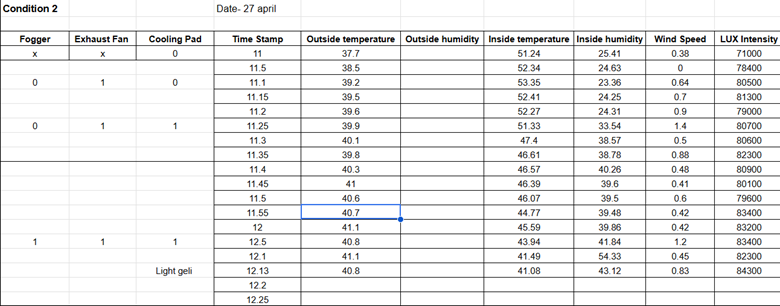
The second trial on the same combination of Fan-Pad-fogger.
Started with the fan reading, then jumped to the pad as there is no change in the fan. The pad system has sufficiently reduced the temperature and increased the humidity.
This was all okay, but there was an electricity failure, so we stopped the experiment. We were able to achieve the inside and outside temperature at the same level – 41 °C and humidity at 43%
Unusual thing I notice while fixing the pressure of water in the fogger and the pressure of air. As pressure started by the air compressor of 2 Bar, the water on the pad evaporated faster, which means need more water as earlier ex. 10L now 20L around.
This anomaly occurs when I discuss with dixit sir Sir explain me about the VENTURY effect for the pressure being exerted in the polyhouse. It creates some sort of vacuum inside it so the pad evaporates more inside, and the fan expels more water and air.
28/4/2026
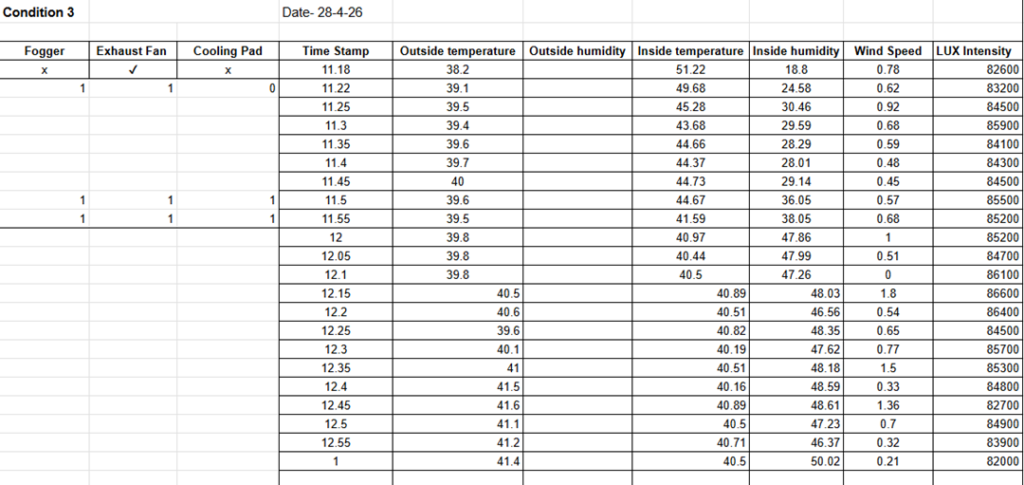
The third experiment on the polyhouse data collection began on 11.08 AM, but slide change in the combination. Start the fan and fogger together because the fan alone does not change the atmosphere inside the polyhouse, so directly combine the fogger.
After 3-4 readings, the changes were visible and more stable at the end of 5-6 readings. After steady temperature and humidity, we started the pad system for checking the combinations.
This combination of constant temperature and humidity was found at 12.40 PM with the same inside and outside temperature.
29/4/26
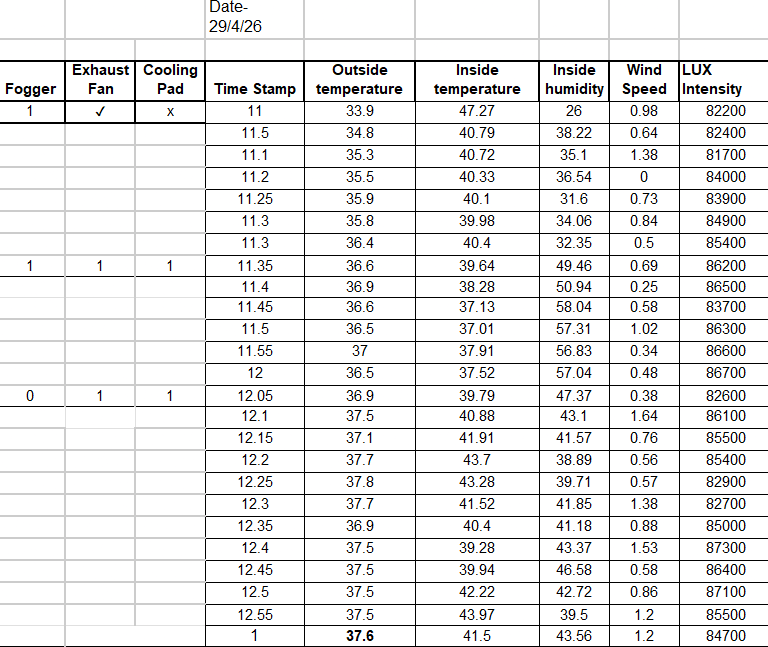
By discussion, the following conclusion has been made
- The inside temperature has been affected by the intensity of the light.
- To reach the first equilibrium in the polyhouse by starting the cooling pad or fogger is the same.
- The first delta in polyhouse for fogger and fan pad is nearly 6-8 degree celcious.
- The inside temperature has been achieved to the outside temperature only if the outside temperature is 39, then the inside temperature will also reach 39 degree celcious only.
- As it only maintains inside and outside tempreture equilibrrium only, there in nesessity to check the calculations for the heat transfer and change the fogger or fan, or pad system to achieve the desired temperature and humidity.
As of now, the first phase of the experiment has been done; calculations remain to maintain the desired temperature and humidity.
5/5/26
Discussion on the experimental data with TEAM
By the calculations, Dixit sir had some of the interpretations regarding the polyhouse. On the specific calculation with internal and outside heat transfer.
If the fan is OFF, there will be a high temperature inside the polyhouse because of green house effect. As soon fan turns on, it must reduce to some extent, that’s in theory. Based on the inside energy, fans were placed after thorough calculations.
The length of the polyhouse is 4m, height is 4.25m, and width is 2.3m. To remove the total volume of air in a cycle requires 8000CFM fans; that’s what the calculation says. But for now, neither major difference nor minor difference using only fans to reduce the temperature inside the polyhouse.
There could be two possibilities as follows.
- Fans are not of 8000CFM to reduce the temperature inside the polyhouse.
- The path has been compromised- short circuits or channelization.
1. Fan
As per the old calculation, Fans have been selected to reduce temperature with 1000CFM of each fan placement inside the polyhouse. So the total CFM is 8000 CFM from 8 fans in total. But now there is no change in Temperature.
- Check the CFM of the fan by anemometer by making ducts in a closed environment.
2. Short circuits
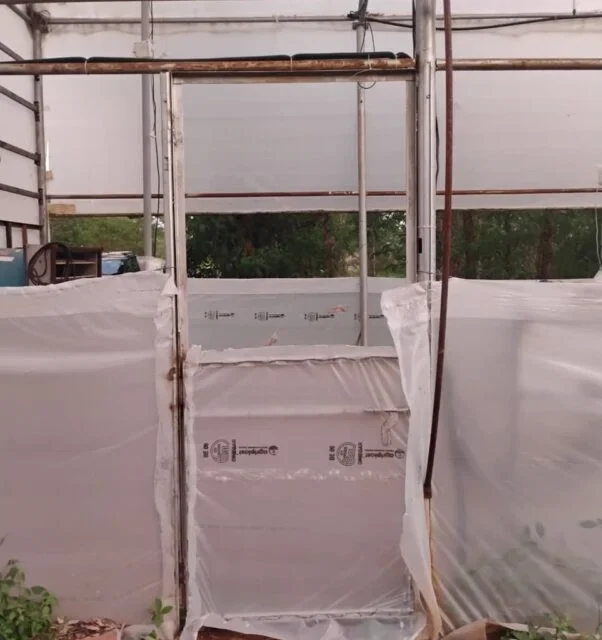
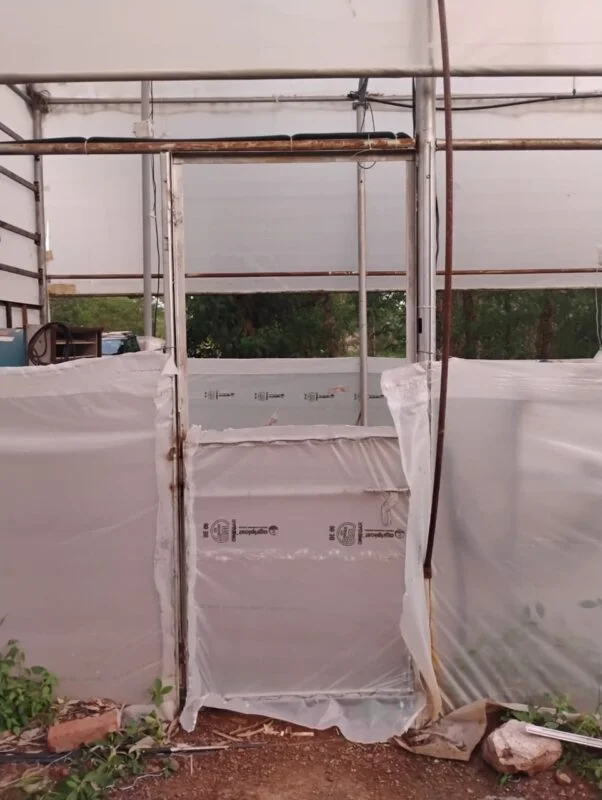
If the fan is of 8000cfm, then check for the short circuits inside the polyhouse. Although the polyhouse is closed, through the door and sliding, there is a slight opening to pass air inside the polyhouse instead of the pad system, more air is inserted through these openings.
- Check the airflow inside the polyhouse to make sure there is a uniform airflow in one direction, i.e., towards the fan from the pad systems only.
- Close the opening with the duct tape to make sure there is no opening for air beside the pad system.
Field Checking- By the Fragrance Stick for the following aspects.
- Short circuits
- Uniform airflow.
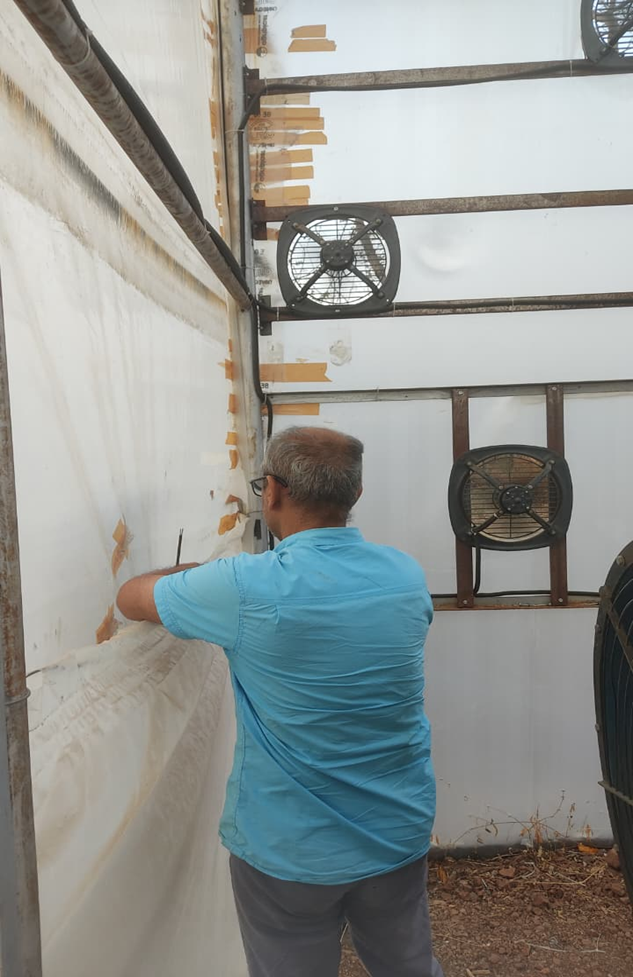
Conclusion of the field testing with Stick
- Short circuits- From the nearby sliding and opening of the door, most of the air is transferred to the fans, directly creating a shorter path for air. Because of this reason, most of the air is circulating inside the polyhouse without making it clearer path towards the fans. Moreover, the air being sucked near the fan itself creates short circuits(channelization)
- Uniform Airflow- Near the pad, sometimes the air has been moving OUT. This is why we are still figuring..
When the fan is OFF, airflow is multidirectional, with most of the air going upward as it is a lower-density air. When the Fan is ON, it must follow the path towards the pad. Here in this scenario, most of the air is moving upward and with minor multidirectional flow, with no major current flow towards the Fans. This is because of the channelization created inside the polyhouse.
6/6/26
Second verification for the short circuits and airflow- By the UTT
At 9.15AM We conducted same set of experiment with UDD…
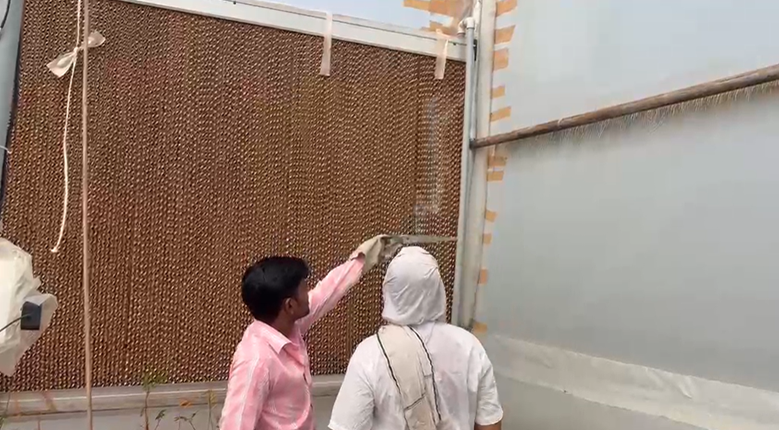
Nearby Pad the Lower edge pad most of the air has been moved upward, and some air been went ouside through the pad itself.
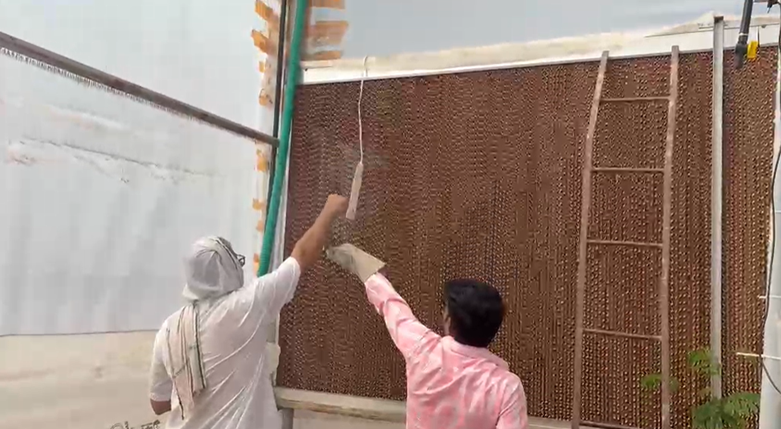
Above the pad, almost all smoke has been upward direction as there is no current flow towards the fan.

In the middle of the polyhouse, air is moving upward, and the direction of the opening of the slider.

Near the Left lower, there is a major opening, so all the air is moving towards fan and upward direction towards the middle-left fan.
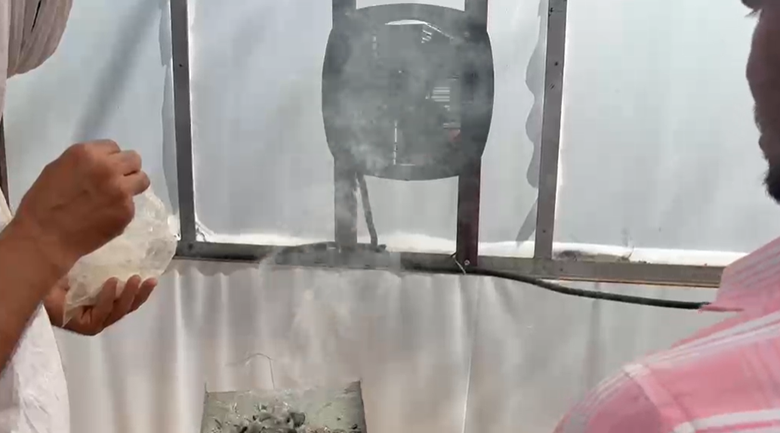
Only in the lower middle fan, there is uniformity of air flow as there is no or minor short circuits.
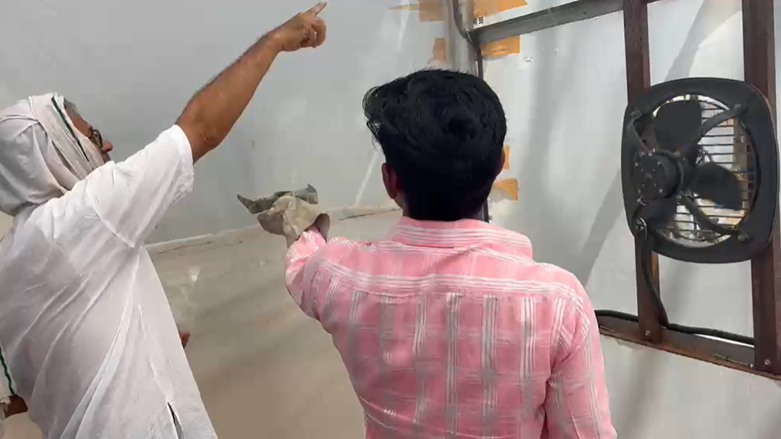
Near the Right lower, there is a major opening, so all the air is moving towards the fan and upward direction towards the middle-right fan.
Video Link- https://drive.google.com/file/d/1ACOlTlUsVFZEDZsK9z81KxE_vDt4x0fY/view?usp=drive_link
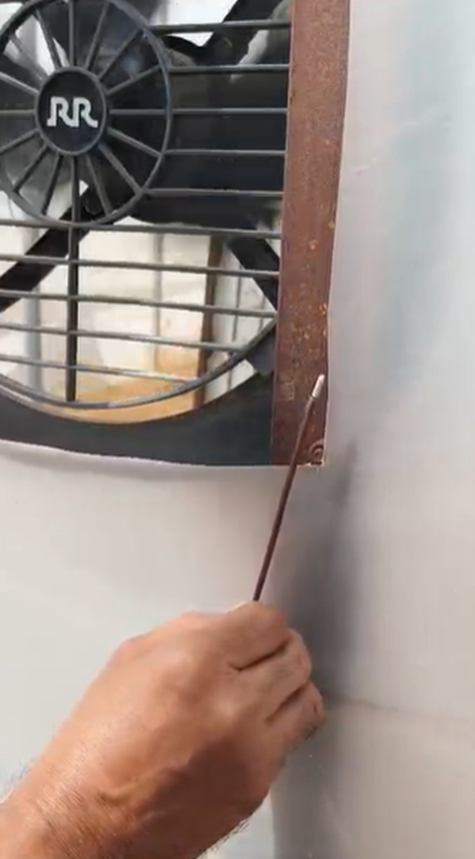
As we concluded earlier, the experiment with canalization and openings inside the polyhouse, this set of experiments confirms it further. There is one more addition to the short circuits scenario because the fan attached to the polyhouse is not closely packed, so it also creates a shorter path for sir to circulkate air to circulate in a circle to make sure it is or not. We perform an experiment near the fan with a stick.
Video Link- https://drive.google.com/file/d/1DEB-vmEAK7AYKbMCAotxiX2g66XsztDG/view?usp=drive_link
Next Approach to tackle these problems
- Calculate the CFM of the fan using the anemometer
- Close the opening of the connection of the fan and polyhpuse first.
- Make the door open inside; now it is opening outside, which makes it more difficult to open and close, and also reduces the sliding.
- Close the polyhouse all the opening by the duct tape.
Conclusion – By this experiment, we certainly know that the short circuites in now in the nearby fan, which connects the polyhouse and fan, but there is a gap which allow the air to go inside and makes it a shorter path to travel.