
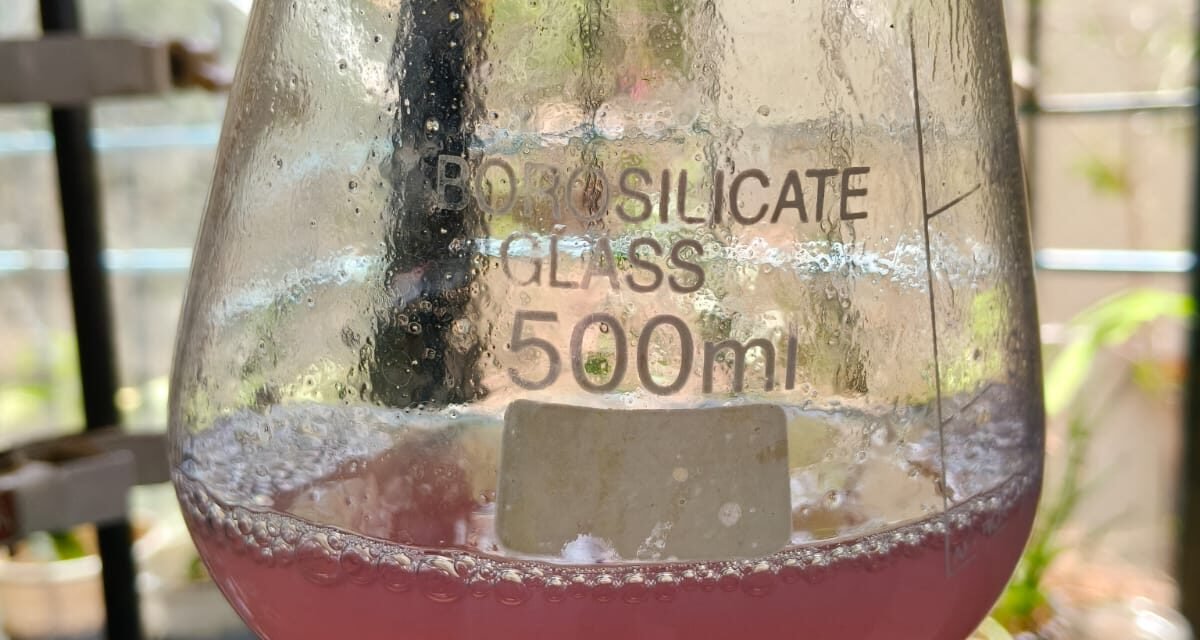
Aim
To determine the Calcium Carbonate (CaCO₃) content in soil using the rapid neutralization method involving hydrochloric acid (HCl) and sodium hydroxide (NaOH) titration.
Principle
Calcium carbonate present in the soil reacts with a known excess amount of hydrochloric acid. After the reaction is complete, the remaining unreacted acid is determined by titration with standard sodium hydroxide solution. The amount of acid consumed by calcium carbonate is used to calculate the CaCO₃ content of the soil.
Reaction : CaCO₃ + 2HCl → CaCl₂ + H₂O + CO₂↑
Materials Required
- Air-dried soil sample
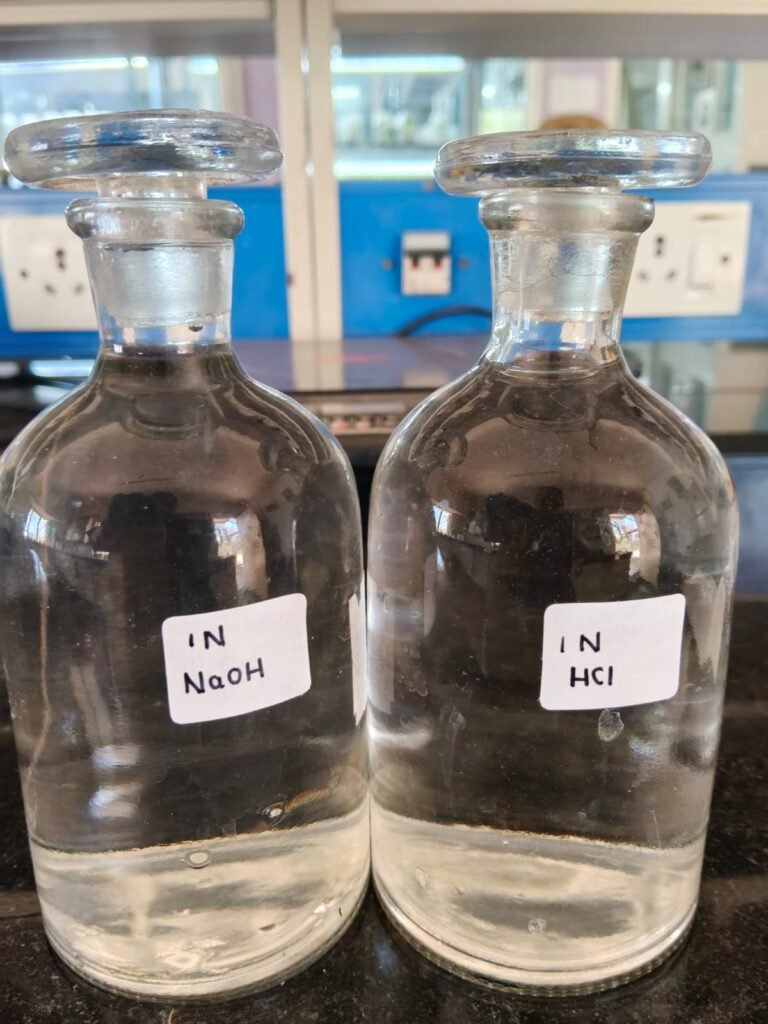
- 1 N Hydrochloric acid (HCl)
- 1 N Sodium hydroxide (NaOH)
- Phenolphthalein indicator
- Conical flask
- Burette
- Pipette
- Funnel
- Measuring balance
- Distilled water
- Filter paper
Preparation of 1 N HCl (500 mL)
Calculation
Using the dilution formula:
N₁V₁ = N₂V₂
Where:
- N₁ = 12 N (Concentrated HCl)
- N₂ = 1 N
- V₂ = 500 mL
V₁ = (N₂ × V₂) / N₁
V₁ = (1 × 500) / 12
V₁ = 41.7 mL
Procedure
- Take about 400–450 mL distilled water in a 500 mL volumetric flask.
- Carefully add 41.7 mL concentrated HCl to the water while stirring.
- Allow the solution to cool.
- Make up the volume to 500 mL with distilled water and mix thoroughly.
Preparation of 1 N Sodium Hydroxide (NaOH)
Procedure
- Weigh 20 g of NaOH pellets.
- Dissolve the pellets in distilled water.
- Transfer the solution to a 500 mL volumetric flask.
- Make up the volume to 500 mL with distilled water and mix well.
Procedure
- Air-dry the soil sample and pass it through a 2 mm sieve.
- Accurately weigh 5 g of soil and transfer it into a conical flask.
- Add 50 mL of 1 N HCl.
- Swirl gently and allow the reaction to proceed for 30 minutes.
- Effervescence (bubbling) indicates the presence of calcium carbonate.
- Filter the suspension to remove soil particles.
- Collect the filtrate in a clean flask.
Titration
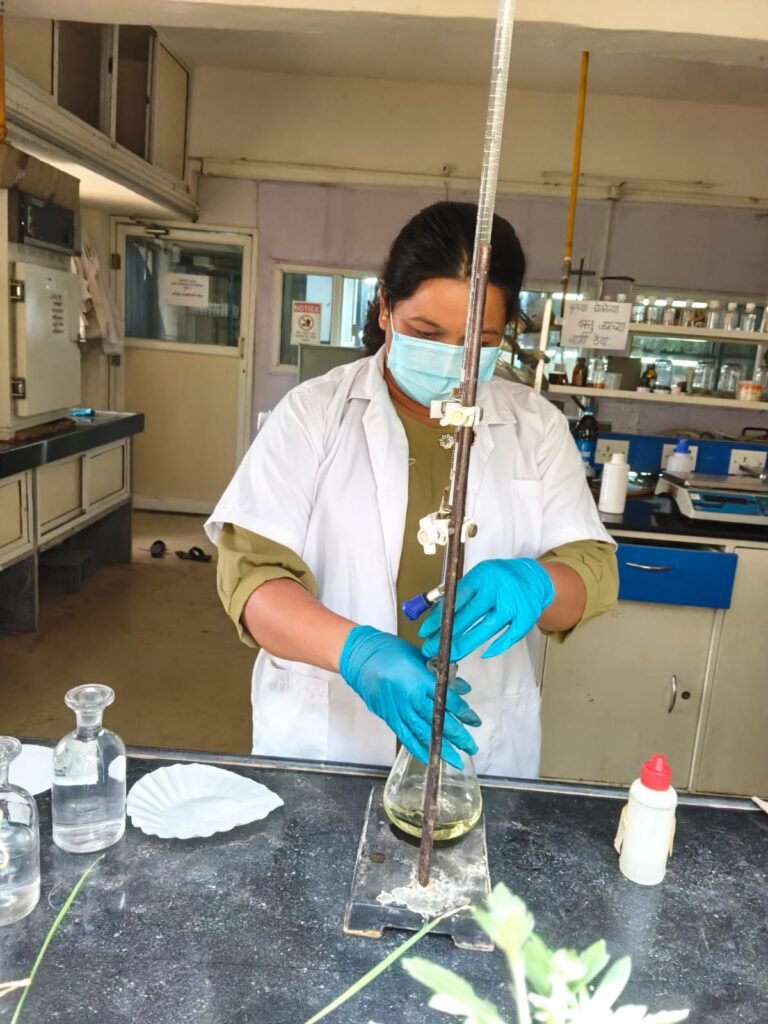
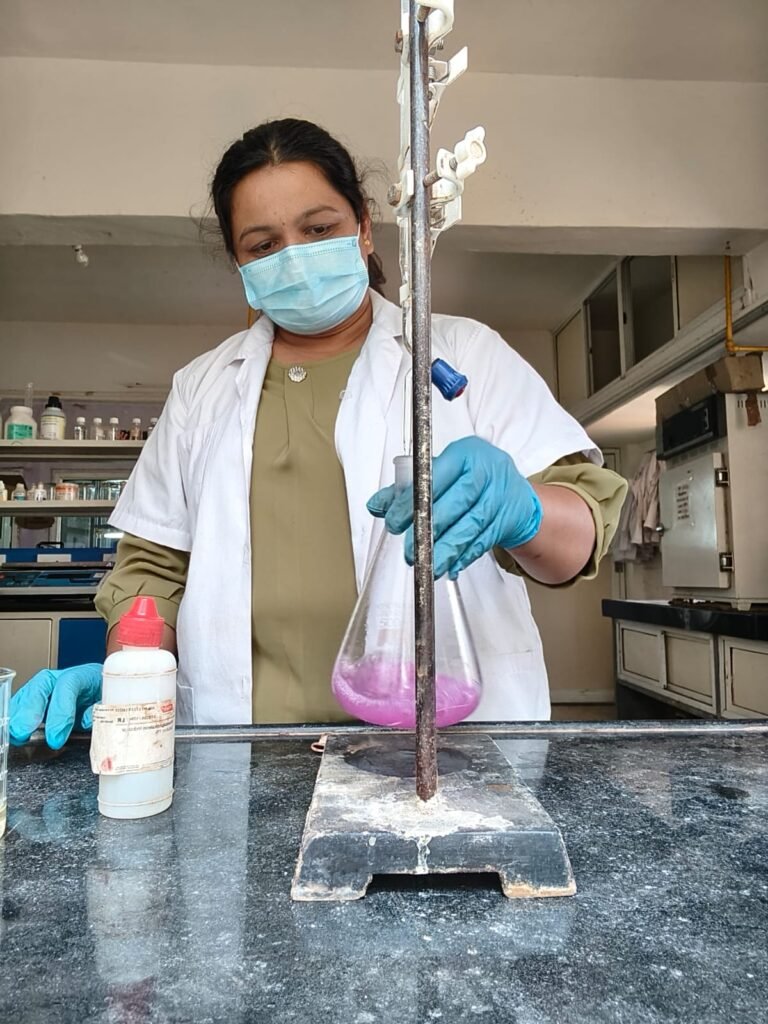
- Add 2–3 drops of phenolphthalein indicator to the filtrate.
- Titrate with 1 N NaOH until a faint permanent pink colour appears.
- Record the volume of NaOH used.
Calculations
Acid Consumed (ml) = Initial HCl Added − NaOH Used
CaCO₃ Percentage
Amount of CaCO₃ (g) = Acid Consumed (mL) × 0.05
CaCO₃ (%) = (Amount of CaCO₃ / Weight of Soil) × 100
Sample Calculation
Given
- Weight of soil = 5 g
- HCl added = 50 mL
- NaOH used = 8 mL
Step 1: Calculate Acid Consumed
Acid Consumed = 50 − 8
Acid Consumed = 42 ml
Step 2: Calculate CaCO₃
Amount of CaCO₃ = 42 × 0.05
Amount of CaCO₃ = 2.1 g
Step 3: Calculate CaCO₃ Percentage
CaCO₃ (%) = (2.1 / 5) × 100
CaCO₃ (%) = 42%
Interpretation
| CaCO₃ (%) | Soil Type |
|---|---|
| Less than 5% | Non-calcareous |
| 5–10% | Slightly calcareous |
| 10–20% | Moderately calcareous |
| More than 20% | Highly calcareous |
| Sr.No. | Farmar Name | CaCO₃ (%) | Soil Type | Suitability for Mango Cultivation |
| Arvind Zende | 16 % | Moderately Calcareous | Moderately suitable. Mango can be grown with proper nutrient management and micronutrient application. | |
| 38 % | Highly Calcareous | Not suitable. High CaCO₃ may cause iron and zinc deficiency, resulting in poor growth and yield. | ||
| 24.9 % | Highly Calcareous | Not suitable. Cultivation is possible only with intensive soil and nutrient management. | ||
| 16.3 % | Moderately Calcareous | Moderately suitable. Suitable with regular application of organic matter and micronutrients. | ||
| 42 % | Highly Calcareous | Not suitable. Very high CaCO₃ content can adversely affect nutrient uptake and orchard performance. |
Conclusion
१) Arvind Zende – CaCO₃ : 16% (Moderately Calcareous)
ही जमीन आंबा लागवडीसाठी योग्य आहे, परंतु सेंद्रिय खतांचा वापर आणि लोह (Fe), जस्त (Zn) यांसारख्या सूक्ष्म अन्नद्रव्यांचे योग्य व्यवस्थापन करणे आवश्यक आहे.
२) CaCO₃ : 38% (Highly Calcareous)
ही जमीन आंबा लागवडीसाठी योग्य नाही, कारण जास्त कॅल्शियम कार्बोनेटमुळे सूक्ष्म अन्नद्रव्यांची उपलब्धता कमी होते. या जमिनीत डाळिंब, अंजीर, बोर किंवा खजूर यांसारखी क्षारयुक्त व चुनखडीयुक्त जमीन सहन करणारी फळपिके अधिक योग्य ठरतात.
३) CaCO₃ : 24.9% (Highly Calcareous)
ही जमीन आंबा लागवडीसाठी शिफारस केली जात नाही. या जमिनीत डाळिंब, अंजीर, बोर आणि सीताफळ यांसारखी पिके तुलनेने चांगली वाढतात.
४) CaCO₃ : 16.3% (Moderately Calcareous)
ही जमीन आंबा लागवडीसाठी योग्य आहे, मात्र सेंद्रिय पदार्थांचा वापर आणि सूक्ष्म अन्नद्रव्यांचे व्यवस्थापन केल्यास उत्पादन अधिक चांगले मिळू शकते.
५) CaCO₃ : 42% (Highly Calcareous)
ही जमीन आंबा लागवडीसाठी योग्य नाही. या जमिनीसाठी डाळिंब, अंजीर, बोर, खजूर आणि सीताफळ ही फळपिके अधिक अनुकूल मानली जातात.
निष्कर्ष : 16–16.3% CaCO₃ असलेली जमीन योग्य व्यवस्थापनासह आंबा लागवडीसाठी वापरता येते. परंतु 24.9%, 38% आणि 42% CaCO₃ असलेली अत्यंत चुनखडीयुक्त (Highly Calcareous) जमीन आंब्यासाठी शिफारस केली जात नाही. अशा जमिनीत डाळिंब, अंजीर, बोर, सीताफळ आणि खजूर यांसारखी चुनखडीयुक्त जमीन सहन करणारी फळपिके घेणे अधिक फायदेशीर ठरते.