
Introduction –
Silver sulfate is an important inorganic compound used mainly in COD analysis as a catalyst to improve oxidation of organic matter. It is prepared by reacting silver with strong oxidizing acids such as nitric acid and sulfuric acid. The synthesis of silver sulfate helps in understanding redox reactions and crystal formation
Objective –
1.To produce silver sulfate for applications such as COD analysis and analytical chemistry.
2.To reduce the overall cost compared to purchasing commercially available silver sulfate directly.
- 25 g commercial silver sulfate costs ₹11,570
- 5 g silver gives about 7.2 g silver sulfate
- Buying 7.2 g commercially costs about ₹3332
- Lab preparation costs about ₹1700–₹1900
- Hence, laboratory synthesis is more economical than direct purchase.
Theory –
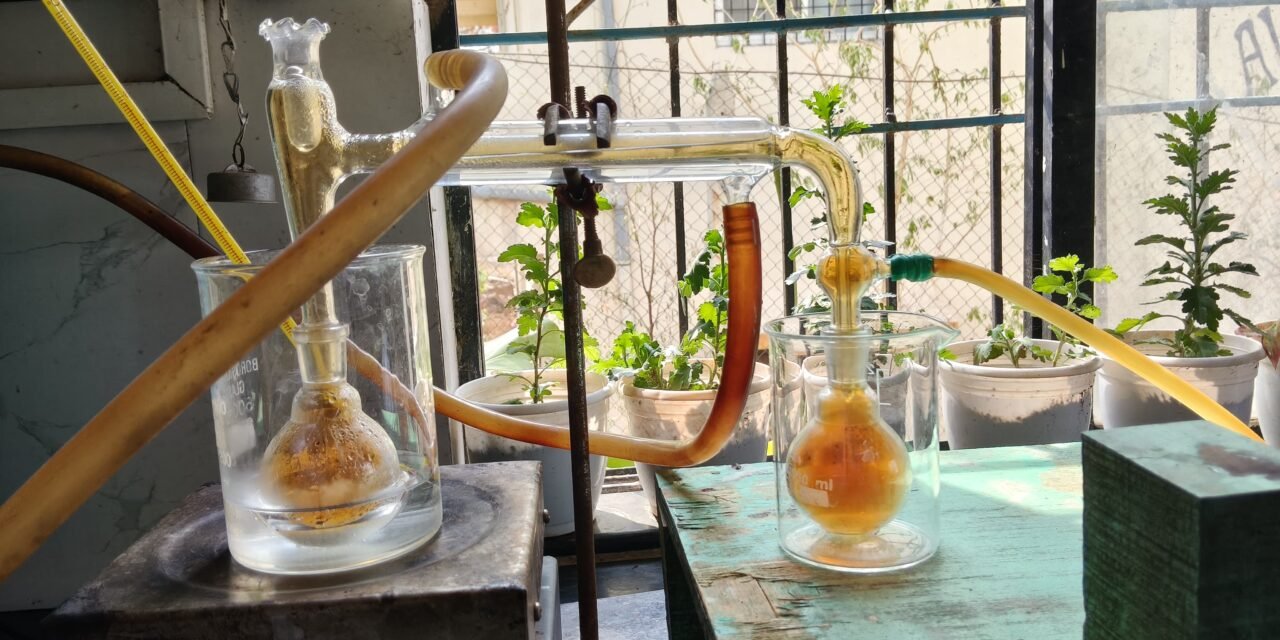
Silver is a less reactive metal and it does not react with dilute acids. Hence, concentrated nitric acid is used as an oxidizing agent to convert silver into silver nitrate with evolution of nitrogen oxide gases (Brown colored). The silver nitrate formed then reacts with concentrated sulfuric acid to produce white silver sulfate crystals. The process involves oxidation-reduction reaction and precipitation. Heating was used to speed up the synthesis, while the condenser cooled the vapors and prevented loss of chemicals by returning them to the reaction flask. A NaOH scrubber was connected to absorb and neutralize the toxic gases produced during the reaction.
Reactions
Formation of Silver Nitrate
Ag + 2HNO3(conc) =AgNO3 + NO2 + H2O
Formation of Silver Sulfate
2AgNO3 + H2SO4= Ag2SO4 + 2HNO3
Materials Required
- Silver metal (5 g)
- Concentrated nitric acid
- Concentrated sulfuric acid
- Distilled water
Apparatus Required
- Beaker
- Round bottom flask
- Measuring cylinder
- Glass rod
- Funnel and filter paper
- Heating mantle
- Gas scrubber setup
- Wash bottle
- Clamp stand and tubing
Silver Sulphate(Theoretical Yield)
Atomic mass of silver (Ag) = 107.87 g/mol
Moles of Ag =4.96/107.87 =0.0459 mol
By stoichiometry,
2 mole Ag gives 1 mol Ag2SO4
Moles of Ag2SO4 = 0.0459/2 = 0.02295mol
Calculate mass of silver sulfate
Molar mass of (Ag2SO4) = 311.8 g/mol
0.02295*311.8 = 7.15 g
approximately 7.15 g of silver sulfate can be produced theoretically from 4.96 g of silver.
Amount of Chemicals to be added
for Nitric acid
For 4.96 g silver
Ag + 2HNO3(conc) =AgNO3 + NO2 + H2O
Moles of Ag =4.96/107.87 =0.0459 mol
Moles of HNO₃ required = 0.046* 2 = 0.092mol
Mass of pure HNO₃ = 0.092*63 = 5.80g
For 70% nitric acid = 5.80/0.70 = 8.29
Take 8.29 g of 70% nitric acid (Take excess to ensure complete dissolution of silver)
For Sulfuric acid –
Moles of AgNO₃ formed = 0.046
2AgNO₃ + H₂SO₄ → Ag₂SO₄ + 2HNO₃
Moles of H₂SO₄ required =0.046/2=0.023 mol
Mass of H₂SO₄ =0.023*98=2.25
Adding 5% excess = 2.25*1.05 = 2.36g
15–20 g NaOH in 250 mL water is used as a scrubber solution to absorb toxic acidic gases (NO₂ and SO₂) formed during the reaction.
Procedure –
- Setup of Round Bottom Flask and Gas Scrubber
- Weighing of Silver Using Weighing Balance
- Addition of Concentrated Nitric Acid in Round Bottom Flask
- Heating of Flask on Heating Mantle for Dissolution of Silver
- Formation of Silver Nitrate Solution Inside Flask
- Passage of NO₂ Gas Through Gas Scrubber
- Wait Till it Cool Completely
- Addition of Concentrated Sulfuric Acid in Reaction Flask
- Heating of Reaction Mixture for Silver Sulfate Formation
- Heat it until all brown gas get reduced
- Cooling of Solution in Ice Bath for Crystallization
- Filtration of Silver Sulfate Using Funnel and Filter Paper
- Washing of Crystals with cold Distilled Water
- Drying of Silver Sulfate on in Hot Air Oven
- Collection and Storage of Final Product in Sample Bottle
Note –
- Use the washing water in minimum amount because the solubility of silver sulphate is 8gm per liter of water
- Heating should be controlled to avoid chemical loss and splashing
- Be careful while repeatedly transferring silver sulphate crystals from one container to other
Experimental set up
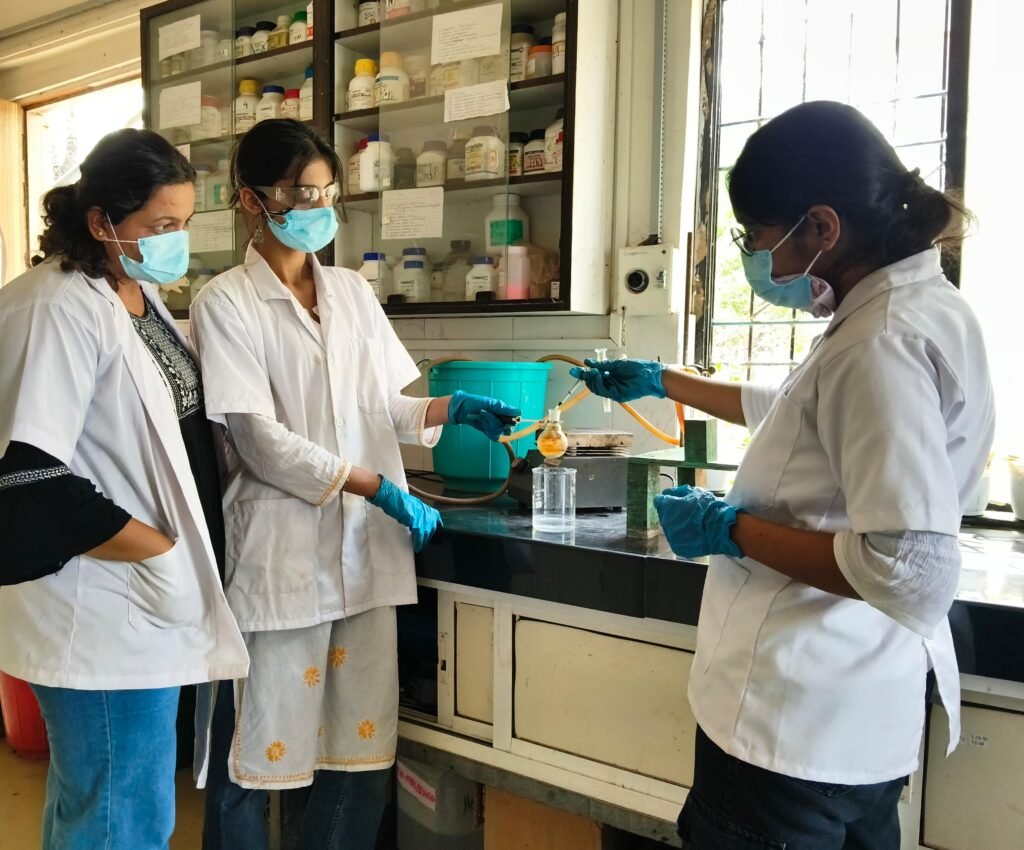
Addition of sulfuric acid slowly
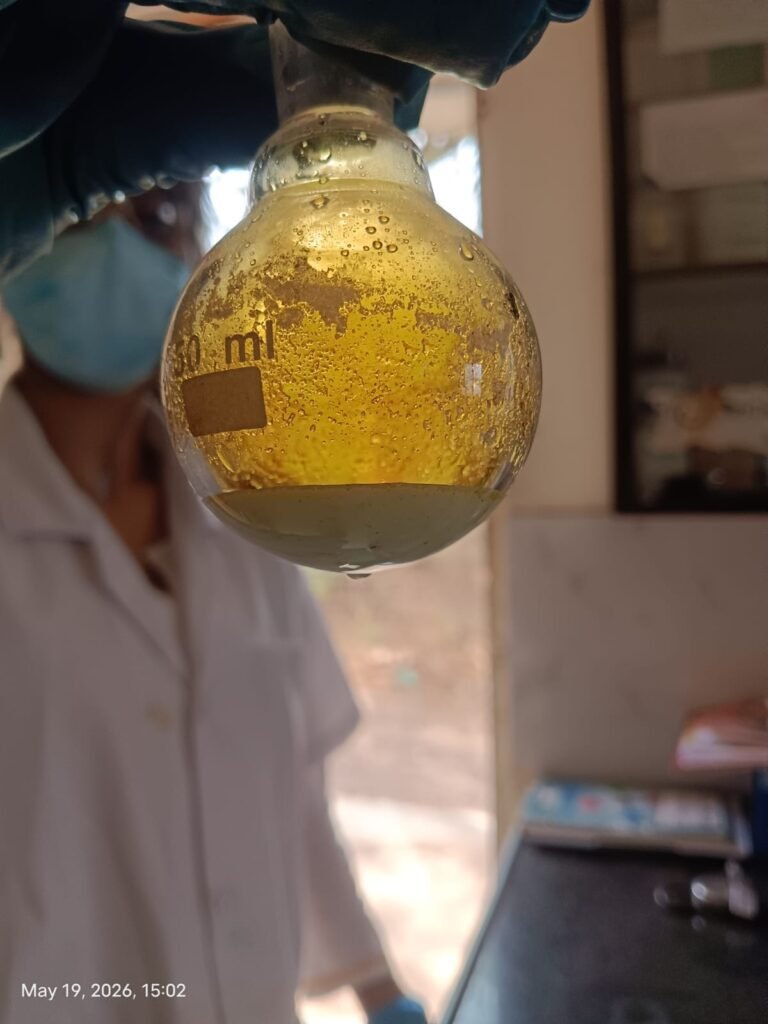
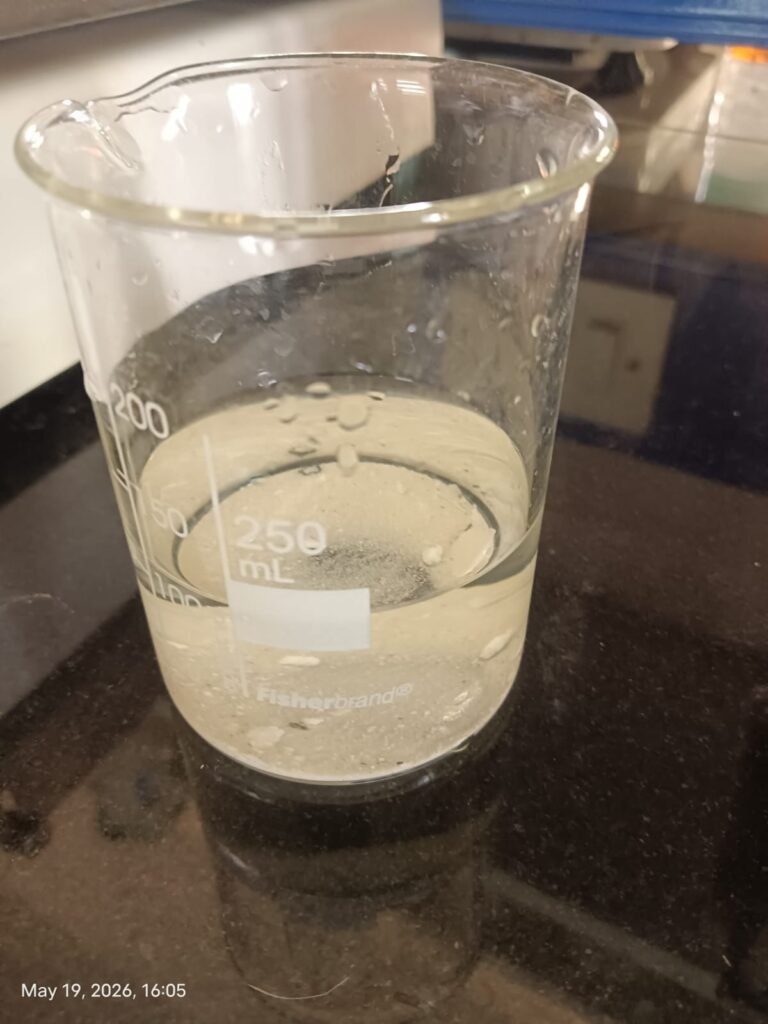
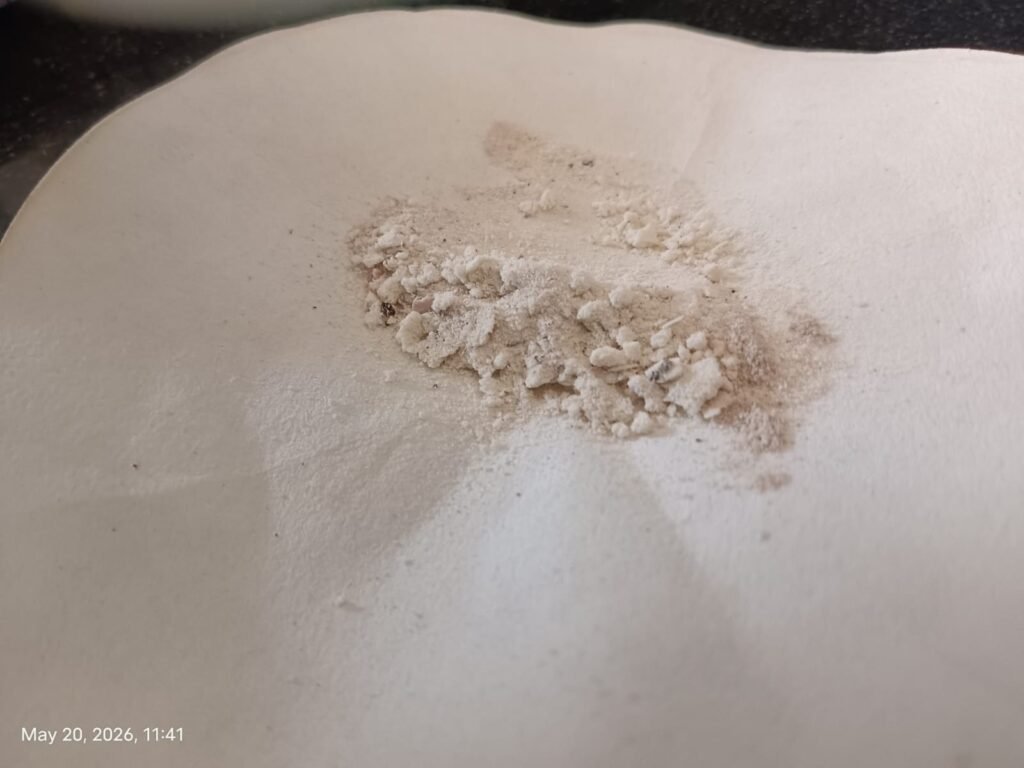
A slurry of silver sulfate crystals in acidic solution was formed, which was then washed with cold distilled water and dried.
We get 5.26 gm of silver sulphate
Percentage yield:
= 73.6%
Actual Yield = 5.26 g
Percentage Yield = 73.6%
Conclusion
Silver sulfate was successfully synthesized from silver metal using nitric acid and sulfuric acid. The theoretical yield was 7.15 g, while the actual yield obtained was 5.26 g, giving a percentage yield of 73.6% (This happened because excess water was added during washing, causing more silver sulfate to dissolve and reducing the final yield).
NOTE: This experiment was performed by me and Gayatri as a part of synthesis of silver sulphate which was used later in comparative study on COD reduction in wastewater using natural and aeration based treatment techniques.
.