Definition:
Biodegradable plastic is a type of plastic that can be broken down naturally by microorganisms such as bacteria, fungi, and other microbes into simpler substances like water, carbon dioxide or methane , and biomass. Unlike ordinary plastics, which may remain in the environment for 400 + years, biodegradable plastics are designed to decompose faster under suitable conditions i.e. temperature, moisture, oxygen, and microbial activity.
Aim :
Development of a Microbial Consortium for Biodegradation of Plastic Containing Terephthalic Acid, Adipic Acid, Butanediol and Starch
Historical Background:
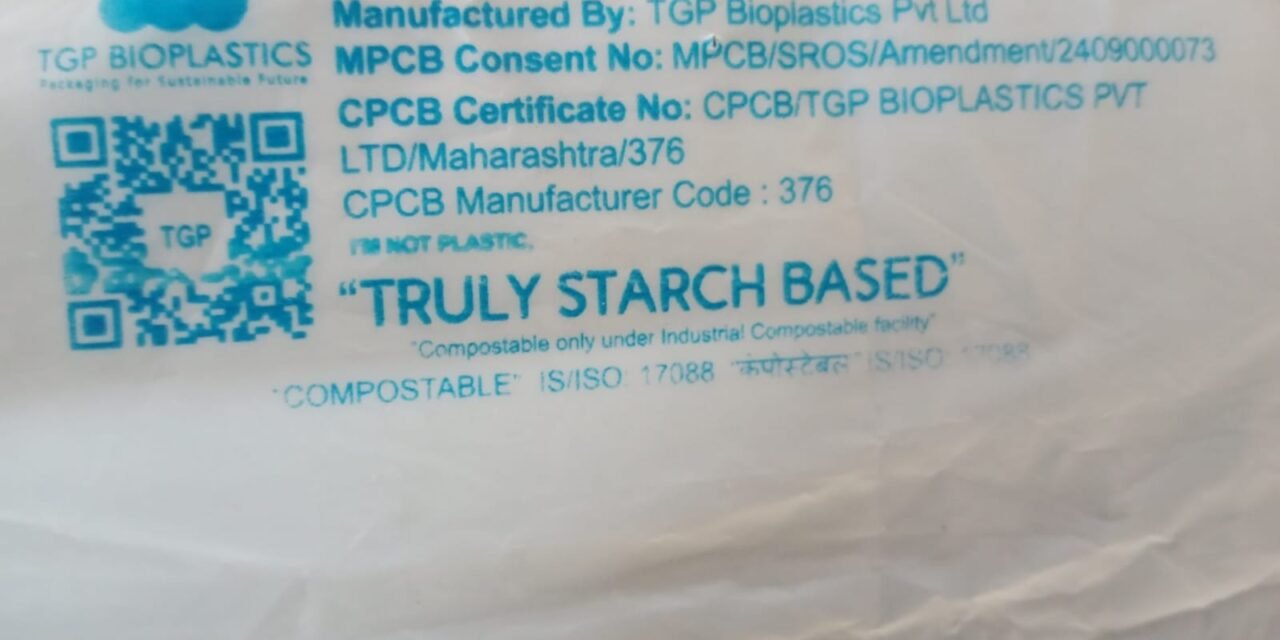
Indian Standard 17088 has given the requirements for compostable plastics. It is used to decide whether a plastic product can truly be called compostable / biodegradable under composting conditions.The standard checks mainly 4 things:
- Biodegradation – Can microbes break the plastic down?
- Disintegration – Does it physically break apart during composting?
- Effect on composting process – Does it disturb compost formation?
- Safety of compost – Does the final compost remain safe and not contain harmful substances?
Principle:
Biodegradable plastics work on the principle of microbial degradation, where microorganisms use the plastic as a food source and convert it into carbon dioxide, water and methane.
Objectives:
As an fellow student to study and learn the process of degrading biodegradable plastic.
- To understand the types pf biodegradable plastics.
- To study about the bacteria and fungi which work to degrade the plastic.
- To observe the functioning of the bacterias and fungi on plastic.
10 /6/26 to 20/6 26
I had discussions with Dr. Dixit Sir and learnt about the types of Biodegradable plastic, the criteria of IS 17088, which plastic are we choosing for the test, monomers and linkages of that plastic , which enzymes will break the linkages, and the bacteria and fungi that contain these enzymes.
PBAT Plastic
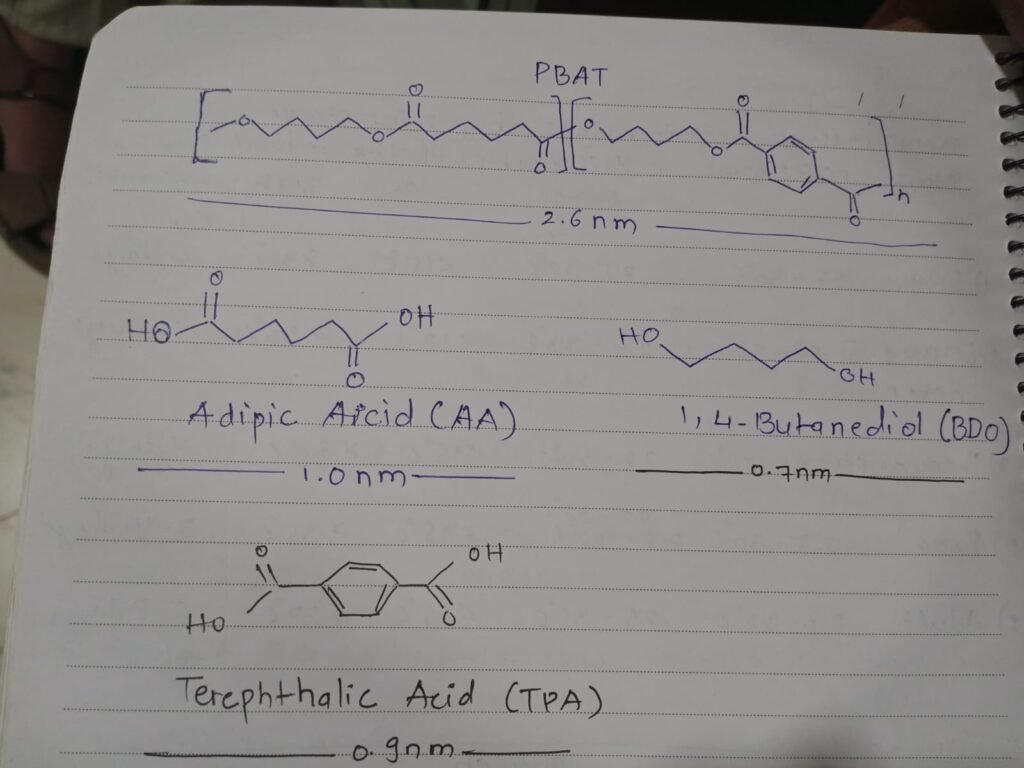
PBAT plastic stands for Polybutylene Adipate Terephthalate. It is a flexible biodegradable plastic that is designed to break down under suitable composting conditions.
The PBAT sample which we are using is PBAT+ Starch.Here the PBAT is 35% and Starch is 65%.
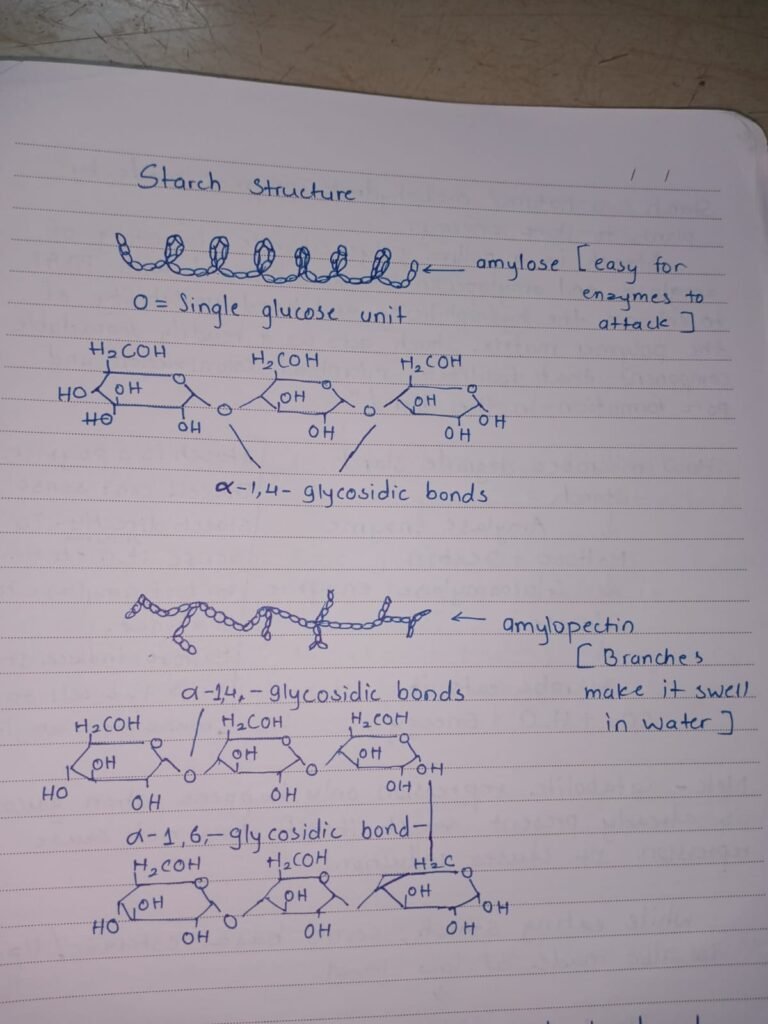
Starch= A natural carbohydrate polymer made by plants to store energy.
Starch is a polysaccharide consisting of amylose and amylopectin .It was blend with PBAT to enhance the hydrophilicity and biodegradation of the polymer matrix. Starch acts as a readily degradable component that facilitates microbial colonization and pore formation in the blend.
How microbes degrade starch
Starch
↓ (Amylase)
Maltose + Dextrins
↓ (Glucoamylase)
Glucose
↓
Microorganisms utilize glucose as a carbon and energy source.
↓
CO₂ + H₂O + Energy + Biomass
Starch is a polymer .The cell can’t sense starch directly. To sense it, microbes needs tiny bit of amylase to leak out.
Maltose=inducer. It tells the cell to make more amylase.
By the time glucose is gone ,pores are already formed.The fungus is already attached to PBAT surface.And in MSM(Mineral Salt Media), Nitrogen is limiting.That itself induces hydrolytic enzymes even without carbon.
Note-Catabolite repression only happens when glucose is already present.Starch itself does not cause repression. It causes induction.
While eating starch,some basal esterase/lipase is also made at low level.
Starch gone,film now full of pores.
No easy glucose left. It switches survival mode.
The fungus starts attaching PBAT oligomers that are now exposed in the pores.
When PBAT gets cut a little, it releases adipic acid, 1,4-butanediol,TPA oligomers.
These PBAT breakdown products = the inducer for esterase/cutinase gene.
Induced esterase + cutinase + lipase now attack PBAT backbone activity.
The products of PBAT keep feeding back and inducing more enzymes.Its a positive loop.
IS 17088:2021 rules for PBAT
| Test name | Pass limit for PBAT | PBAT Problem |
| Biodegradation | ≥90% carbon → CO₂ in ≤180 days at 58°C ± 2°C. | Benzene ring slows breakdown. Thick films fail. |
| Disintegration | ≥90% pieces <2mm after 12 weeks at 58°C. | Enzymes cut ester but stop at benzene. Need special fungi. |
| Ecotoxicity | compost must grow plants normally. | If degradation stops, left over PBAT bits= microplastic. |
| Heavy metals | Pb <50 ppm, Cd <0.5 ppm, etc. | PBAT itself ok ,but color additives may fail. |
Requied Microbes for degradation of PBAT+ Starch
Fungi
- Fusarium solani
- Humicola insolens
- Choetomium thermophilum
- Aspergillus oryzae
Bacteria
- Pseudomonas aeruginosa
- Pseudomonas stutzeri
- Comamonas testosteroni
- Rhodococcus erythropolis
- Ideonella sakaiensis
- Geobacillus thermophilus
Actinomycetes
- Thermobifida fusca
- Thermomonospora curvata
- Streptomyces thermoviolaceus
For this project some of the microbes are being purchased and some are being taken from the near by sample.
4 /7/2026
Isolation of SAMPLE 1
We have taken the old compost jersey cow dung.(dung should be dry to avoid the wrong microbes)
Procedure
1) Sterilization
Keep around 7 testubes and 8 pairs of petriplates in hot air oven for 2 hrs.
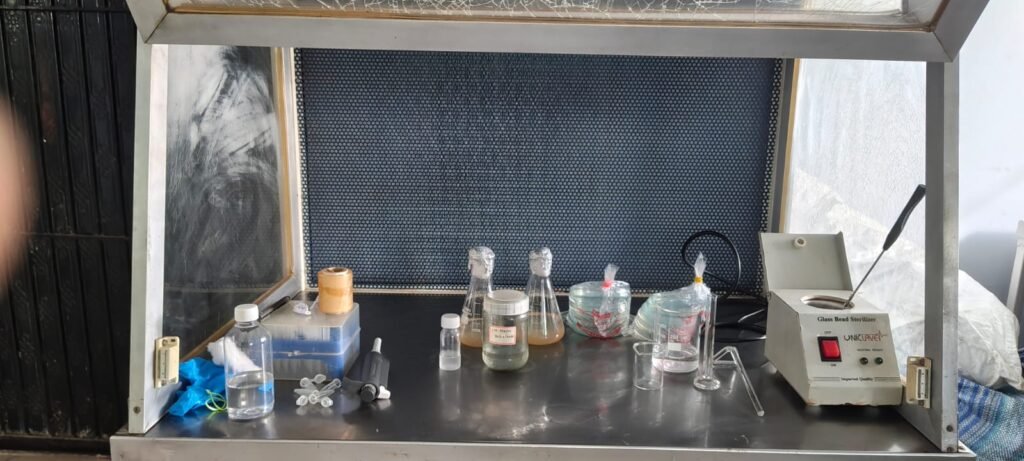
Clean the LAF with ethenol and turn on the UV light.
2) Preparation of Media.
A) Potato Dextrose Agar (PDA
- 9.75 gm PDA powder in 250 ml distilled water.
- Cover with cotton plug and foil paper.
- Autoclave at 121°C-15 psi for 15 min.
- Let the media get cool (50 °C) .Then add 2.5 ml Streptomycin stock .
- Pour the media into petriplates before the media gets solidify and name the petriplate.
B) Nutrient Agar (NA)
- 7 gm NA powder in 250ml distilled water.
- Cover with cotton plug and foil paper.
- Autoclave at 121°C-15 psi for 15 min..
- Let the media get cool (50 °C) .
- Pour the media into petriplates before the media gets solidify and name the petriplate.
3) Serial Dilution
About 1 gm of dung sample was mixed with sterile distilled water and serial dilutions were prepared from 10⁻¹ to 10⁻⁷. From selected dilutions, 0.1 ml sample from 10⁻4 to 10⁻7 was spread on NA and PDA plates using a sterile glass spreader.
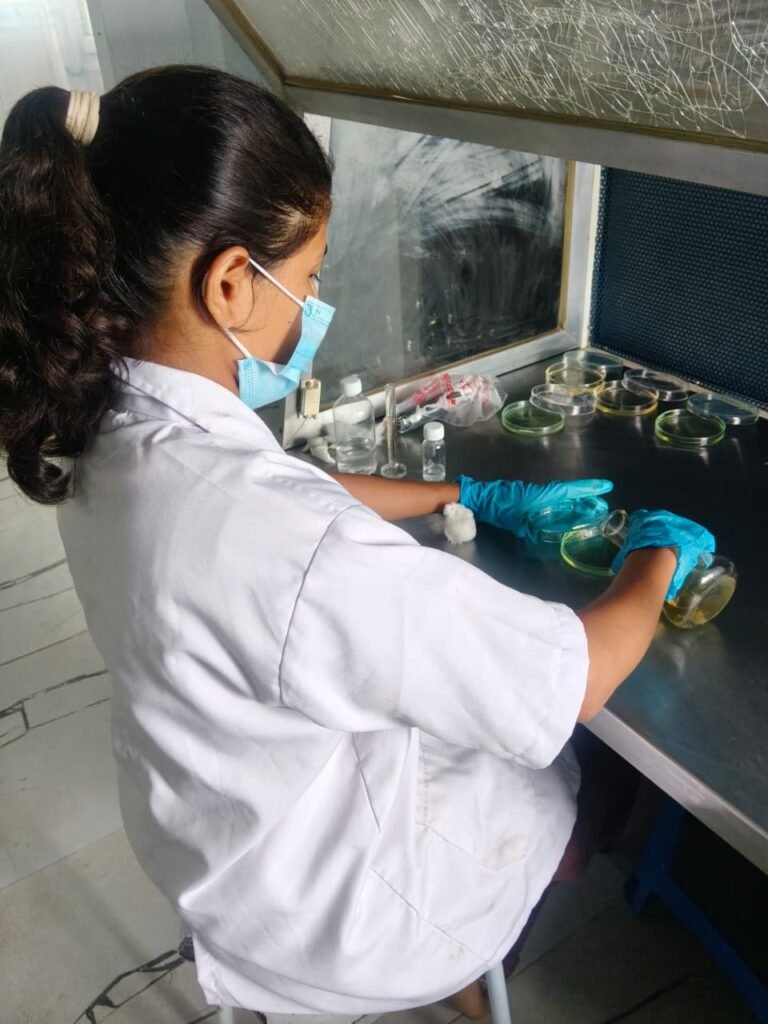
Keep the petriplates in incubator for further observaton.
10/7/2026
Fungal colonies
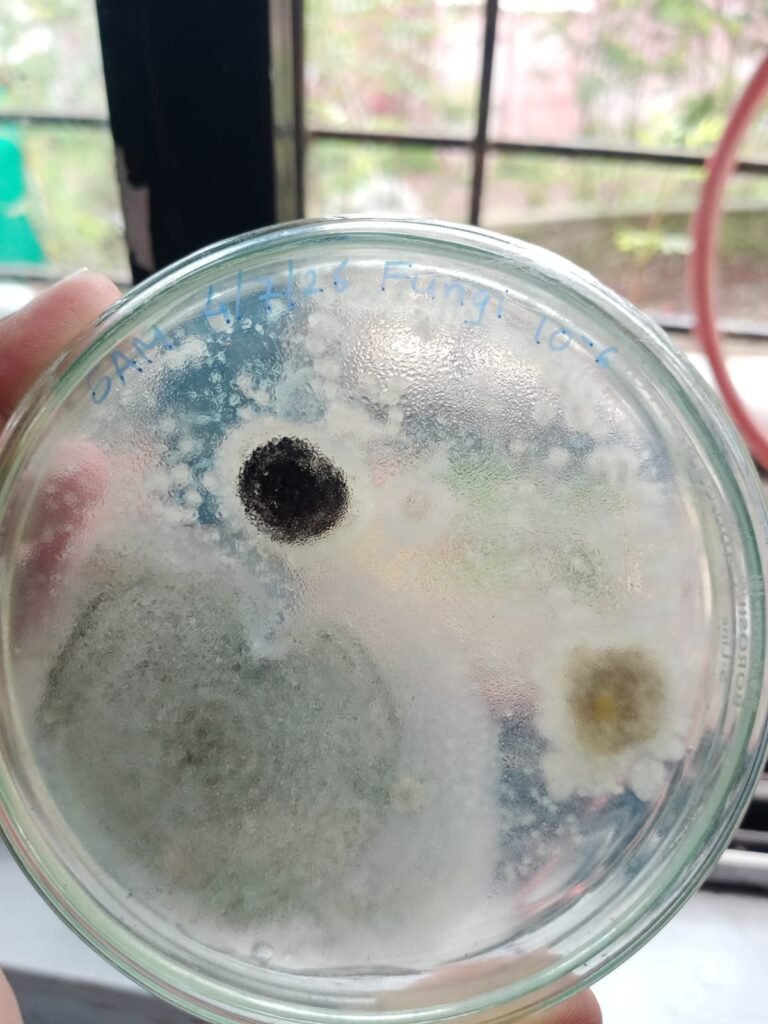
Aspergillus sp.
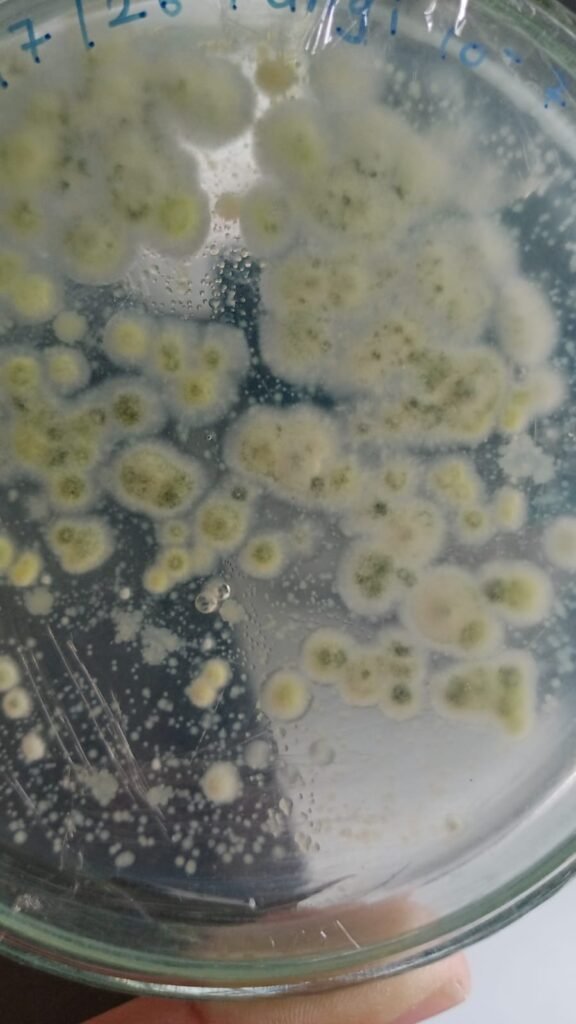
Michorhizium
Required species were not found.
18/7/26
Isolation of Sample 2
We have taken soil sample from nearby area of garage.
Procedure
A. 1000X Trace Element Stock – 100 mL
Chemicals needed:
Rexolin Iron : 0.84 g
Manganese(II) sulfate monohydrate: 0.20 g
Zinc sulfate heptahydrate: 0.20 g
Cobalt(II) chloride hexahydrate: 0.10 g
Procedure:
- Take a 100 mL volumetric flask / measuring cylinderAdd ∼80 mL distilled water
- Weigh and dissolve all 4 salts one by one
- Make up volume to 100 mL with distilled water
- Label: “1000X Trace Stock”. Store at 4°C.
- For 100 mL MSM use: 100 µL = 0.1 mL
B. 10X Mg + Ca Stock – 100 mL
Chemicals needed:
Magnesium sulfate heptahydrate: 0.10 g
Calcium chloride dihydrate: 0.01 g
Procedure:
- Take a 100 mL volumetric flaskAdd ∼80 mL distilled water
- Weigh and dissolve both salts
- Make up volume to 100 mL
- Label: “10X Mg-Ca Stock”. Autoclave 121°C, 15 min. Store at RT.
- For 100 mL MSM use: 10 mL
C. MSM Final Medium – 100 mL
Chemicals to weigh directly:
Dipotassium hydrogen phosphate K2HPO4 0.20 g
Potassium dihydrogen phosphate KH2PO4 0.10 g
Ammonium chloride NH4Cl 0.10 g
Procedure:
- Take 250 mL conical flask. Add ∼80 mL distilled water
- Weigh and add: 0.20g K2HPO4 + 0.10g KH2PO4 + 0.10g NH4Cl. Swirl to dissolve
- Add Stock 2: Pipette 10 mL of 10X Mg-Ca Stock
- Add Stock 3: Pipette 100 µL of 1000X Trace Stock
- Make up volume: Add distilled water till total = 100 mL
- Adjust pH: to 7.0 ± 0.2 using 1N NaOH or 1N HCl
- Sterilize: Plug with cotton + foil. Autoclave at 121°C, 15 psi for 15-20 min
- Cool to room temp before use
D. For Biodegradation with Diesel
- After MSM is sterile and cool:Add carbon source: 1% v/v Diesel = 1 mL diesel
- Add soil sample: 10 g
- Shake on150 rpm for 5-6 days
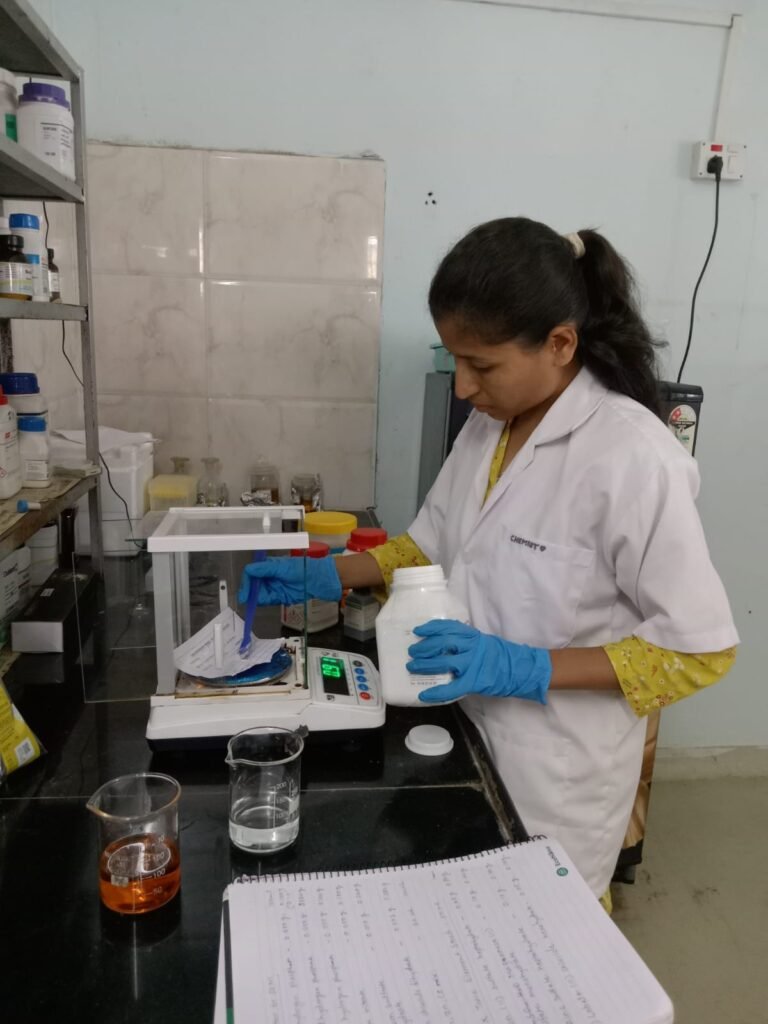
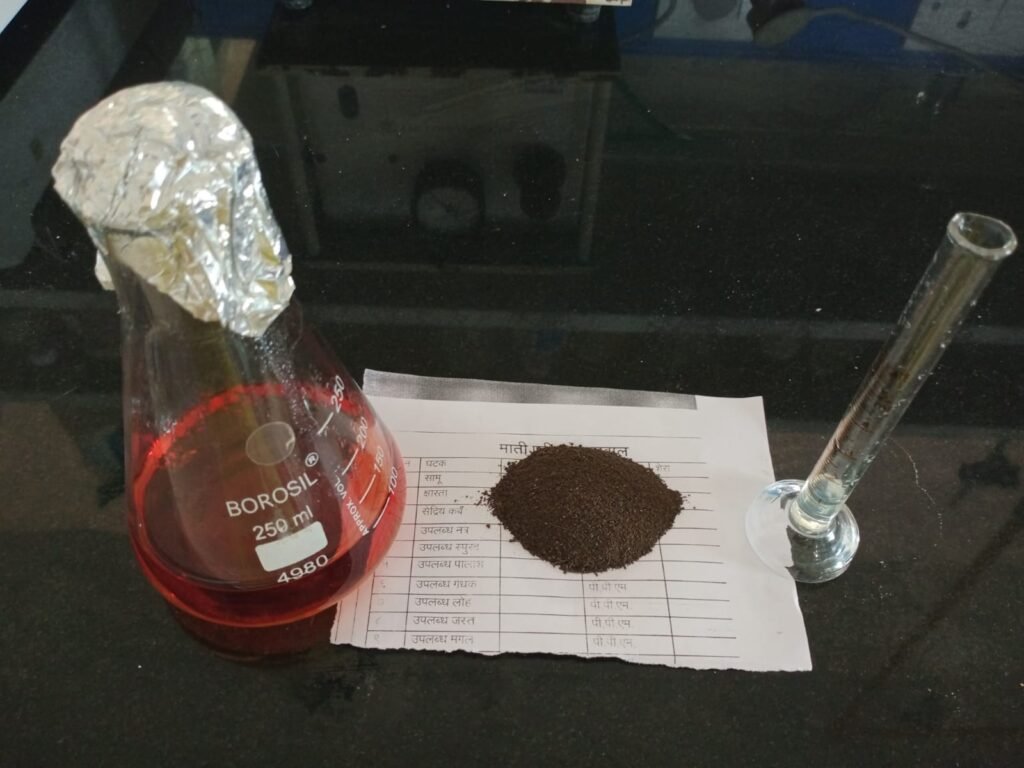
6/7/26
Effect of H₂SO₄ Treatment on PBAT Plastic
Objective: To study the effect of H₂SO₄ treatment at 50°C for 10 hours on the weight, appearance, and tensile strength of PBAT plastic.
- A water bottle was completely filled with water, and its initial weight was measured.
- The PBAT–starch blend plastic sample was securely attached to the bottle.
- Water was gradually added to increase the load on the plastic until the sample stretched and broke.
- The weight at which the sample broke was recorded as the initial breaking load.
- The plastic sample was then hydrolysed in H₂SO₄ at 50°C in hot water bath and dried before testing.
- The hydrolyzed sample was attached to the bottle using the same procedure, and water was gradually added until it broke.
- The breaking load after hydrolysis was recorded and compared with the initial breaking load to determine the effect of hydrolysis on the mechanical strength of the blend.
| Paramete | Before Treatment | After Treatment |
| Weight | 0.23 g | 0.20 g |
| Physical Nature | Flexible, tough film | Brittle, breakable by hand like paper |
| Breaking Load | 1.25 kg | 0.60 kg |
After treatment with H₂SO₄ at 40°C for 10 hours, PBAT plastic showed 13.04% weight loss and 52% reduction in tensile strength. The film became brittle and could be torn by hand like paper, indicating severe degradation.This change from tough to paper-like confirms that H3PO4 accelerated the degradation of PBAT.
28/7/26
Preparation of Mineral Salt Media for plating (MSM) for 250 ml
| Chemical Name | Amount for 250 ml | Role |
| Disodium hydrogen phosphate Na2HPO4 | 0.10 g | Buffer |
| Potassium dihydrogen phosphate KH2PO4 | 0.10 g | Buffer |
| Dipotassium hydrogen phosphate | 0.10 g | Buffer |
| Ammonium chloride NH4Cl | 0.10 g | Nitrogen source |
| Magnesium sulfate heptahydrate MgSO4⋅7H2O | 0.020 g | Mg source |
| Calcium chloride dihydrate CaCl2⋅2H2O | 0.0025 g | Ca source |
| Fe, MN, Zn, Co | 100µL | Nitrogen source |
| Agar | 3.75 g | Solidifying agent – skip for broth |
| Distilled water | 250 ml | Solvent |
pH: 7.0 ± 0.2 ( First check the pH and then add the Agar).
Procedure
Weigh & Dissolve: Add all salts + agar to ∼200 ml distilled water. Stir till dissolved.
Adjust pH: Set pH to 7.0 using 1N NaOH or 1N HCl.
Make up volume: Top up to 250 ml.
Sterilize: Autoclave at 121°C, 15 psi for 20 min.
Add Carbon Source: Cool to 45-50°C. Add 2.5 mL diesel into the media.
Pour Plates: Aseptically pour ∼20 ml per petri plate in LAF. Let it solidify.
Serial Dilution of Soil Sample
1)Take 1 mL from 10⁻¹ tube → transfer to 9 mL sterile tube.
2)This is 10⁻²Take 1 mL from 10⁻² → transfer to next 9 mL tube.
3)This is 10⁻³Repeat till you reach 10⁻⁶, 10⁻⁷, 10⁻⁸ .
From 10⁻³, 10⁻⁴, 10⁻⁵, 10⁻⁶ take 0.1 mL and spread on agar plates.
02/8/26
Effect of H3PO4 Treatment on PBAT Plastic
Objective: To study the effect of H3PO4 treatment at 50°C for 10 hours on the weight, appearance, and tensile strength of PBAT plastic.
- A water bottle was completely filled with water, and its initial weight was measured.
- The PBAT–starch blend plastic sample was securely attached to the bottle.
- Water was gradually added to increase the load on the plastic until the sample stretched and broke.
- The weight at which the sample broke was recorded as the initial breaking load.
- The plastic sample was then hydrolysed in H3PO4 at 50°C in hot water bath and dried before testing.
- The hydrolyzed sample was attached to the bottle using the same procedure, and water was gradually added until it broke.
- The breaking load after hydrolysis was recorded and compared with the initial breaking load to determine the effect of hydrolysis on the mechanical strength of the blend.
| Paramete | Before Treatment | After Treatment |
| Weight | 0.23 g | 0.22 g |
| Physical Nature | Flexible, tough film | Brittle, breakable by hand like paper |
| Breaking Load | 1.25 kg | 0.90 kg |
After treatment with H3PO4 at 50°C for 10 hours, PBAT plastic showed 4.35% weight loss and 28% reduction in tensile strength. The film became brittle and could be torn by hand like paper, indicating severe degradation. This change from tough to paper-like confirms that H3PO4 accelerated the degradation of PBAT
Note:Sulfuric acid was selected for further hydrolysis studies because the PBAT–starch blend showed better hydrolysis in sulfuric acid than in phosphoric acid under the same conditions of 50 °C for 10 hours. This is mainly due higher acidity of sulfuric acid, which provides more H⁺ ions and promotes the breakdown of the glycosidic bonds in the starch component more effectively. Phosphoric acid is a weaker acid, so its hydrolysis action is comparatively slower under the same conditions. Therefore, based on both experimental results and its stronger hydrolysis ability,we selected sulfuric for the subsequent studies.
4/8/26
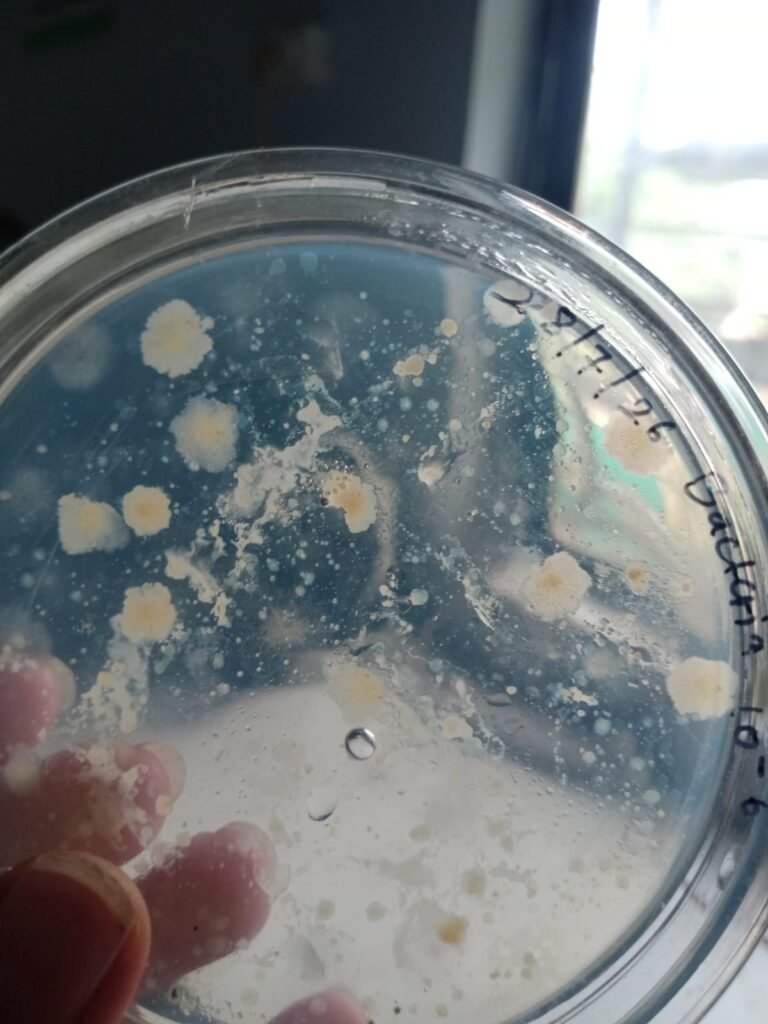
Bacillus sp. has been seen in plating instead of Rhodococcus.Thus Bacillus is able to eat the desiel.
5/8/26
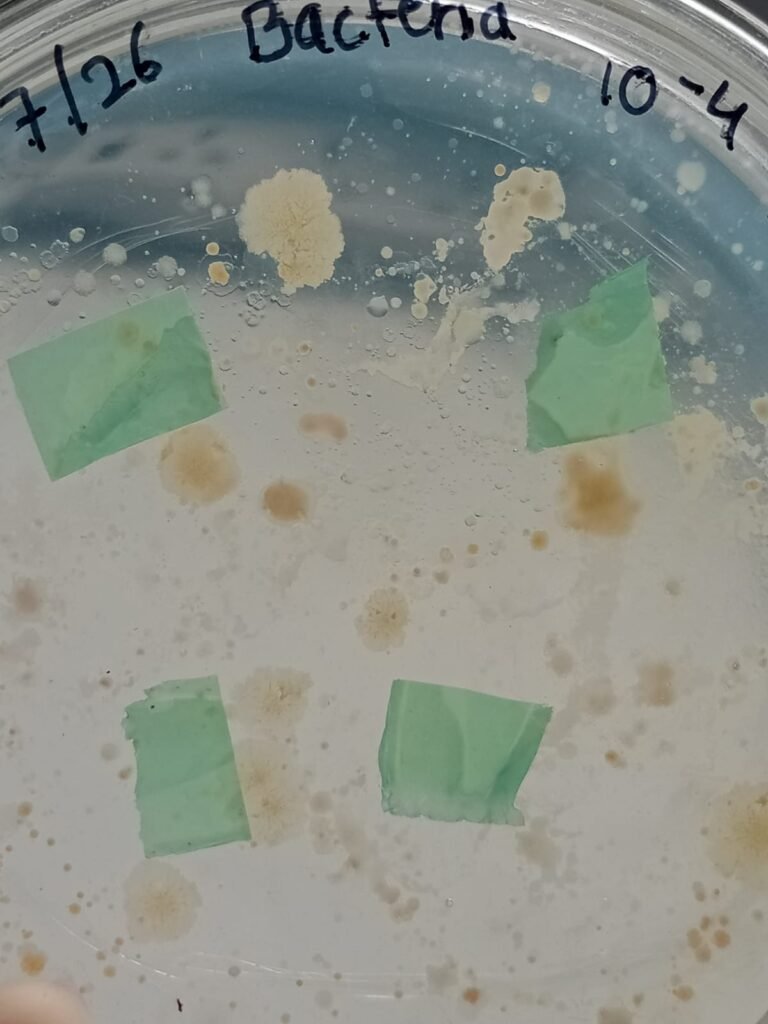
Hydrolysed PBAT pieces (0.5cm) in the sulfuric acid was placed into the plating consisting desiel eating bacteria.
7/8/26
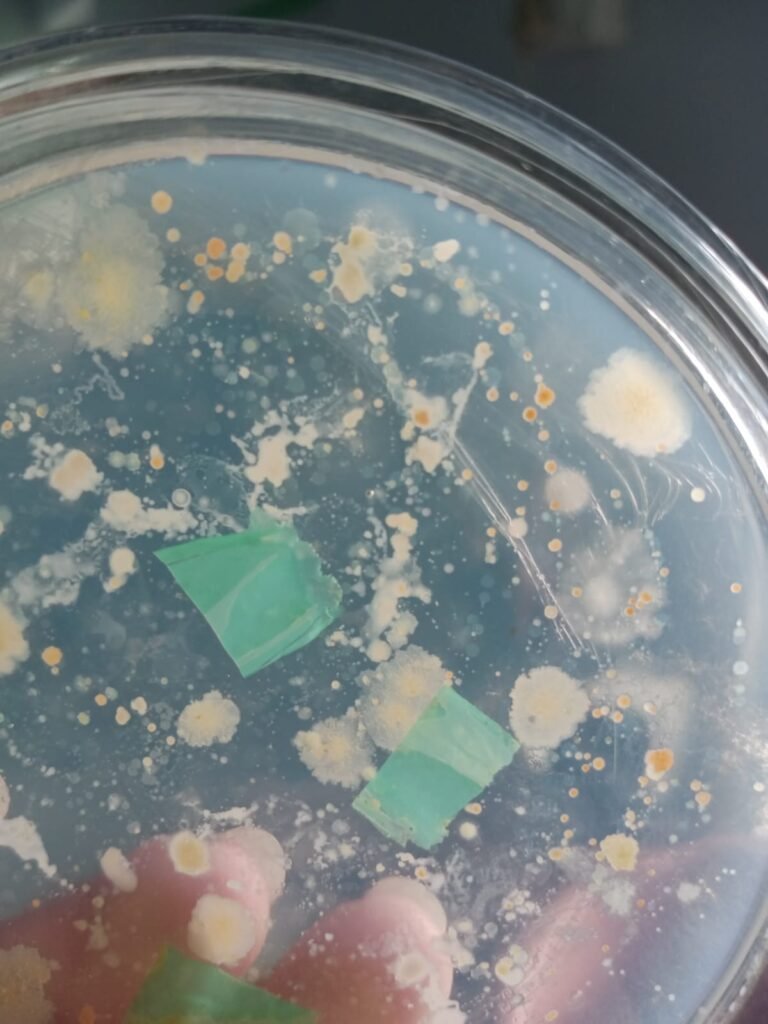
Rhodococcus sp. is seen in the plating.
8/8/26
We have purchased the fungal cultures required for the PBAT degradation from Agharkar Institute.
Fungal Growth Conditions & Characteristics
| Parameter | Fusarium solani | Aspergillus oryzae | Chaetomium sp. |
| Media | PDA | PDA | PDA |
| Temperature | 25°C – 28°C | 30°C – 35°C | 25°C -30°C |
| Time to Grow | 3-5 days for visible colonies.7 days for good sporulation | 2-3 days for colonies. 4-5 days for green-yellow conidia. | 5-7 days for colonies. 10-14 days for perithecia with ascospores |
| Surroundings / pH | Aerobic. pH 5.5 – 6.5. Needs moisture | Aerobic. pH 5.0 -8.0. Needs good aeration | Aerobic. pH 6.0 – 7.0. Needs moisture + cellulose |
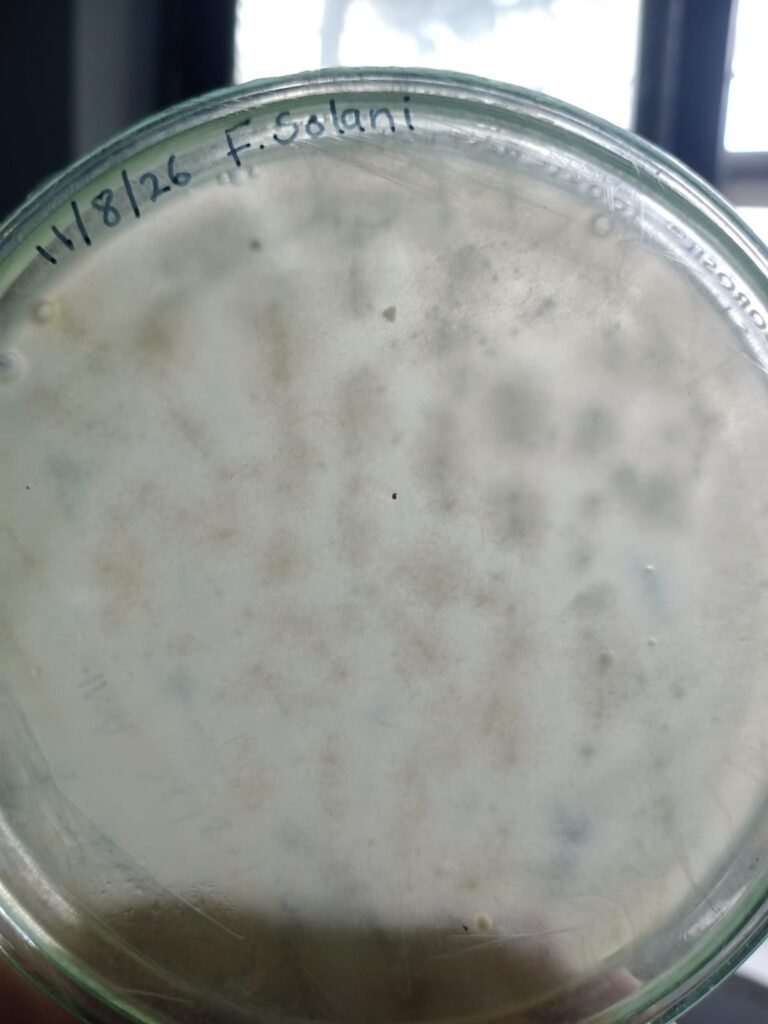
| Colony Appearance | White to cream mycelium, later pinkish. Grows well on plant debris/diesel – it’s a known degrader | Used in fermentation/Koji. Forms powdery, yellow-green to brown colonies | Grows on paper, dung, soil. Forms cottony white/grey mycelium with black dot-like fruiting bodies |
pH 5.6. Autoclave 121°C, 15 min.
Most common for all 3.Set to 28°C.All are aerobic fungi.
Don’t seal plates airtight. Use cotton plug for flasks.
10/8/26 TO 14/8/26
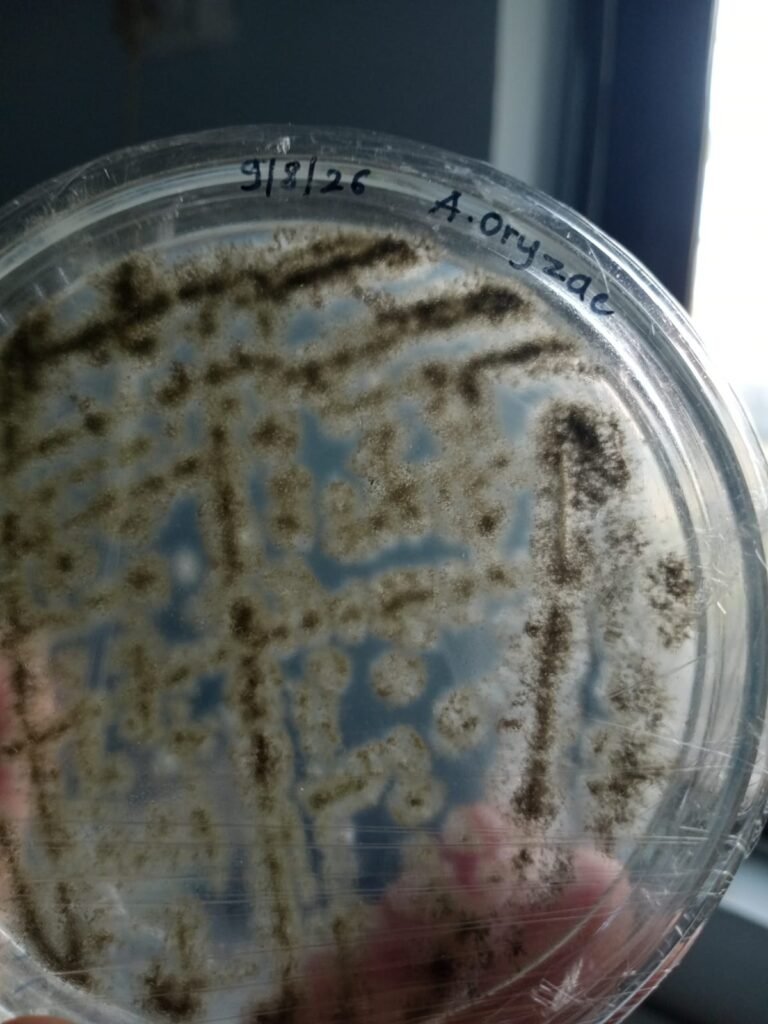
Multiplication of the Aspergillus oryzae Culture
- 1. Keep petriplates in hot air oven for 2 hrs.
- 2. Clean the LAF with ethanol and turn on the UV light.
- 3.Take out the Aspergillus oryzae cuture testtube out of fridge and keep at room temp. for 30-40min.
- 4. Preparation of PDA.3.9 gm PDA in 100 ml d/w.
- 5. Check the pH (5.6).
- 6. Cover with cotton plug & foil paper.
- 7. Autoclave 121°C.
- 8. Petriplates & PDA.
- 9. Add 1 ml streptomycin in PDA after cooling (50°C) Keep the petriplates & PDA in LAF Pour the PDA evenly in petriplates.
- 10. Name, Date on the cover.
- 11. After the drying of Media ,Inoculate the Aspergillus oryzae culture onto the petrilpates with the help of inoculating loop in LAF.
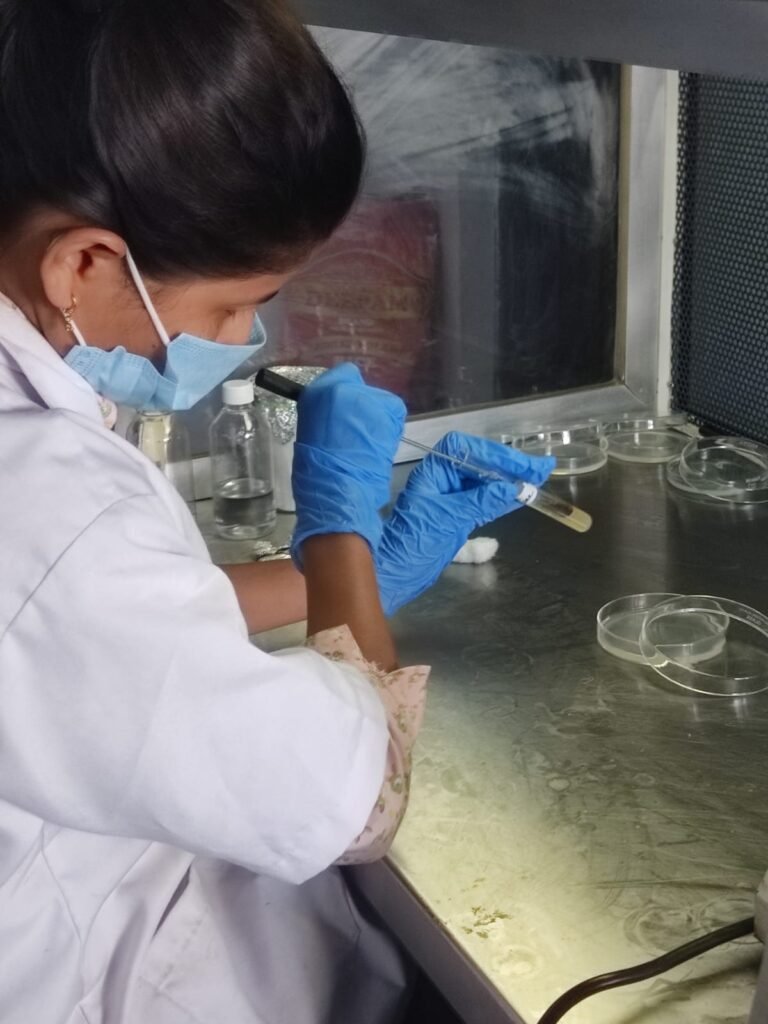
- 12. Seal the plates loosely as the fungus needs areation.
- 13. Keep in the incubator at 30°C.
- 14. Repeat the procedure for Chaetomium globosum and Fusarium solani cultures.
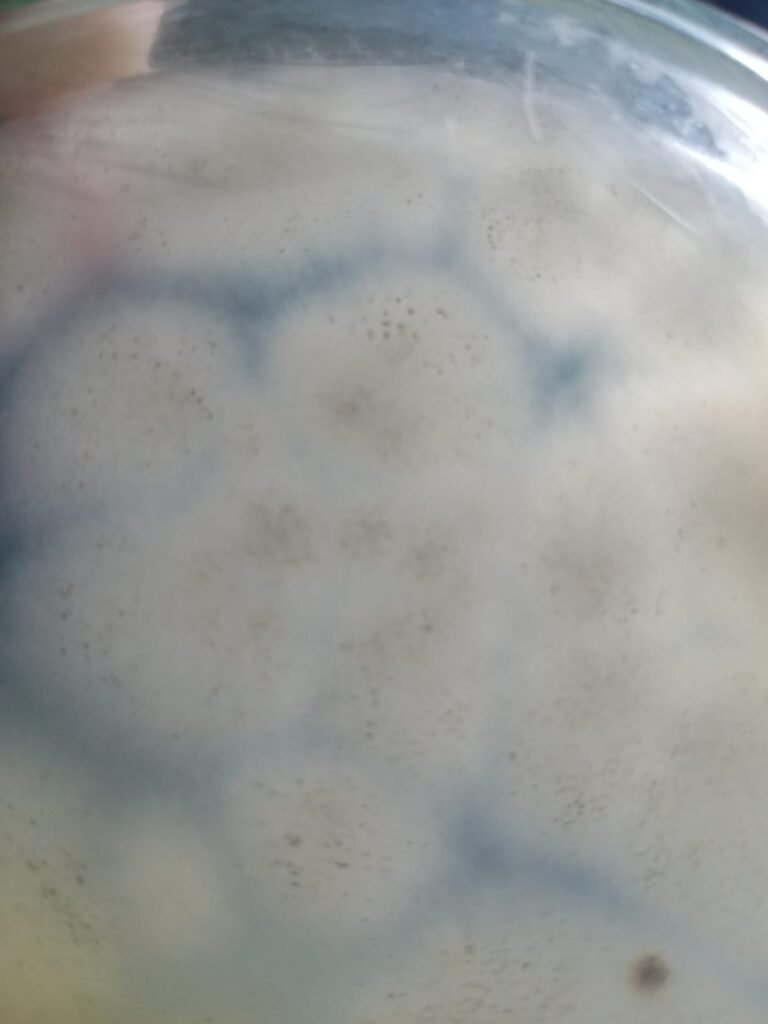
16/8/26
Isolation of the rhodococcus species from the Soil Sample palting
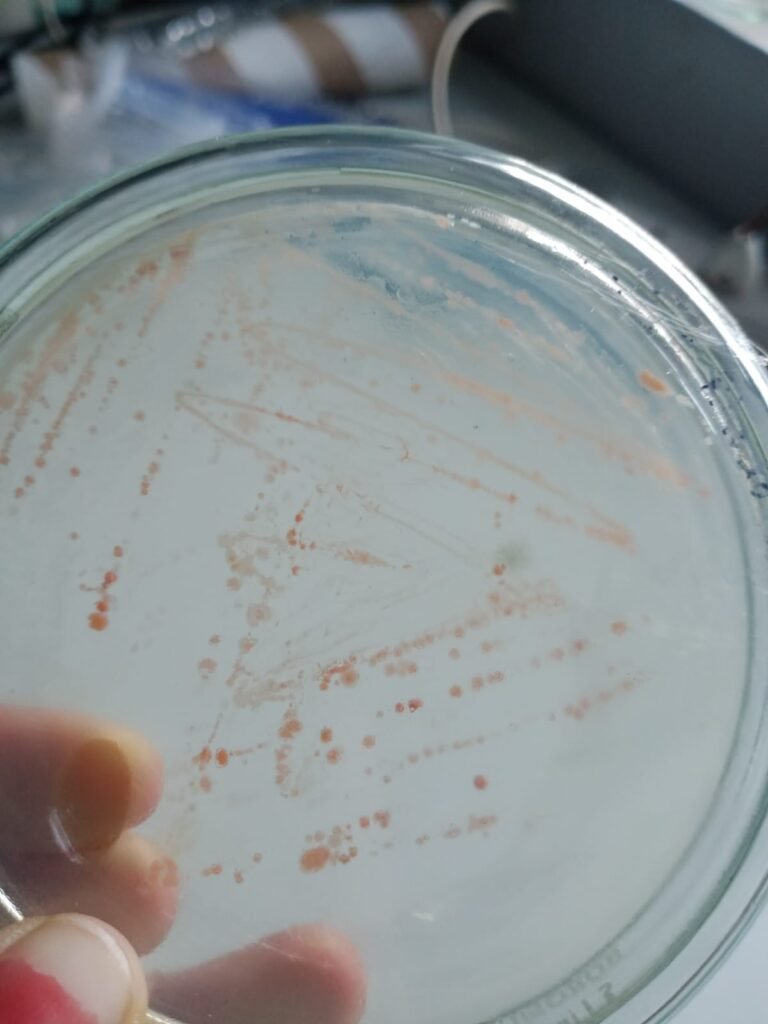
19/8/26 TO 23/8/26
Stock Preparation for MSM
A. 1000X Trace Element Stock – 100 mL
Chemicals needed:
Ferrous sulfate: 0.84 g
Manganese(II) sulfate monohydrate: 0.20 g
Zinc sulfate heptahydrate: 0.20 g
Cobalt(II) chloride hexahydrate: 0.10 g
Procedure:
- Take a 100 mL volumetric flask / measuring cylinderAdd ∼80 mL distilled water
- Weigh and dissolve all 4 salts one by one
- Make up volume to 100 mL with distilled water
- Label: “1000X Trace Stock”. Store at 4°C.
- For 100 mL MSM use: 100 µL = 0.1 mL
Preparation of Mineral Salt Media for plating (MSM) for 100 ml
| Chemical Name | Amount for 250 ml | Role |
| Disodium hydrogen phosphate Na2HPO4 | 0.10 g | Buffer |
| Potassium dihydrogen phosphate KH2PO4 | 0.10 g | Buffer |
| Dipotassium hydrogen phosphate | 0.10 g | Buffer |
| Ammonium chloride NH4Cl | 0.10 g | Nitrogen source |
| Magnesium sulfate heptahydrate MgSO4⋅7H2O | 0.020 g | Mg source |
| Calcium chloride dihydrate CaCl2⋅2H2O | 0.0025 g | Ca source |
| Fe, MN, Zn, Co | 100µL | Nitrogen source |
| Agar | 3.75 g | Solidifying agent – skip for broth |
| Distilled water | 250 ml | Solvent |
Procedure:
- Take 250 mL conical flask. Add ∼80 mL distilled water
- Weigh and add: 0.20g K2HPO4 + 0.10g KH2PO4 + 0.10g NH4Cl. Swirl to dissolve
- Add Stock 2: Pipette 10 mL of 10X Mg-Ca Stock
- Add Stock 3: Pipette 100 µL of 1000X Trace Stock
- Make up volume: Add distilled water till total = 100 mL
- Adjust pH: to 7.0 ± 0.2 using 1N NaOH or 1N HCl
- Sterilize: Plug with cotton + foil. Autoclave at 121°C, 15 psi for 15-20 min
- Cool to 50°C temp.
Note- To study the biodegradation of PBAT + starch plastic, plating will be performed to check whether the selected microorganisms can directly utilize adipic acid, 1,4-butanediol, and terephthalic acid as carbon sources. Each chemical will be provided separately in MSM as the sole carbon source, and microbial growth will be observed and compared with a control. This will help identify microorganisms capable of utilizing the individual components of PBAT for further biodegradation studies
Who eats which monomer.
| No. | Monomer | Best Microbe |
| 1) | 1,4- Butanediol | Bacillus sp |
| 2) | Adipic acid | Rhodococcus erythropolis |
| 3) | Terephthalic acid / TPA | R. erythropolis |
| 4) | TPA +Adipic mix | Fusarium Solani |
| 5) | All 3 together | Aspergillus oryzae + Chaetomium globosum |
Biodegradation and Microbial Utilization of Adipic Acid, 1,4-Butanediol, and Terephthalic Acid as Carbon Source
- Adipic Acid
| No. | Control Type | Composition | Bacteria | Expected Result |
| 1 | Test plate | MSM + Adipic Acid | R. erythropolis | Test growth on Adipic Acid |
| 2 | Positive control | MSM + Glucose | R. erythropolis | Should grow |
| 3 | Negative control | MSM + Adipic Acid | No bacteria | Check for contamination |
| 4 | No-carbon control | MSM + No carbon | R. erythropolis | Should not grow |
Procedure:
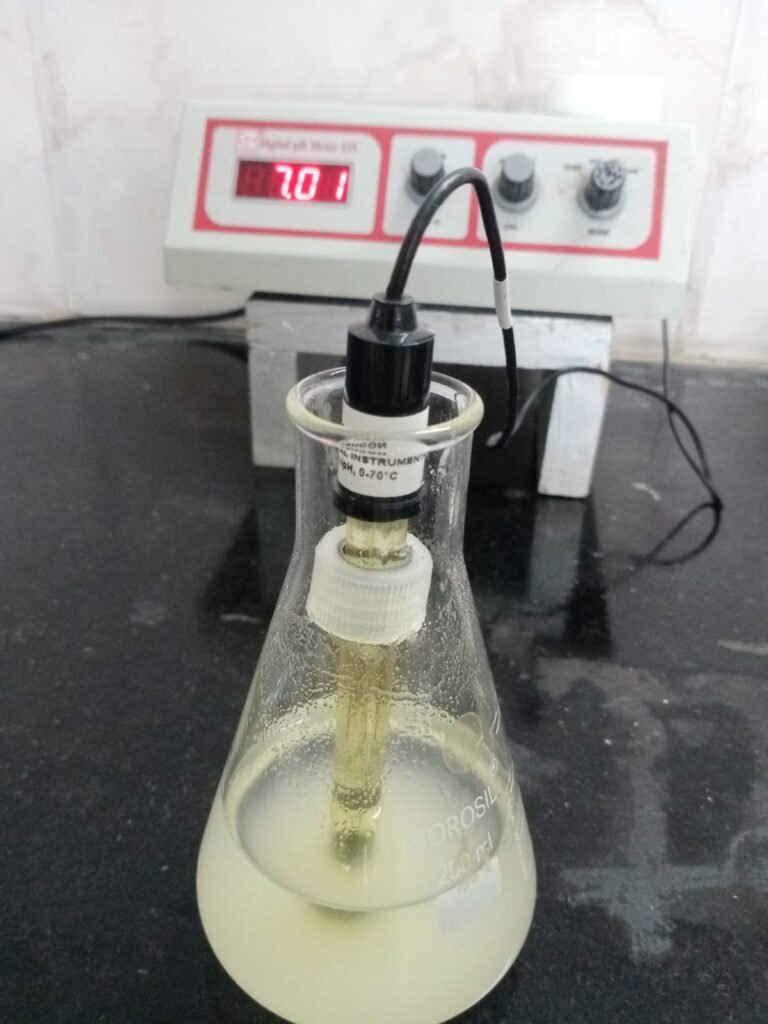
- Make MSM media and check pH 7.0
- Pour the media into 3 different Conical flasks(100ml,100ml,50ml)
- Make 20g – D Glucose in 100 ml
- Dissolve 0.50g adipic acid in warm water + 2-3 drop NaOH.
- Take separately 150 ml & Add Adipic acid ,name the flask. (0.30g).
- Take only 100 MSM -> name the flask.Check the pH 7.0
- Autoclave MSM.
- Autoclave Glucose Stock for 10 min.
- After cooling add glucose to 100ml media
- Make plating of 100 ml – 4 platings – Name – No carbon control.
- Then add glucose to media (0.5ml) for 50ml
- Make remaining plating – from the media – Name positive control.
- Take 150 ml media
- Make 5-6 platings – Name Test Plate
- Then add glucose to media (0.5ml) for 50ml.Make remaining plating -from the media – Name positive control.
- Take 150 ml media Make all the platings – Name 6 plating – 6-7 plating of Test Plate And remaining Name – Negative control.
- After solidifying inoculate R.erythropolis on the agar plate with the innoculating loop.
2. 1,4 Butandiol
- Test plate – with butandiol
- Negative control – without butandiol (carbon)
- Positive control – MSM agar + 1% Glucose
Procedure:
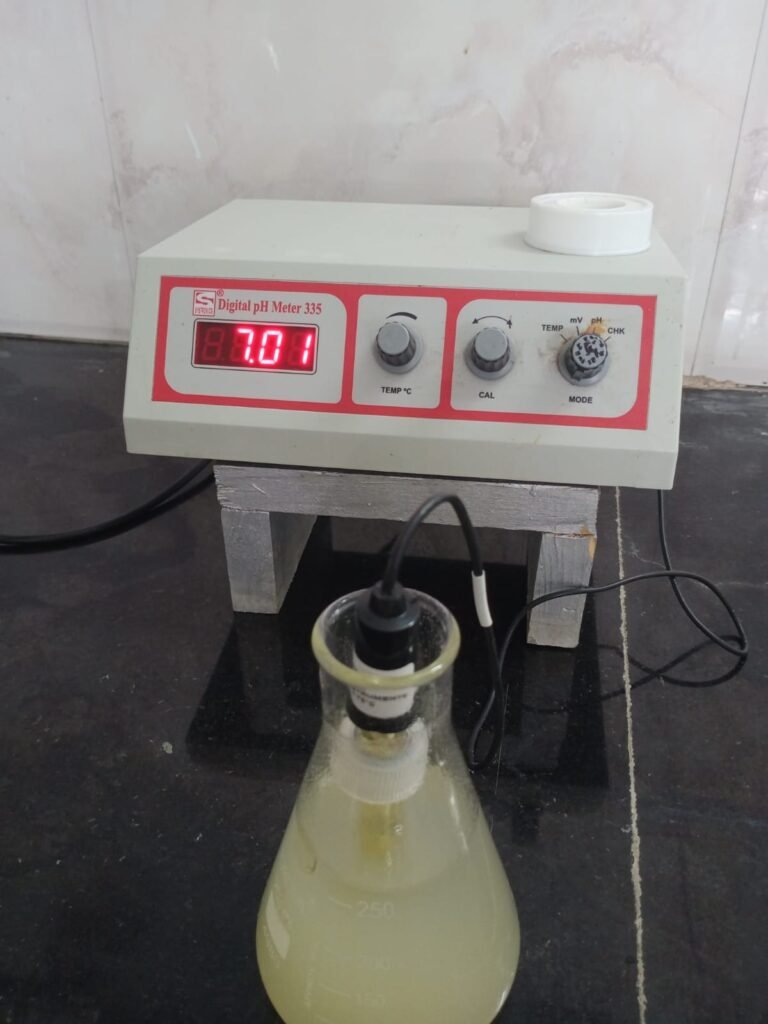
- Take NaCl 0.9g, NaCl in 100ml d/w.
- Make MSM media Glucose only MSM.
100 + 150ml . - Check pH 7.0.Autoclave petridish ,MSM ,Saline water,measuring cylinder,spreader
- Take out MSM & petri petridish + cylinder
- Add or put into plates (2 plates)
1% = 1ml butanediol in 100ml media – Make 5 plates . - Keep for 1-2 hrs and then.
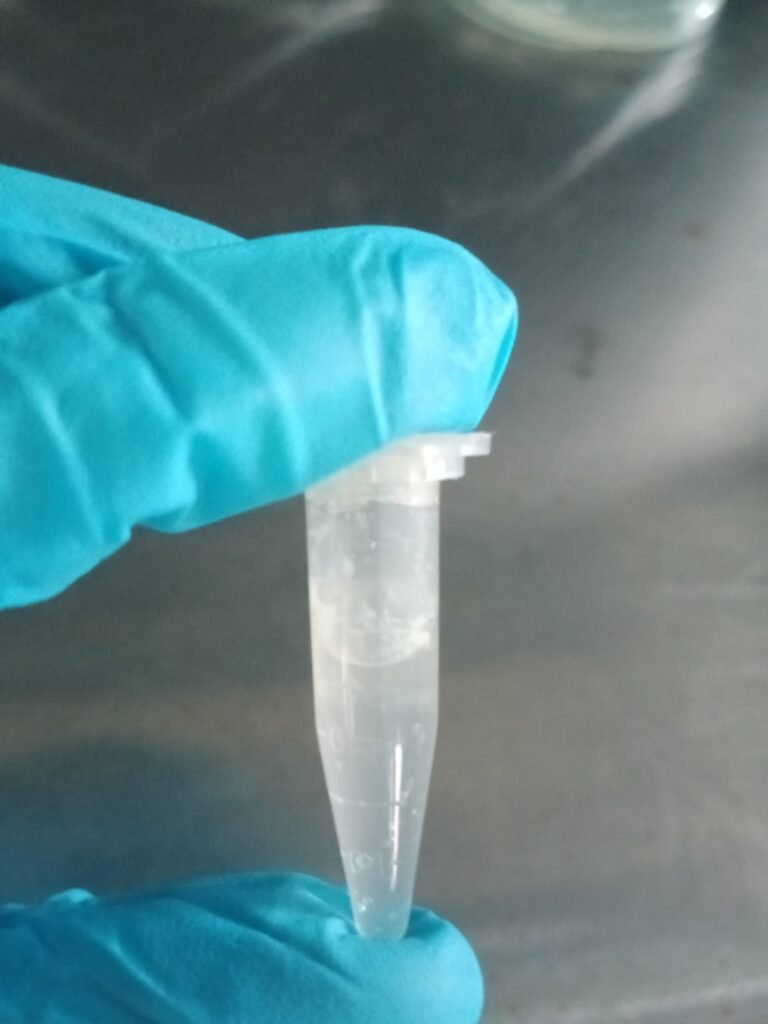
- Take eppendorf, add saline water
take the loop , add colony in the water , shake well for 30 sec. - Take top cloudy part into pipette & drop on plates.
27/8/26 to 30/8/26
3. Terpthalic acid +Adipic acid
- Test plate – with TPA+ adipc acid
- Negative control – without TPA+adipic acid (carbon)
- Positive control – MSM agar + 1% Glucose
Procedure:
- Make MSM media and check pH 7.0.
- Pour the media into 3 different Conical flasks(100ml,100ml,50ml).
- Make 20g – D Glucose in 100 ml.
- Dissolve 0.50g adipic acid in warm water + 2-3 drop NaOH.
- Dissolve 0.50g TPA in warm water + 2-3 drop NaOH.
- Take separately 150 ml & Add Adipic acid and TPA ,name the flask. (0.30g).
- Take only 100 MSM -> name the flask.Check the pH 7.0.
- Autoclave all the MSM.
- Autoclave Glucose Stock for 10 min.
- After cooling add glucose to 100ml media.
- Make plating of 100 ml – 4 platings – Name – No carbon control.
- Then add glucose to media (0.5ml) for 50ml.
- Make remaining plating – from the media – Name positive control.
- Take 150 ml media.
- Make 5-6 platings – Name Test Plate.
- Then add glucose to media (0.5ml) for 50ml.Make remaining plating -from the media – Name positive control.
- Take 150 ml media Make all the platings – Name 6 plating – 6-7 plating of Test Plate And remaining Name – Negative control.
- Keep for 1-2 hrs and then.
- Take eppendorf, add saline water.
take the loop , add colony in the water , shake well for 30 sec. - Take top cloudy part into pipette & drop on plates.
- Spread on the plate with the help of spreader.
Replating of R.erythropolis Cheatomeum sp. and Bacillus sp.
As for further test fresh cultures are required and we have cultures older than 2 weeks.
Procedure
1) Weigh & Dissolve: Add all salts + agar to ∼200 ml distilled water. Stir till dissolved.
2) Adjust pH: Set pH to 7.0 using 1N NaOH or 1N HCl.
3 Make up volume: Top up to 250 ml.
4) sepetate the media into two flaskes (100 ml and 150 ml).
5) Sterilize: Autoclave at 121°C, 15 psi for 20 min.
6) Add Carbon Source: Cool to 45-50°C. Add 2.5 mL diesel into the 150 ml media media.
7) Pour Plates: Aseptically pour ∼20 ml per petri plate in LAF. Let it solidify.
8) After solidifying innnoculate R.erythropolis on the desiel and chaetomium into MSM plate with the help of innoculating loop.
9) For Bacillus sp. ake eppendorf, add saline water.
take the loop , add colony in the water , shake well for 30 sec.
10) Take top cloudy part into pipette & drop on plates.
11) Spread on the plate with the help of spreader.
1/9/26
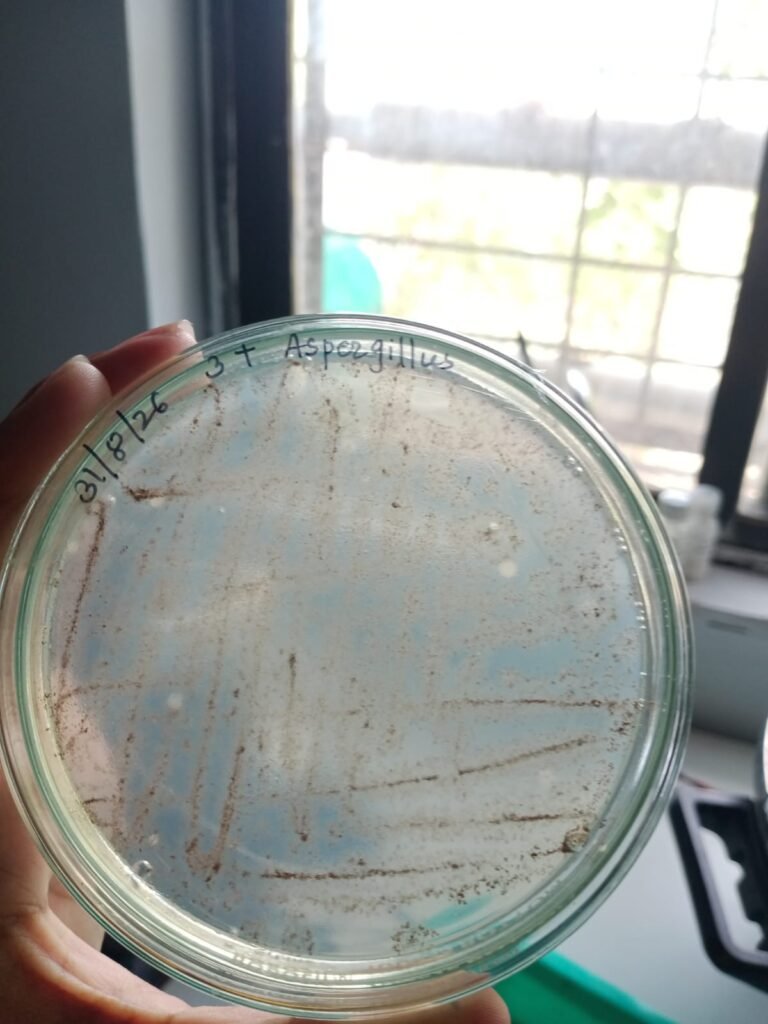
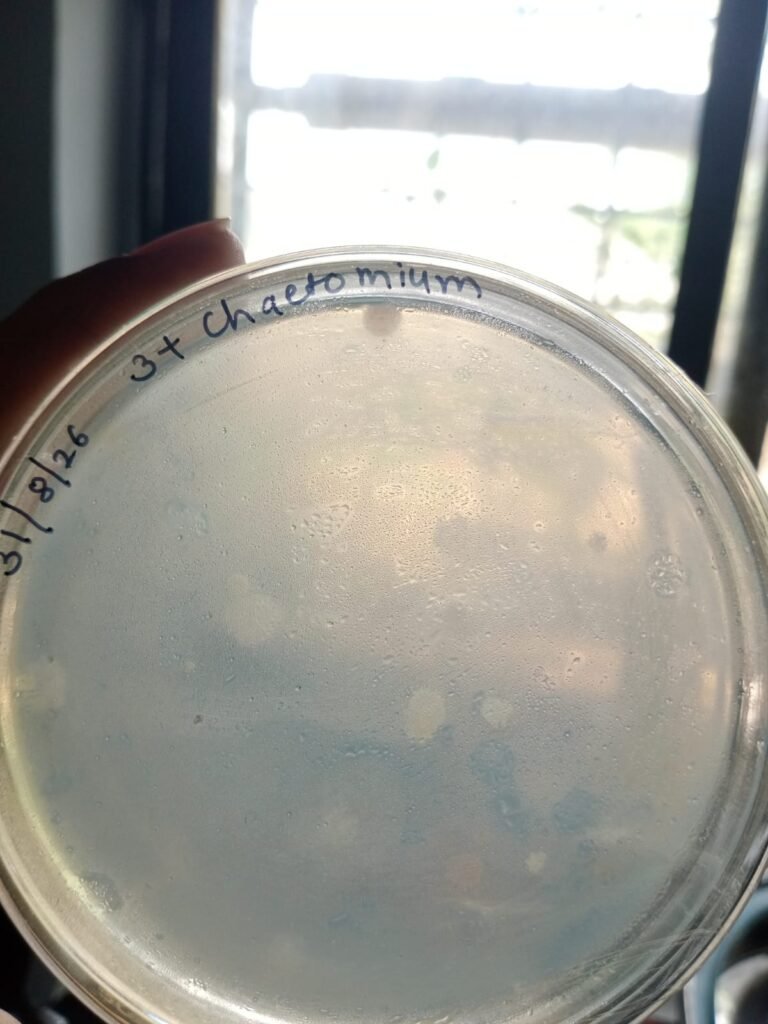
Plating of Aspergillus and Chaetomium sp. into the MSM by giving Terpthalic Acid + Adipic Acid + Butandiol.
3/9/26
Plating of rhodococcus into the MSM by giving Terpthalic Acid as carbon source.
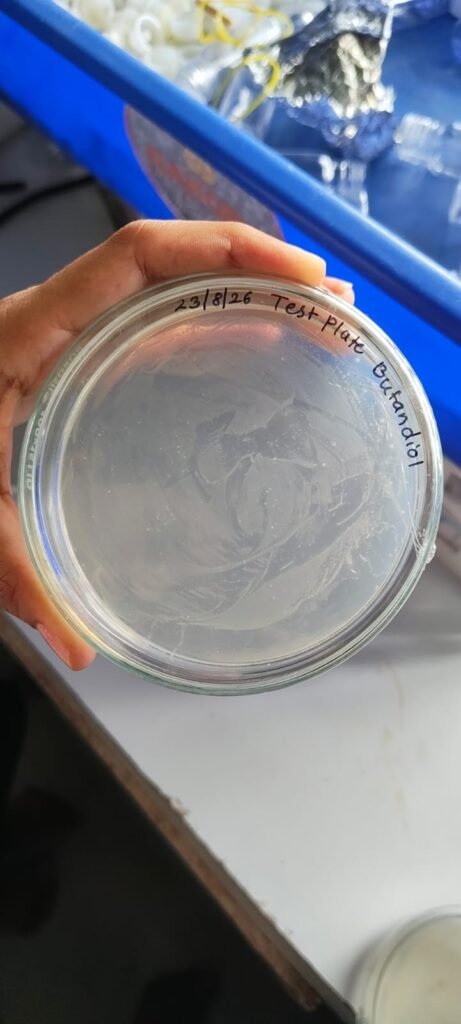
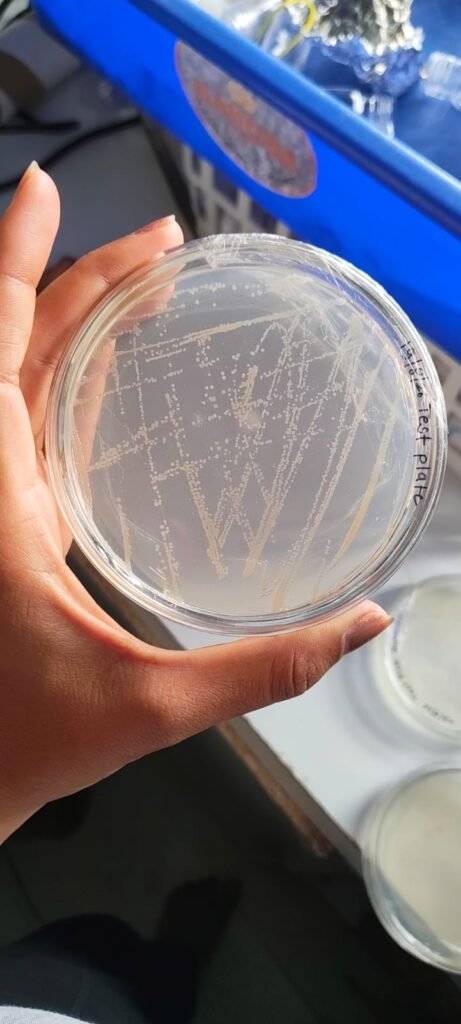
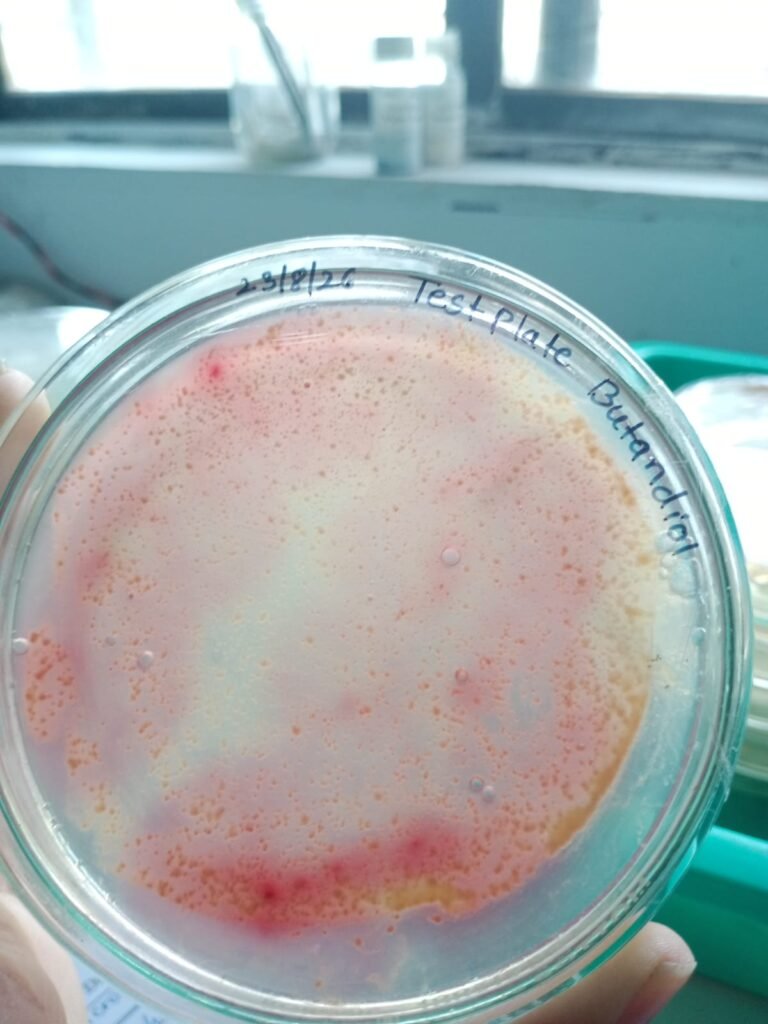
Growth of R.erythropolis and Bacillus sp. is seen on the Butandiol and adipic acid plating.But bacillus sp. has shown less growth,so we need to wait for another week to see the actual growth and on R.erythropolis sp. due to slow metabolism pigmentation produduction is noot seen.
09/09/26
| Sr. | Date | Chemical | Microbe | Result |
| 1) | 31/8/26 | Butandiol | A.oryzae, C.globosum | Only A.oryzae is grown |
| 2) | 31/8/26 | Butandiol | A.oryzae | Growth is seen |
| 3) | 28/8/26 | TPA + Adipic Acid | F. solani | No growth at all |
| 4) | 31/8/26 | Butandiol | C.globosum | No growth + contamination |
| 5) | 19/8/26 | Adipic acid | R.erythropolis | Growth is seen. Orange pigmentation is not seen. |
| 6) | 23/8/26 | Butanediol | Bacillus sp. | Poor growth is seen.pinkish pigmentation due to change in pH |
| 7) | 3/9/26 | TPA | R.erythropolis | Poor growth |
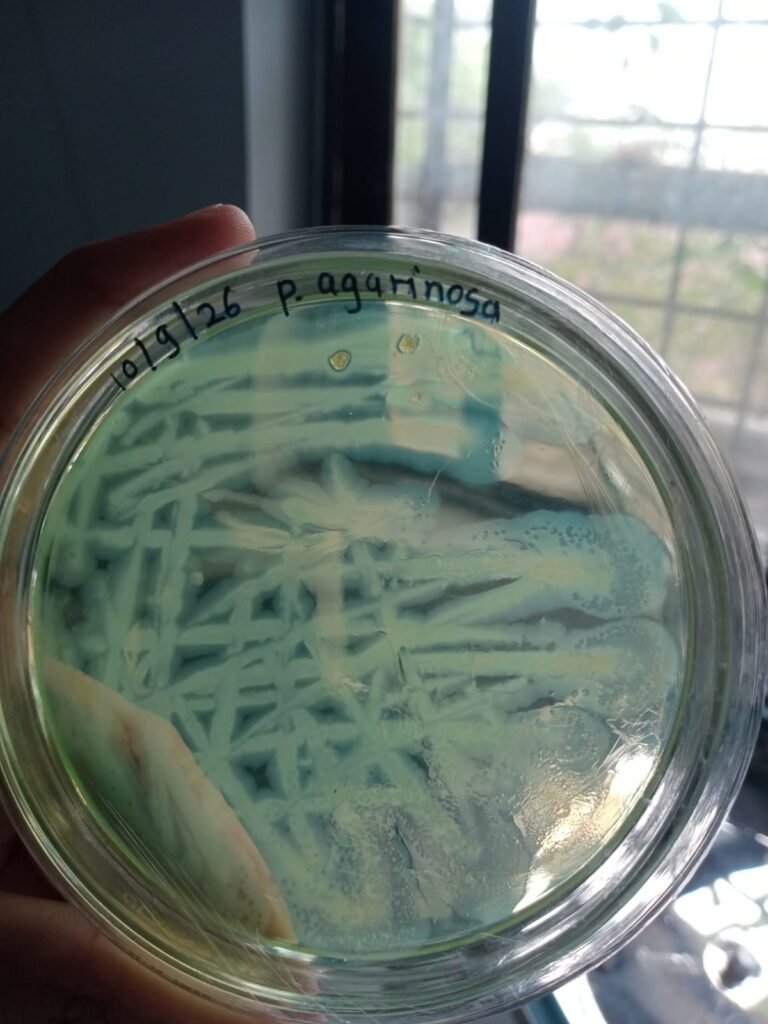
10/9/26
We have Ordered Bacterial culture from Agharkar Institute
1)Pseudomonas aruginosa
2)Psedomonas stutzeri
Multiplication of these bacteria
Procedure
- 1. Keep petriplates in hot air oven for 2 hrs.
- 2. Clean the LAF with ethanol and turn on the UV light.
- 3.Take out the Pseudomonas aruginosa cuture test tube out of fridge and keep at room temp. for 30-40min.
- 4. Preparation of NA media.7 gm NA in 250 ml d/w.
- 5. Check the pH (5.6).
- 6. Cover with cotton plug & foil paper.
- 7. Autoclave 121°C.
- 8. Petriplates & PDA.
- 9. Add 1 ml streptomycin in PDA after cooling (50°C) Keep the petriplates & PDA in LAF Pour the PDA evenly in petriplates.
- 10. Name, Date on the cover.
- 11. After the drying of Media ,Inoculate the Pseudomonas aruginosa culture onto the petrilpates with the help of inoculating loop in LAF.
- 12.Repeat the same procedure for Psedomonas stutzeri.
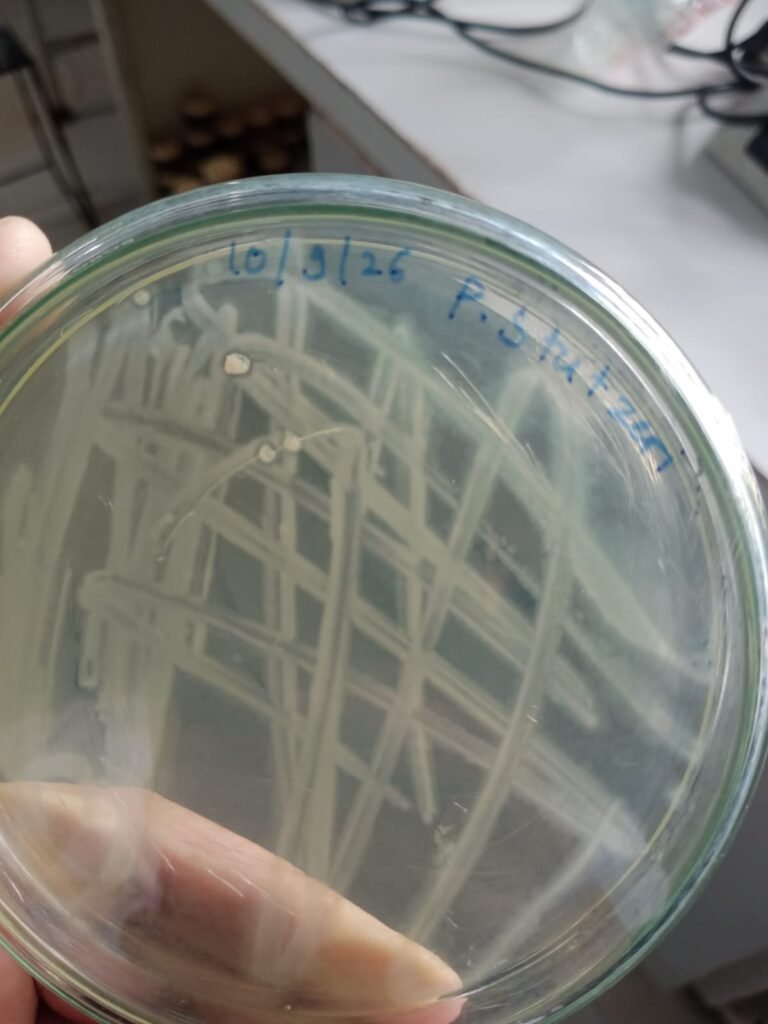
13/9/26
Plating of P.aruginosa and P.stutzeri into MSM by using terpthalic acid,butaidiol and adipic acid as carbon sourse seperately.
Procedure:
- Make 250 ml of MSM and autoclave.
- Take the media into 3 different flasks (70 ml)
- Add 1 ml of terpthalic acid in first flask,butandiol in second and adipic acid in third.
- Pour into petriplates
- Let them dry and innoculate the both the cultures saperatly .
- Keep at 30°C for incubation.
Note:Here ,to dissolve terpthalic acid NaOH was used .So the pH of the media was 12 due to which no growth of microbs was seen.Instead we tried sodium bicarbonate ,but the TPA was not disolving completely.After discussion with Dixit sir using ammonia was decided.
16/9/26
Dissolving TPA
1) Take 0.50 gram of TPA & 0.5 ml of ammonia (30%) keep on stirrer and heat up to 60°C.
2) Then check the pH.
3) If the pH is more 8 then add.
4) Keep the beaker open in sun for 5 to 10 min.
5) Then check the pH & adjust the pH from 7 to 7.2.
17/9/26
TPA – 25 ml.
250 ml MSM.
Pour in petriplates for Bacteria.
add Streptomycin.
Pour into Petriplates petriplates.
20/9/26
Storage of Bacteria and Fungi in testubes using slant method (1 to 3)
For Bacteria: NA Slant.
For fungi: PDA Slant
Step 1 – Prepare medium:
For bacteria: Nutrient Agar – 2.8g in 100ml water / 1.4g for 50ml (pH – 7.0-7.2)
For fungi: Potato Dextrose Agar – 3.9g in 100ml water / 1.95g for 50ml (pH 5.6-6.0)
Add 5-7 ml in each test tube / small McCartney bottle. Don’t fill more.
Step 2 – Autoclave:
Loosely close caps with cotton plug. Autoclave 121°C for 15 min.
Step 3 – Make Slant:
While still hot, keep tubes in slanting position on a book / tray at ∼30 degree angle. Let it solidify for 30 min. This is your slant. Now tighten caps.
Step 4 – Inoculation:
Bacteria: Take a loop of your pure TPA-degrader colony, make a single zig-zag streak from bottom to top on the slant surface. Don’t stab.
Fungi: Take a small mycelial piece with needle and place in center of PDA slant.
Step 5 – Incubation then storage:Bacteria: Incubate at 30°C for 24 hrs till you see growth, then store at 4°C in fridge.
Fungi: Incubate at room temp 3-5 days till growth, then store at 4°C.Seal mouth with parafilm / cello tape. Label with name + date.Sub-culture every 45-60 days to fresh slant
For long-term >6 months
23/9/26