Definition:
Branch of biotechnology in which plant cell ,tissue ,organ, or small ,pieces of plants are grown artificially under sterile and controlled laboratory condition on the nutrient culture media.
Aim:
To produce a large number of genetically identical, disease-free plants in a short period of time, independent of seasonal and environmental conditions.
Historical background
Gottlieb Haberlandt known as father of plant tissue culture. He termed the coin Totipotency in plants which means the plant has the ability to grow a new plant from a single cell, as the plant cell transfer complete genetic information.
Principle
Totipotency – Totipotency means every living plant cell has the full set of genes needed to grow into a complete new plant.
Advantages of plant tissue culture :-
- Mass Production – Produce large number of plant in short time, useful for commercial agriculture.
- Disease-free plants – Growing healthy plants stock, eliminate the harmful microorganism like bacteria, fungi, viruses etc.
- Conservation of Rare Species – Tissue culture helps preserve genetics material of rare, or valuable plant species.
- Faster Growth – Fast growing plant tissue culture compare to traditional method like seeds or cuttings.
- Genetics Uniformity – Produces identical plants(clone) with desire traits, maintaining quality and yield.
Objective
As an intern,to study the proper handling of the equipment, instrumentation and learn the skill required for PTC.
1 . To study in detail the step by step procedure for PTC.
2. To understand the requirement ,and reasoning for the preparation of the media stock.
3. To observe the growth of the cultured explant.
First two days we learnt to handle the lab instruments, lab safety and cleaning.
lab instruments
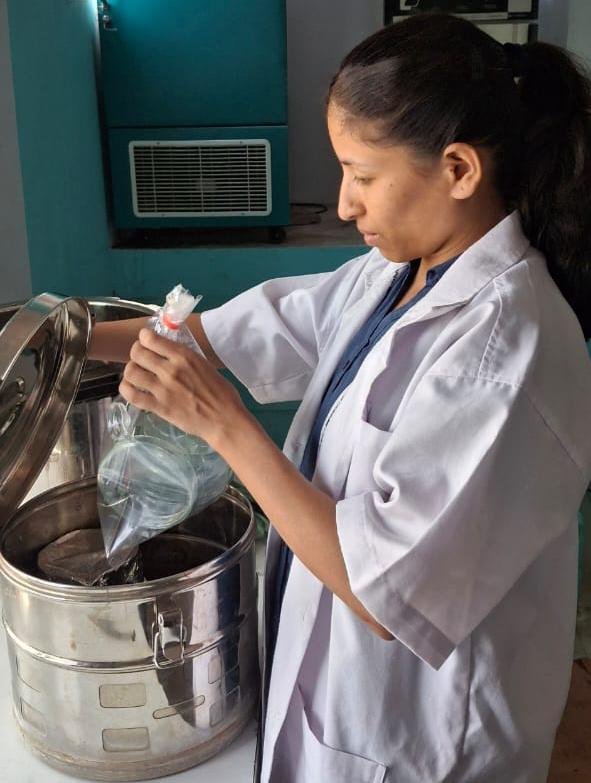
Autoclave: An autoclave works on the principle of moist heat sterilization using steam under pressure. Increased pressure raises the boiling point of water, allowing steam to reach higher temperatures that kill microorganisms and spores.
sterilization conditions: Temp 121°C at 15 psi pressure for 15–20 minutes (most common).
In an autoclave you seal it and pump steam in. That builds pressure to ~15 psi above atmospheric=2 atm total pressure
(2 atm pressure=121°C Boiling point of water
Safety: Never open before pressure becomes 0.
Use heat resisitance glove.
Do not over fill the autoclave and check water level before operation.
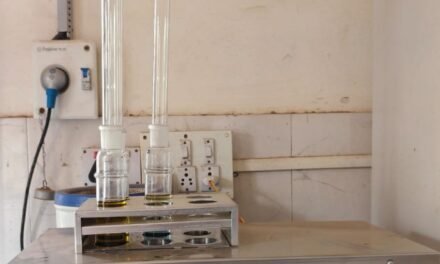
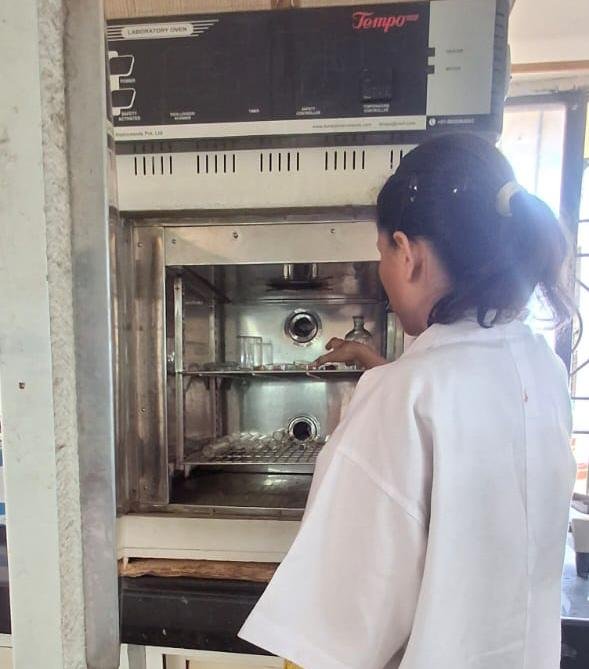
Hot air oven : A hot air oven is an electrical device used to sterilize glassware, metal tools, powders, and other materials using dry heat.
Electricity heats the air inside the oven, and a fan circulates the hot air evenly to kill microorganisms and remove moisture.
The usual sterilization temperature is between 160°C and 180°C.
It kills microorganisms by oxidation, dehydration and protein denaturation.
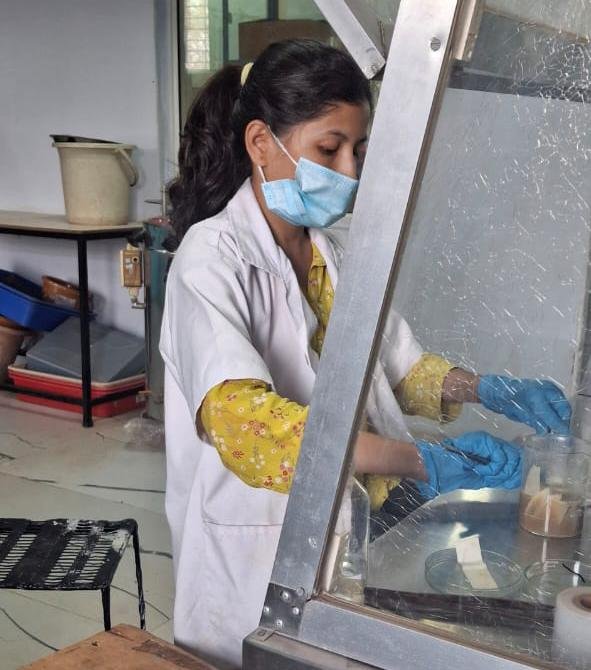
Laminar air flow : A laminar air flow is a cabinet that provides a continuous flow of filtered air to create a sterile working area and prevent contamination.
Principle:
Air passes through a HEPA filter that removes particles and microorganisms of size 0.3 micron (µm) and larger with about 99.97% efficiency. The filtered air flows in a uniform (laminar) direction to maintain sterility.
Our lab has 2 laminars
1) 610X915X75 mm filter size. And the type is MINIPLEAT HEPA BOX TYPE.
2) 915mmX610mmX75mm ,Quantity 2.
Fumigation in PTC
Chemicals Used: 1. Formalin 2. Potassium permanganate (KMnO₄)
Purpose : 1. To sterilize the culture room
2. To kill bacteria, fungi and spores
3. To maintain aseptic conditions
Principle : When formalin is mixed with potassium permanganate, it releases formaldehyde gas which disinfects the entire room.
Materials Required : 1. Formalin (37–40%) , 2. Potassium permanganate (KMnO₄) , 3. Petri dish, 4. Gloves, mask, lab coat
Procedure: 1. Take a heat-resistant container (Petri dish).
2. Add potassium permanganate crystals first (10 gm KMnO₄).
3. Pour 20 ml formalin over it.
4 .Immediate chemical reaction produces formaldehyde gas (fumigation).
General Ratio : Formalin : KMnO₄ ( 20 ml : 10 gm)
Cleaning Procedure for Contaminated Plant Tissue Culture Bottles
Materials Required
- 20 L plastic bucket
- Potassium dichromate (K₂Cr₂O₇) – 15 g
- Distilled water / tap water – 50 ml
- Sulphuric acid (H₂SO₄) – 30 ml
- Glass beaker
- Vim liquid / laboratory detergent
- Oven
- Autoclave
Procedure
- Take a 20 L bucket and fill it with clean tap water.
- In a glass beaker, take 15 g potassium dichromate (K₂Cr₂O₇).
- Add 50 ml distilled / Tap water and stir until crystals dissolve completely.
- Carefully add 30 ml concentrated sulphuric acid (H₂SO₄).( Always add acid to water slowly while stirring. Never add water to acid.)
- Pour this dichromate–sulphuric acid solution into the bucket and mix well.
- Place contaminated culture bottles (opened) into this cleaning solution.
- Keep the bottles immersed for 24 hours to loosen and disinfect contamination.
- After 24 hours, remove the bottles and wash thoroughly using Vim or laboratory detergent with a brush to remove all residues.
- Rinse the bottles 3–4 times with clean tap water.
- Drain the water completely and dry the bottles.
- Place the bottles in a hot air oven at 180°C for 12 hours for complete drying and sterilization.
- After drying, the clean bottles are ready for reuse in the next plant tissue culture process.
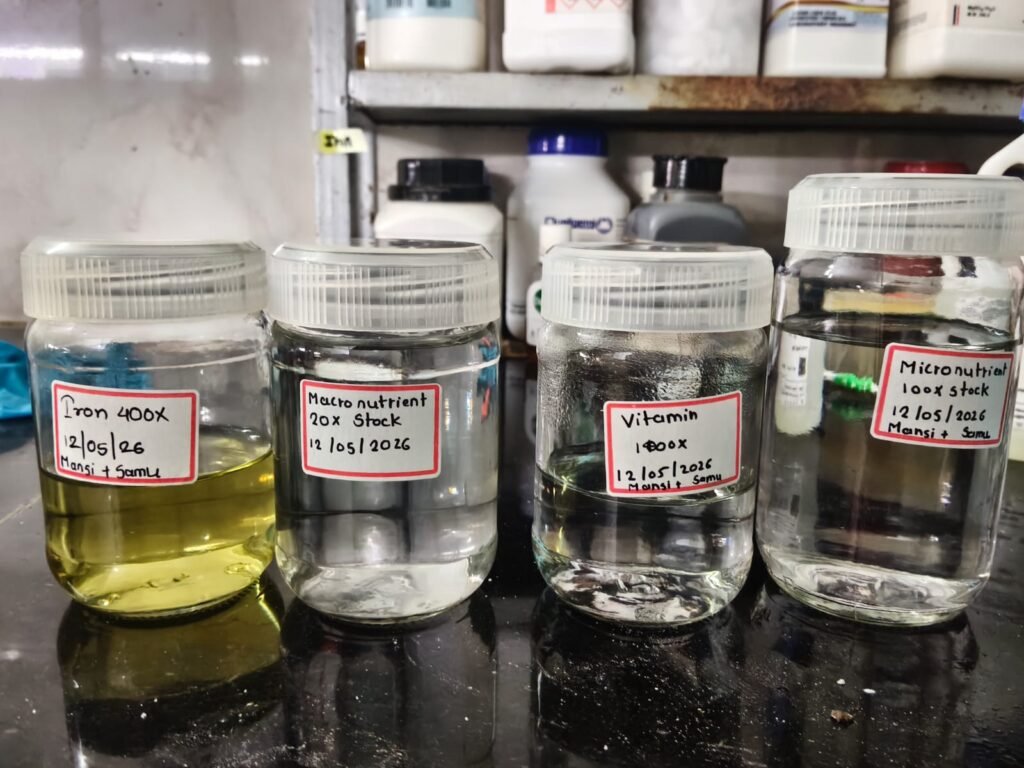
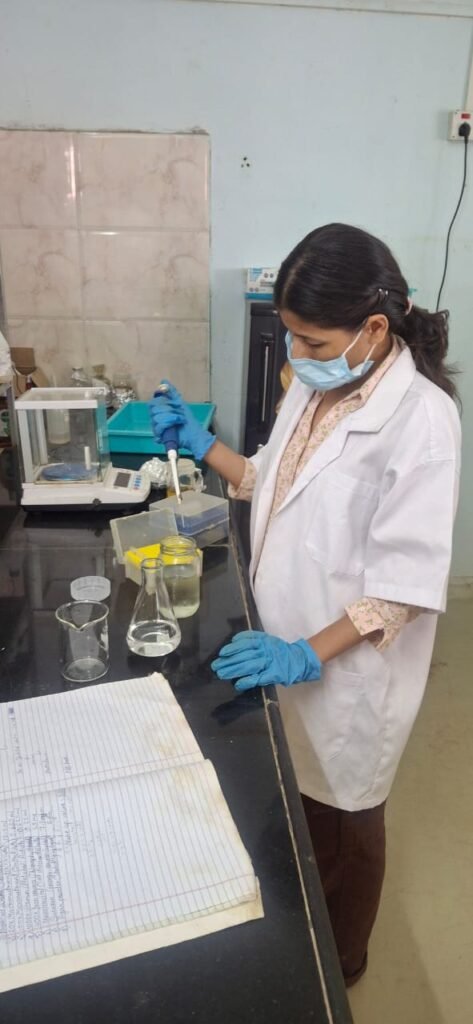
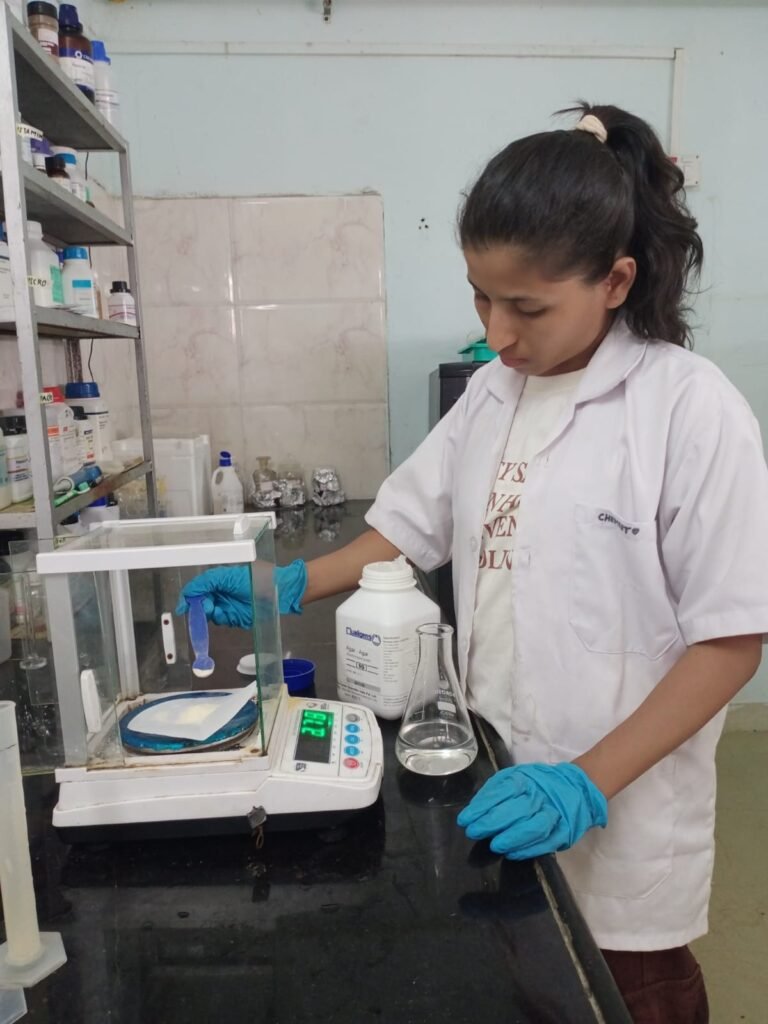
Preparation of stock for MS media preparation.
PREPRATION OF MACRONUTRIENTS SOLUTION:-
| Macro nutrients | Original Concentration | Amount of salt after multiplying original concentration by 20X, Solution Volume (250ml) |
| NH4NO3 Ammonium Nitrate | 1650mg/l | 8250mg (8.25) |
| KNO3 Potassium Nitrate | 1900mg/l | 9500mg (9.50) |
| KH2PO4 Potassium Dihydrogen Phosphate | 170mg/l | 850mg (0.85) |
| MgSO4.7H2O Magnesium Sulphate | 370mg/l | 1850mg (1.85) |
| CaCl2.2H2O Calcium Chloride Dihydrate | 440mg/l | 2200mg (2.20) |
PREPARATION OF MICRONUTRIENTS SOLUTION:-
| Micronutrients | Original Concentration | Amount of salt after multiplying original concentration by 100X, Solution Volume (250ml) |
| H3BO3 Boric acid | 6.2mg/l | 155mg (0.155) |
| MnSO4.4H2O Manganese Sulphate Tetrahydrate | 22.3mg/l | 557.5mg |
| ZnSO4.7H2O Zinc Sulphate Heptahydrate | 8.6mg/l | 215mg |
| Na2MoO4.2H2O Sodium Molybdate Dihydrate | 0.25mg/l | 6.25mg |
| CuSO4.5H2O Copper Sulphate Pentahydrate | 0.025mg/l | 0.625mg |
| CoCl2.6H2O Cobalt Chloride Hexahydrate | 0.025mg/l | 0.625mg |
| Kl Potassium Iodide | 0.83mg/l | 20.75mg |
PREPARATION OF VITAMINS:-
| Vitamins | Original Concentration | Original Concentration multiplying by 1000X, Final solution volume (50ml) |
| Thiamine HCl Thiamine | 0.1mg/l | 5mg |
| Pyridoxin HCl Pyridoxin Hydrochloride | 0.5mg/l | 25mg |
| Niacin Nicotinic acid | 0.5mg/l | 25mg |
| Glycine | 2.0mg/l | 100mg |
IRON SOURCES:-
| Sources | Original Concentration | Original Concentration multiplying by 400X, Final solution volume (50ml) |
| FeSO4.7H2O | 27.8mg/l | 2780mg |
| Na2EDTA.2H2O | 37.3mg/l | 3730mg |
Preparation of ms (Murashige and Skoog ) media :-
| Material | Final Volume (250ml) |
| Distilled water | 100ml |
| 20X, Macronutrients | 12,5ml |
| 100X, Micronutrients | 0.625ml |
| 1000X, Vitamins | 0.625ml |
| 400X, Iron source | 0.25ml |
| Mesoinositol | 25ml |
| Sucrose | 7.5ml |
| Agar powder | 2gm |
Roles
| Macronutrients | N, P,K, Mg, S, Ca |
| Micronutrients | Fe, Zn, B Mo, Mn |
| Iron source | Chlorophyll Formation |
| Vitamins | Metabolic Activity |
| Sucrose | Energy source |
| Plant hormones | Shoot and Root initiation |
| Agar | Solidifying agent |
| Distilled water | Solvent |
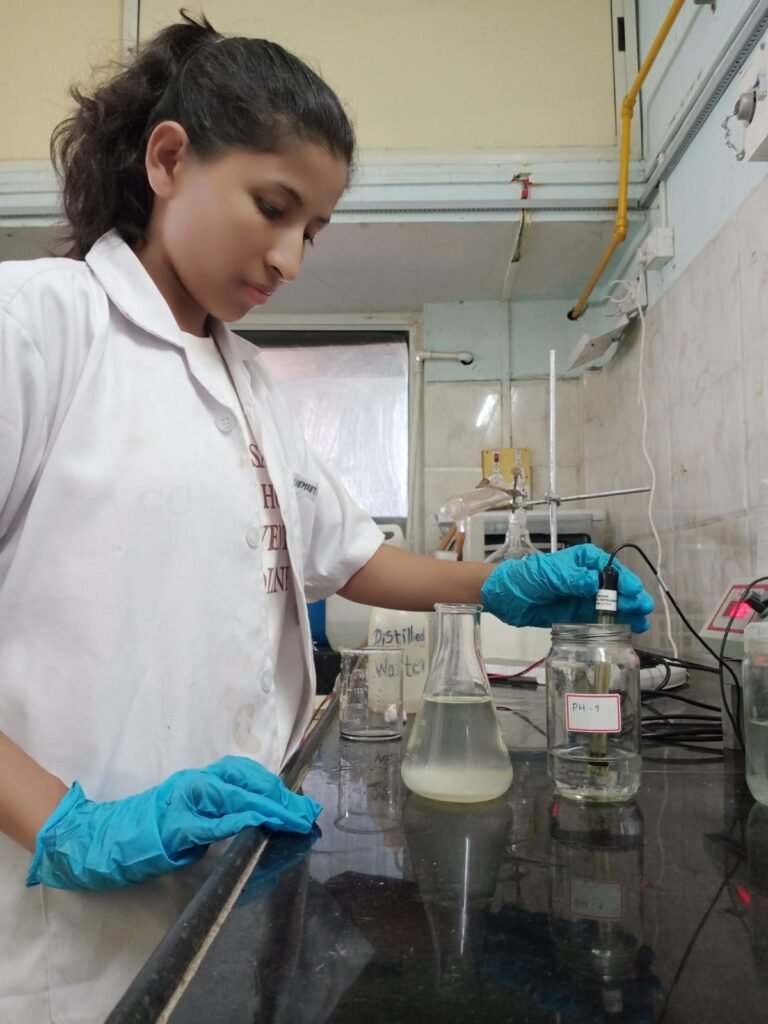
pH Check:-
Prepare MS media pH range is 5.8 – 5.9
Adjust the pH : 1N NaoH is used to increase pH
HCl is used to decrease pH
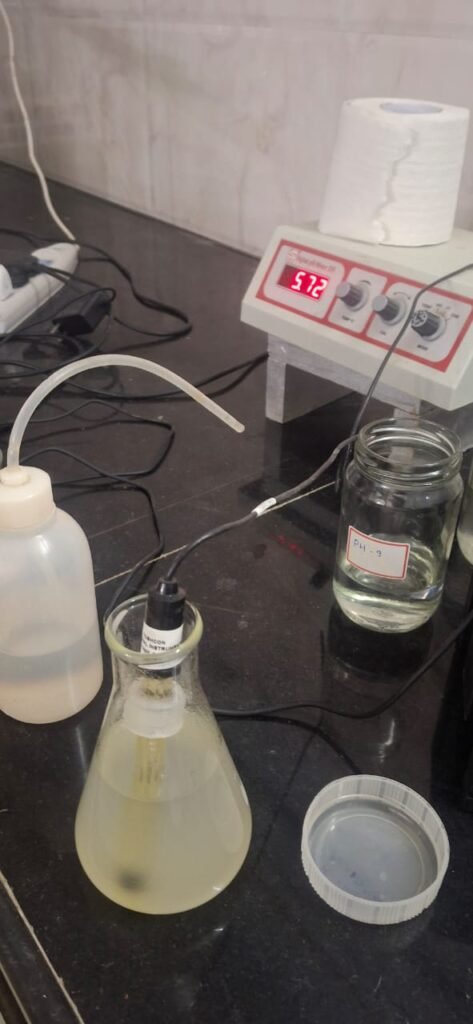
We have to wash the electrode with distilled water and clean with tissue paper. Handle the glass membrane carefully as it contains AgCl and it is very delicate. Then dip in pH 9 for 3 to 4 min and then use for the solution to test the pH.
KCl is the filling solution for electrode.It keeps the AgCl wire stable and maintains liquid junction potential.
Making of KCl
Here – Molar mass of KCl is 75.55g/mol.
We have to make 3M
So 3×74.55= 223.65g per liter.
For 100 ml: 22.37g KCl.
Autoclave Media
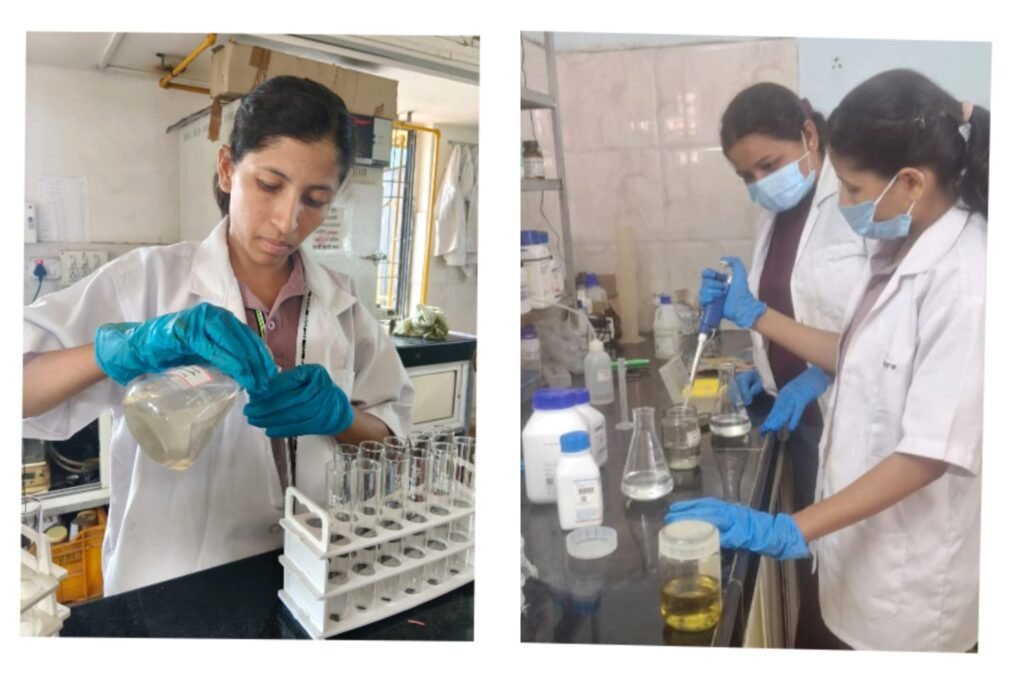
MS media provides essential nutrients, vitamins, hormones, and energy required for plant growth under in vitro condition. The prepared media is sterilized using an autoclave to destroy microorganisms and maintain aseptic condition necessary for successful tissue culture.
Then we poured the media in test tubes and kept in culture room to solidify.
METHODOLOGY
Step 1: SELECTION OF EXPLANT
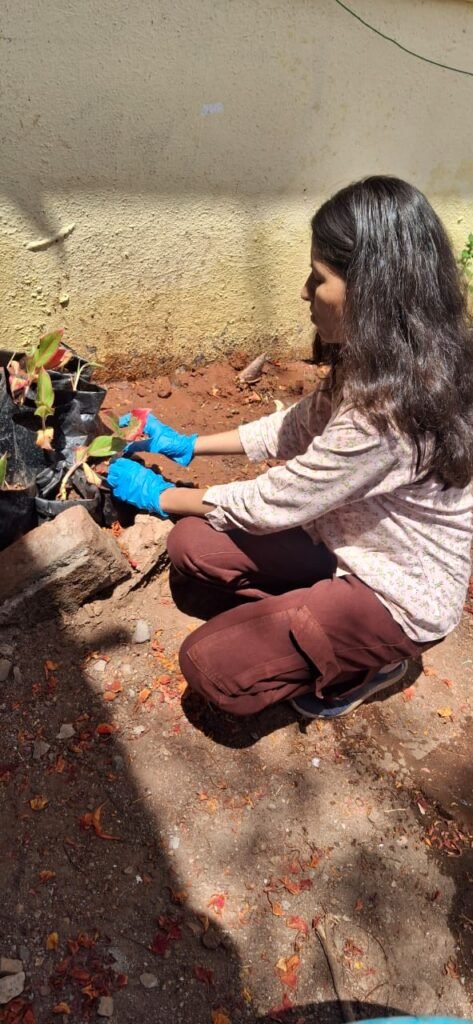
We selected Aglaonema as an explant for handeling.
Take sterilized trey (clean with ethenol) , knife and hand gloves. Select mother plant which is disease free, without yellowing and fresh.
Step 2: CLEANING AND SURFACE STERILIZATION PROCESS:
Autoclave
1. 6 pairs of petri plates
2. 5ml measuring cylinder
3. 2 liter distilled water
4. forcep
5. surgical blade
Clean the laminar air flow with 70% ethanol and keep the sterilized material in UV light for 15 min.
Cut the mother plant in desirable shape and place it in dry trey.
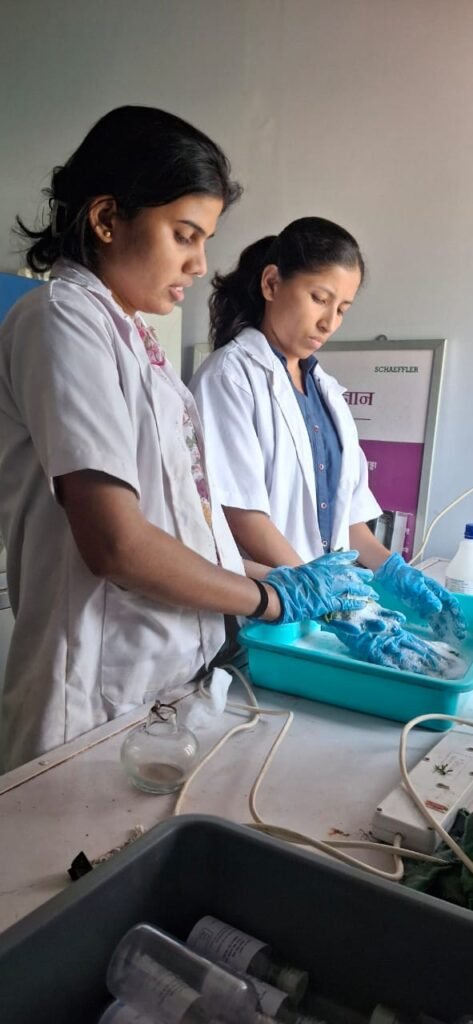
3.Keep the explant in running water for 15 min.
Step 3: BAVISTIN TREATMENT
Prepare Bavistin treatment (5 ml of Bavistin in 500 ml distilled water) .Keep the explant in the solution for 2hrs.
Sterilize a trey with 70% ethenol and transfer the explant in the trey .Wash the explant for 3 to 5 times. Handle the plant material with sterile gloves.
Step 4: SOAP TREATMENT
Prepare soap solution(5 ml Labolene in 270 ml distilled water).wash the explant for 3 to 5 times.
Transfer the explant in a glass beaker.
Step 5: DETTOL/SAVLON TREATMENT
Prepare dettol solution(3 ml detol in 270 ml distilled water). Soak the explant for 30 min.Wash the explant for 3 to 5 times.
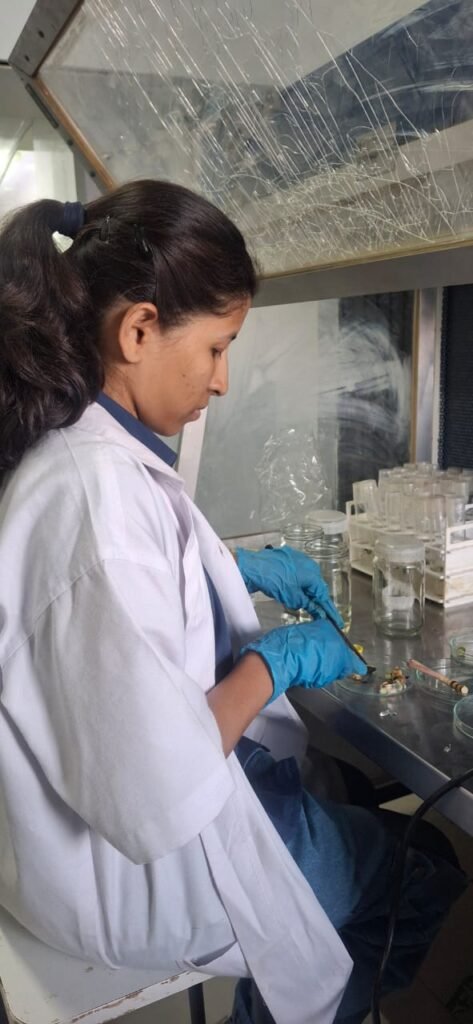
With the help of sterile knife cut the upper cover of plant material in laminar air flow.
Keep the culture bottle in UV light for 15 min.
Step 6: SODIUM HYPOCLORIDE TREATMENT
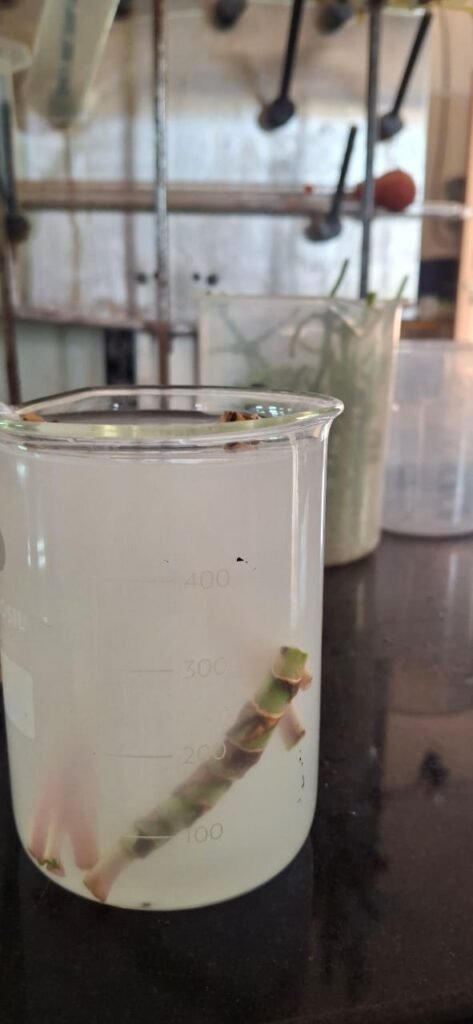
From this process onwords I used double distilled water because from now on the explant need most sterilization.
Prepare Soidum Hypochloride solution (10 ml in 270 ml distilled water).Wash the explant for 3 to 4 times.
Take the explant in petri plate with help of forcep . Cut the material by taking section with the help of surgical knife.
Step 7: ANTIBIOTIC TREATMENT
Prepare antibiotic solution using taxime antibiotic ( in 200 ml sterile distilled water).soak the plant material in the solution for 20 min. Here I used cefotaxime antibiotic which was 500mg.
Step 8: INOCULATION
Inoculate the plant material in culture medium (here test tubes) in culture room for further observation.
In this process I carefully inserted the explant in the media without disturbing it as well as took care that the explant do not touch the surface of culture bottle.
CONCLUSION:
Contamination is seen in the culture tubes.
METHODOLOGY
Step 1: SELECTION OF EXPLANT
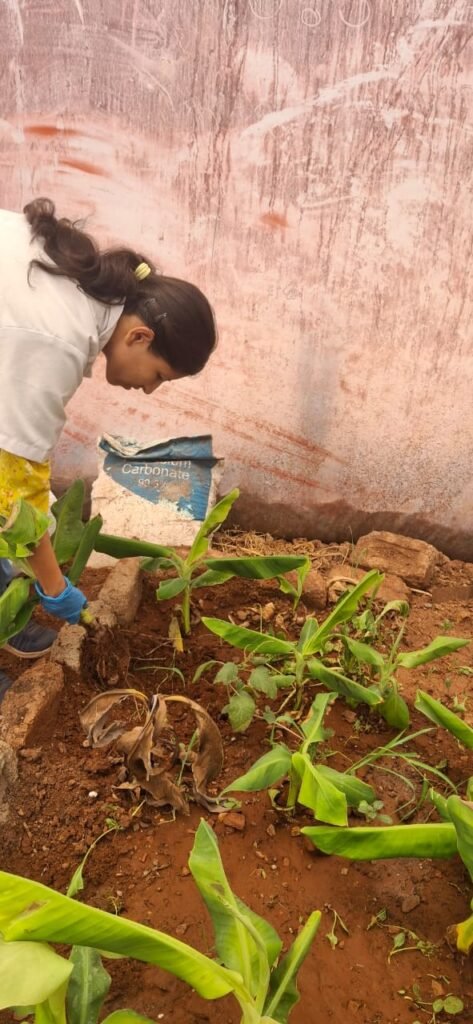
We selected Banana suckers as an explant
Age of the plant :6-12 months. Around 3 feet plant has well developed suckers and meristem.
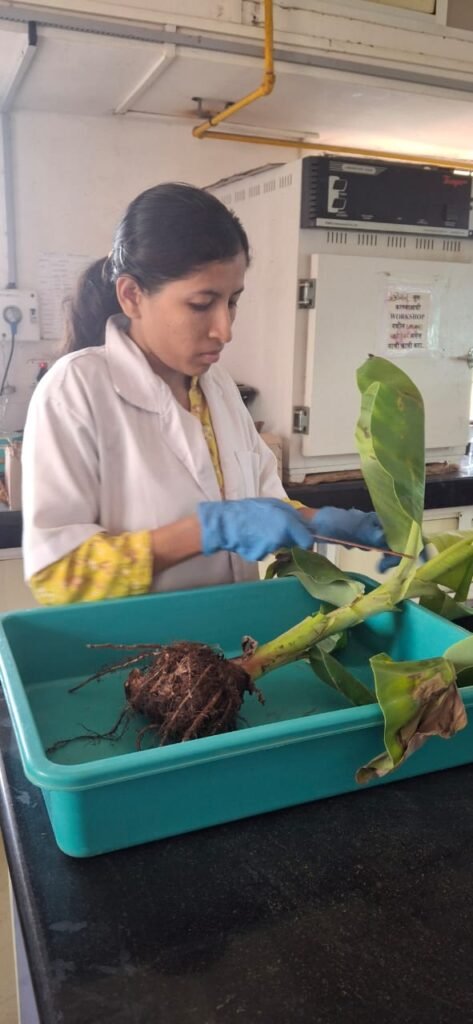
Take sterilized trey (clean with ethenol) , knife and hand gloves. Select mother plant which is disease free, without yellowing and fresh. Cut the leaves and tip of the plant.
Step 2: CLEANING AND SURFACE STERILIZATION PROCESS:
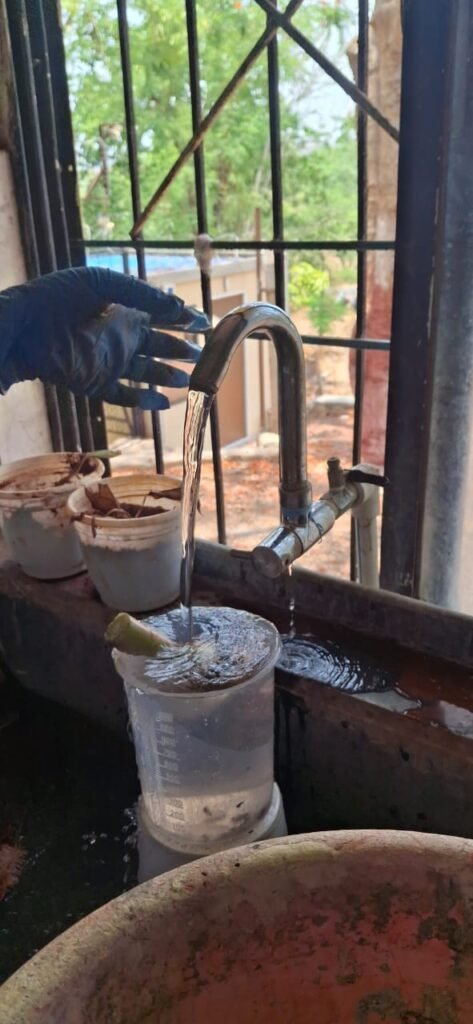
Keep the explant in running water for 15 min.
Autoclave
1. 6 pairs of petri plates (take large petri plates).
2. 2 liter distilled water
3. surgical blade
4. forceps (aprox 4)
(Clean the laminar air flow with 70% ethanol and keep the sterilized material in UV light for 15 min.)
Step 3: SOAP TREATMENT
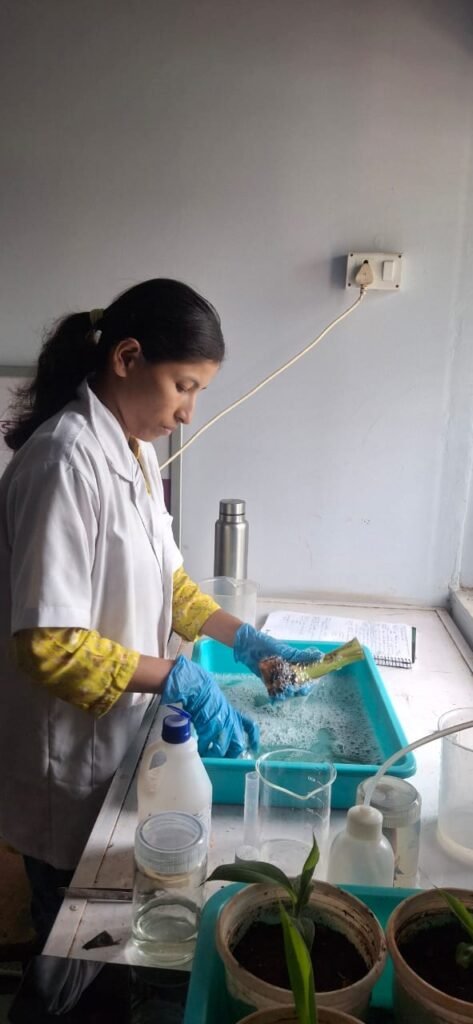
Prepare soap solution(30 ml Labolene in 270 ml distilled water).Wash the explant for 3 to 5 times.
Only gentle rubbing to remove the dirt as well as to break the surface tension.
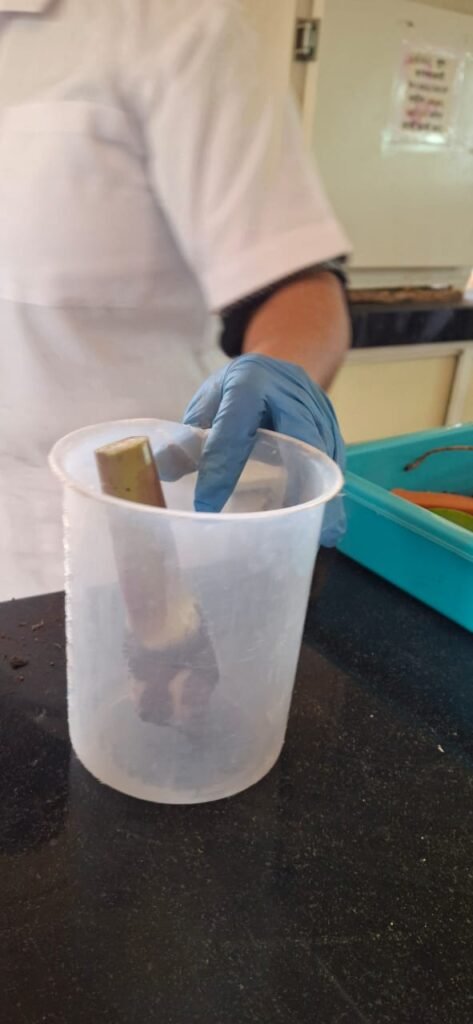
Then transfer the explant in a glass beaker.
Step 4: DETTOL/SAVLON TREATMENT
Prepare dettol solution(3 ml dettol in 270 ml distilled water). Soak the explant for 30 min .Wash the explant for 3 to 5 times.
I used dettol .It has chloroxylenol which is antiseptic ,it kills the bacteria without damaging the plant.
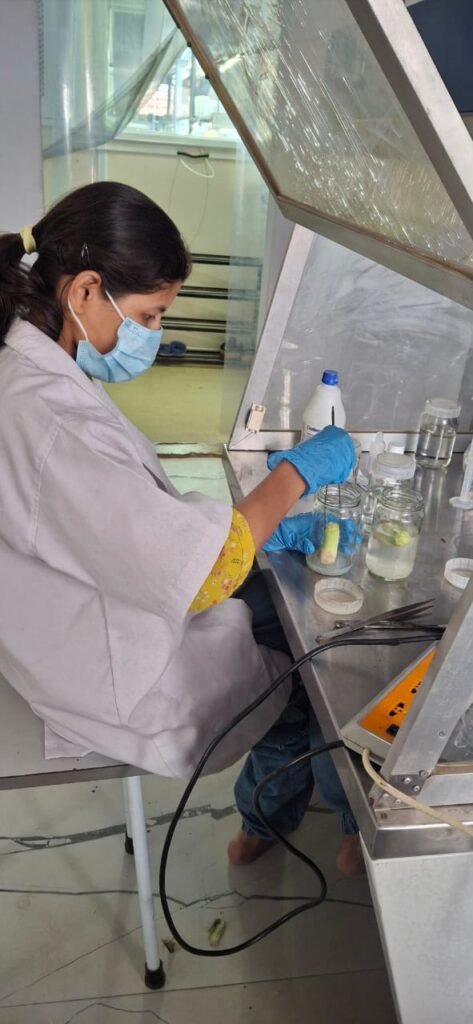
With the help of sterile knife cut the upper cover of plant material in laminar air flow.
(Transfer the culture bottle in UV light for 15 min.)
Step 5: SODIUM HYPOCLORIDE TREATMENT
Prepare Soidum Hypochloride solution (10 ml in 270 ml distilled water).Wash the explant for 3 to 4 times.
Do not dip the explant for more than 20 min.
It kills bacteria,fungi, spores,viruses,algae.It is oxidizing agent-releases chlorine+oxygen.
It breakes the cell wall of the microbes and the microbe dies.
Step 6:
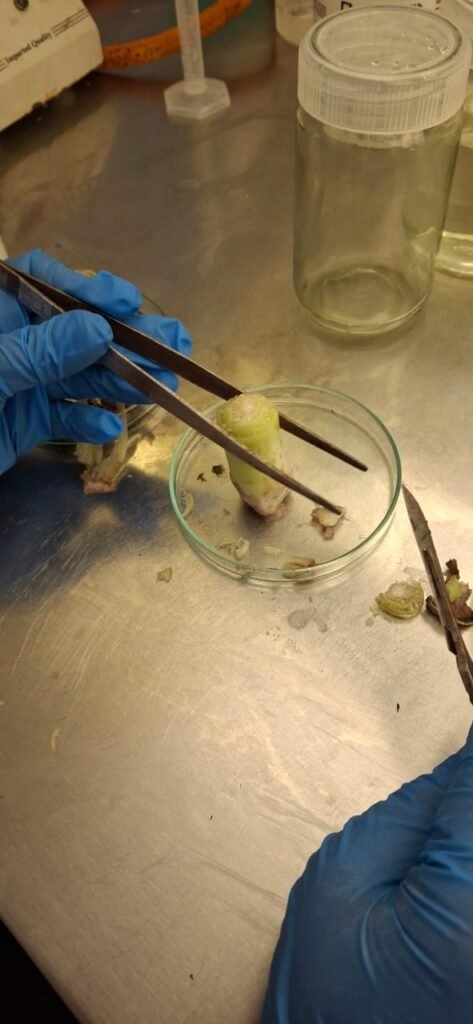
Place the explant in petri plate and with the help of sterile surgical knife cut the sucker and meristem.
Transfer the explant into bottle jar.
We need the most skill and patience in this process because we have to remove the outer surface and not harm the plant as well.
All the damaged parts and extra layers should cut here only.
Step 7: ANTIBIOTIC TREATMENT
Take the explant in petri plate with the help of forcep . Cut the material by taking section with the help of surgical knife.
Prepare antibiotic solution using taxime antibiotic ( in 200 ml sterile distilled water).soak the plant material in the solution for 20 min. Here I used cefotaxime antibiotic which was 500mg.(pour the liquid into the powder bottle and shake well then add into distilled water.
Step 8: INOCULATION
Stage 1:
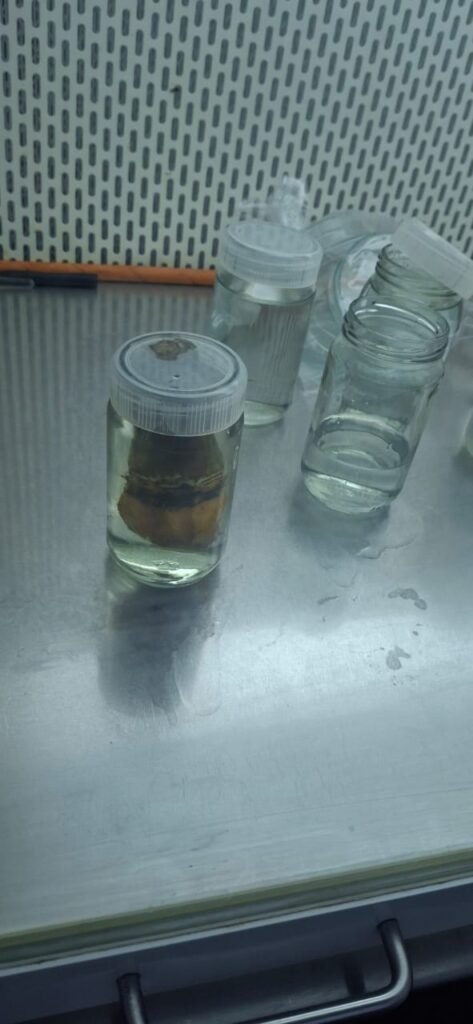
Inoculate the explant into culture bottle.
Wrap the bottle.
Step 9: NAMING THE CULTURE BOTTLE
We Labeled the culture bottle as:
Date, Stage, Name
CONCLUSION:
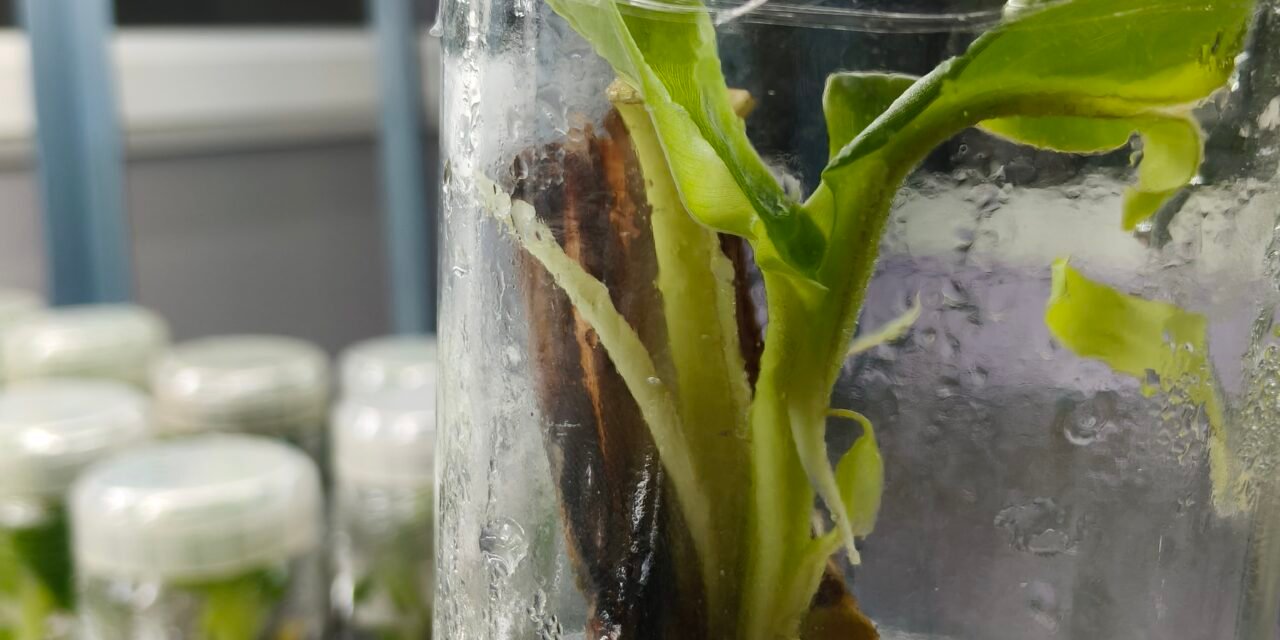
After two days the meristem grown around 0.3 to 0.4 cm.
After four days contamination is seen in the culture bottle.
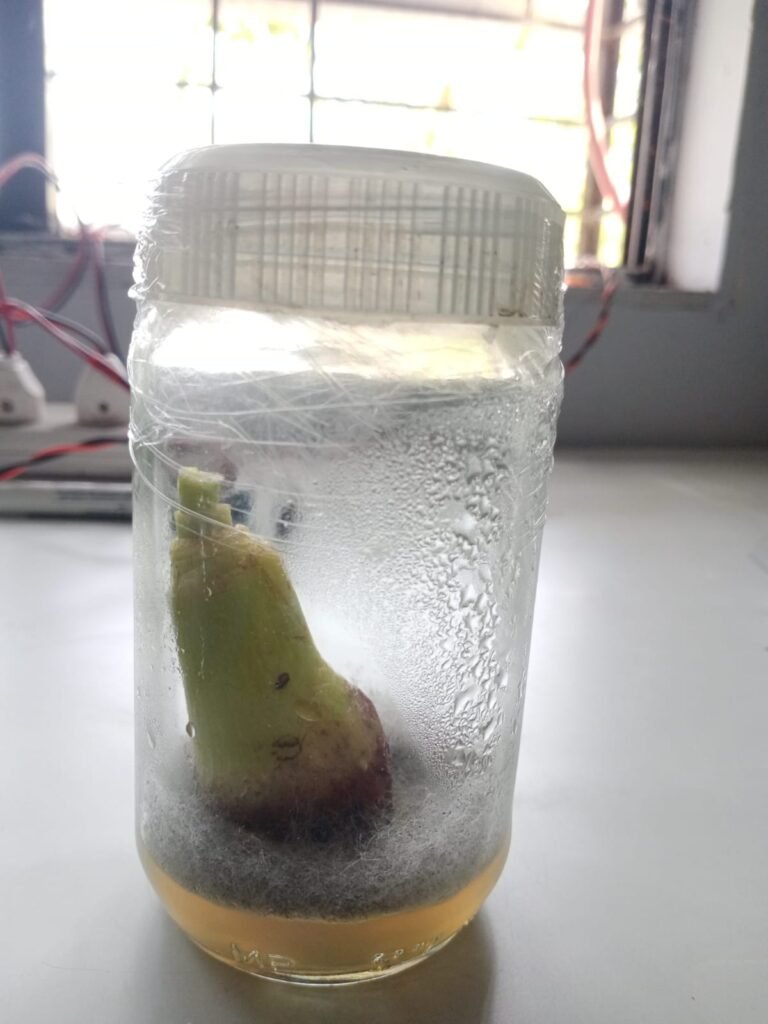
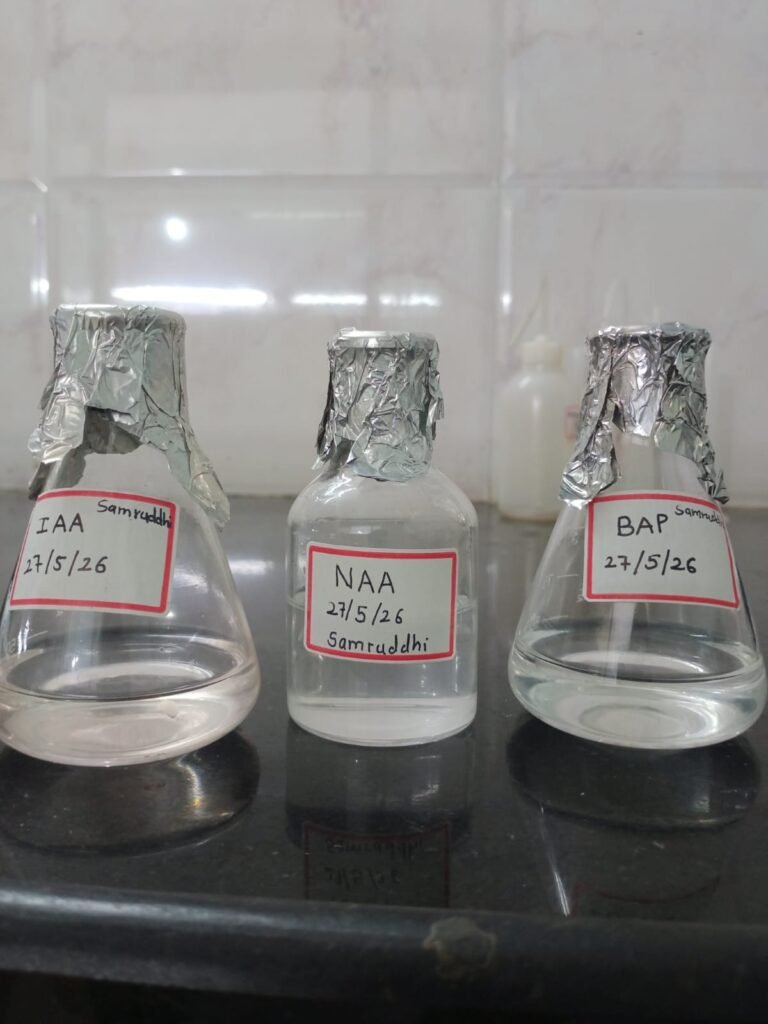
27/5/26
Preparation of Hormone media to transfer stage 1 explant into stage 2.
1) BAP (6-Benzylaminopurine)
BAP is a synthetic cytokinin hormone commonly used in PTC .
-Cell division
-Shoot multiplication
-Bud initiation
2) IAA (Indole-3 Acetic Acid)
IAA is a natural auxin hormone found in plants.
-Root formation
-Cell elongation
-Differentiation
A balanced interaction of BAP and IAA controls overall plant regeneration.
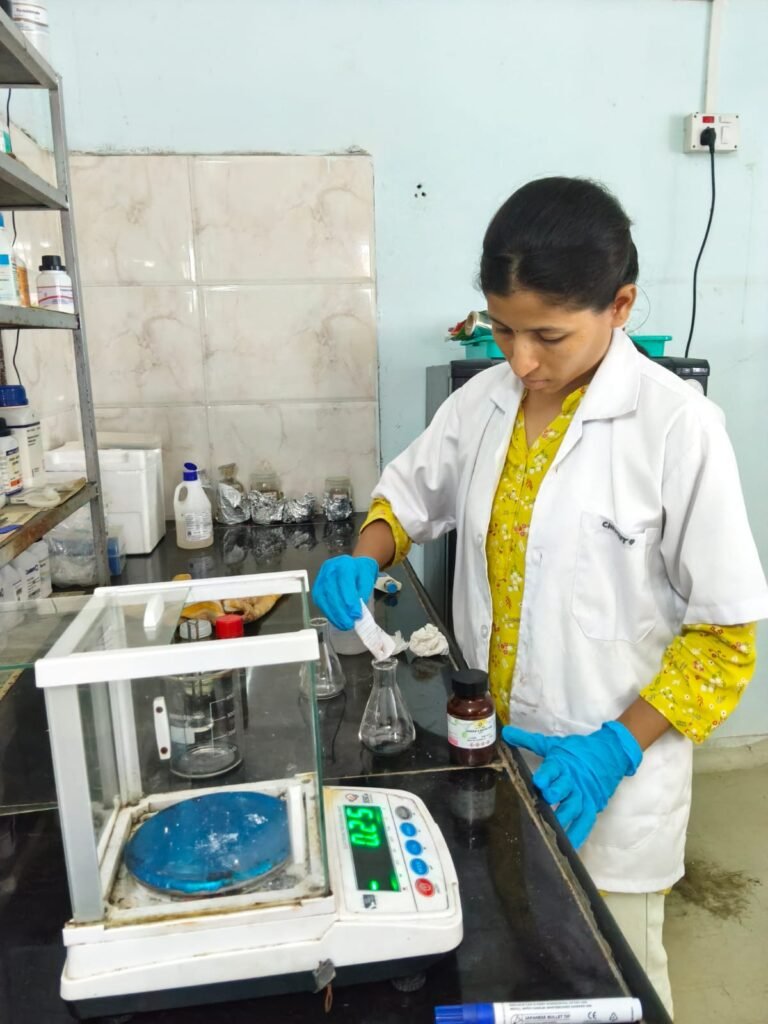
BAP Preparation (6-Benzyl amino purine)
- Take 50mg 0.05) BAP in a dry beaker.
- BAP does not dissolve easily in water . So add 1-2 drops of 1N NaOH.
- Stir continuosly until BAP dissolves completely.
- Make up the volume to 50ml using distilled water.
- If possible filter sterilize using a 0.22 mm filter paper.
- Label the bottle.
- Store at 4
°C(refrigerator).
Same procedure follow for IAA and NAA.
NAA is also used instead of IAA for root formation
Precautions: Always take a dry beaker. Do not place the powder in wet beaker.
| Materials | Final Volume (250) |
| Distilled water (solvent) | 100ml |
| 20X Macronutrient (N,P,K,Mg,Ca,S) | 12.5ml |
| 100X Micronutrient (ZN,Mn,B,Co,Mo) | 0.625ml |
| 1000X Vitamins (Metabolic activity) | 0.625ml |
| 400X Iron source (Chlorophyll formation) | 0.25ml |
| Mesoinositol (Cell division and cell wall formation) | 25mg |
| Sucrose (energy source -carbon) | 7.5gm |
| Agar (Solidifying agent) | 2gm |
| BAP (6-Benzylaminopurine) | 0.750ml |
| IAA (Indole-3 Acetic Acid) | 0.125ml |
pH Check:-
Prepare MS media. pH range is 5.8 – 5.9
Adjust the pH : The pH of the media was below 5.9 so I added 1N NaoH to increase pH.
Then Kept the media in hot air oven untill the media mark up to 200ml.
Let the media cool down. Then poured into the culture bottle.
And kept the culture bottle in the culture room.
SUBCULTURING :-
Autoclave :
Distilled water
Petridishes
Forceps
Knife
2nd Stage :
After 8 to 10 days we prepared hormone media ( ms media + BAP + IAA )
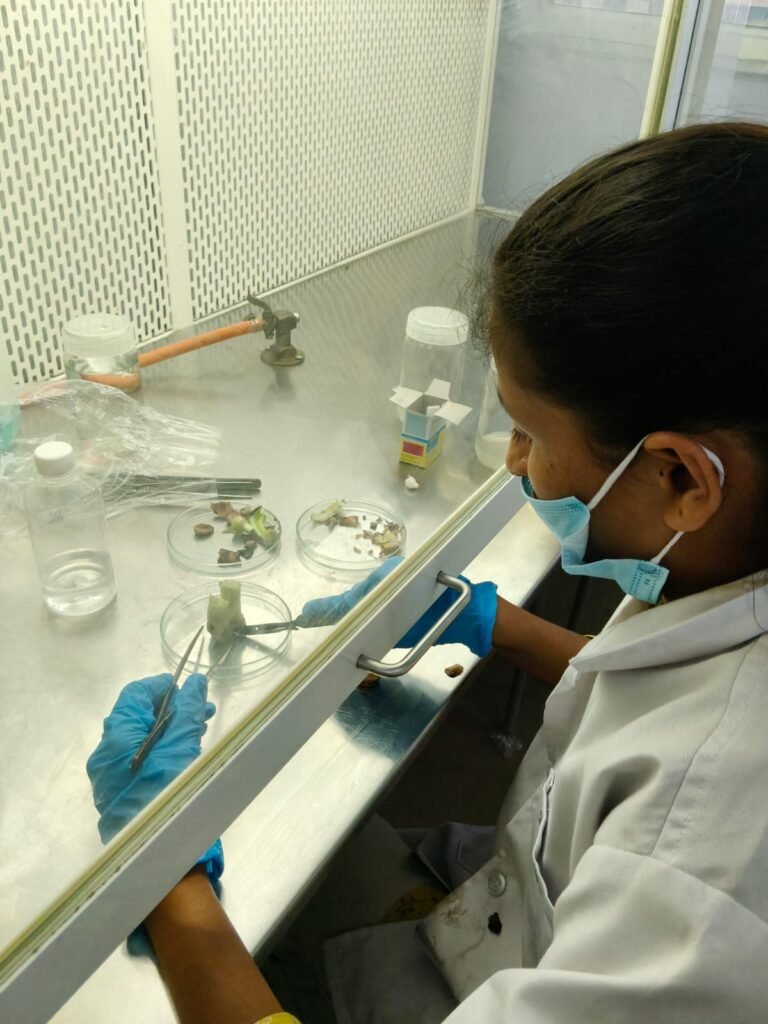
After preparing the hormone-supplemented medium, the explant is taken from the culture bottle and cut into two parts from center (also cut the blackish parts around the sucker). Kept cut banana parts in Antibiotics solution for 20 Min .
Then, each part is inoculate into fresh culture bottles containing the same hormone medium.
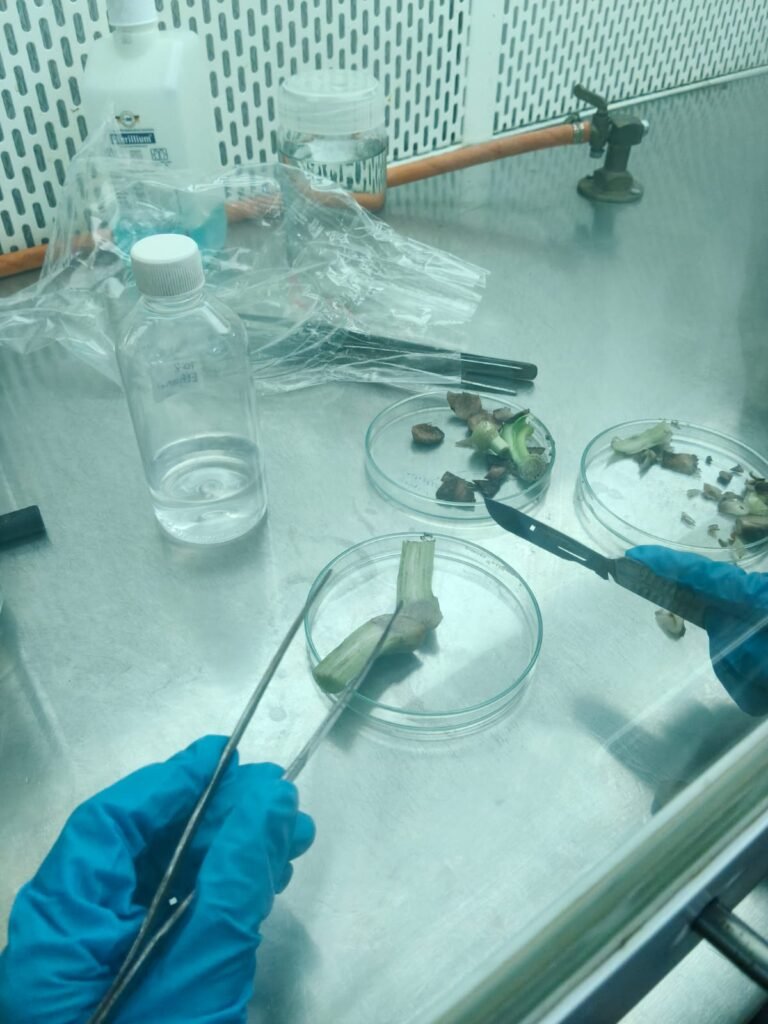
3rd Stage :
After preparing the hormone-supplemented medium, the explant is taken from the culture bottle and cut into two or more parts . kept cut banana parts Antibiotic solution for 20 min. Then, each part is inoculate into fresh culture bottles containing the hormone media.
This procedure is repeated upto 6th Stage (multiplication).
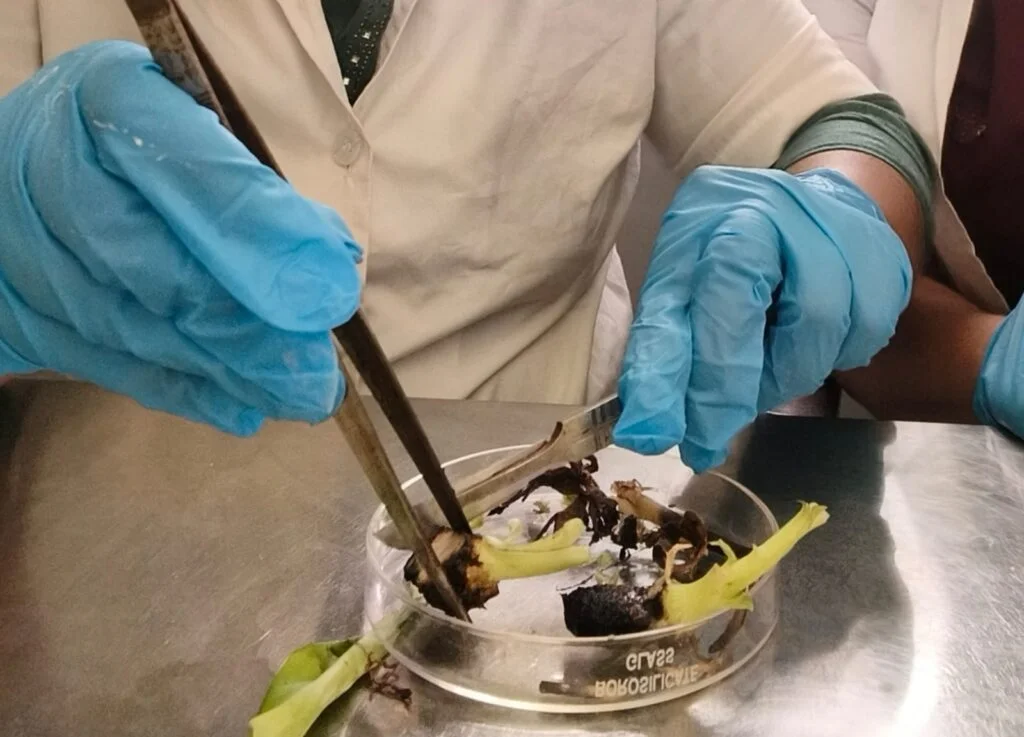
Preparation of Charcoal Media, for Stage 7 to Stage 8.
When we were preparing charcoal media ,we add the media components and hormons.
Then placed it in microoven for 7 minutes.
After 7 minutes we added charcoal powder to the solution and again kept it in microoven for another 7 min.
Finally we poured the medium into culture bottles (if charcoal powder is added to medium first, it destroys the solidification properties of agar).
Autoclave the media bottles and kept them in the culture room.
| Materials | Final Volume (250) |
| Distilled water (solvent) | 100ml |
| 20X Macronutrient (N,P,K,Mg,Ca,S) | 12.5ml |
| 100X Micronutrient (ZN,Mn,B,Co,Mo) | 0.625ml |
| 1000X Vitamins (Metabolic activity) | 0.625ml |
| 400X Iron source (Chlorophyll formation) | 0.25ml |
| Mesoinositol (Cell division and cell wall formation) | 25mg |
| Sucrose (energy source -carbon) | 7.5gm |
| Agar (Solidifying agent) | 2gm |
| BAP (6-Benzylaminopurine) | 0.750ml |
| IAA (Indole-3 Acetic Acid) | 0.125ml |
| Charcoal powder | 0.3gm |
Hardening of the Plant:
Hardening means gradually adapting the plantlets grown in the lab to external environmental condition.
Note- when transfering from charcoal bottles to multiply into another ,the stem should get seperate and the leaves and roots also appear. So when transfering the plant ,cut all the leaves and cut the suckers black coloured layer. Then cut as the sucker should be shared with every stem part.
PRIMAY HARDENING
- Remove the plantlets from the culture bottles.
- Wash off the agar gel from the roots with clean water.
- Dip in fungicide (Bavistin) 0.5g/L
- Plant the plant in cocopeat trays. Here we directly planted in the cocopeat mixed soil.
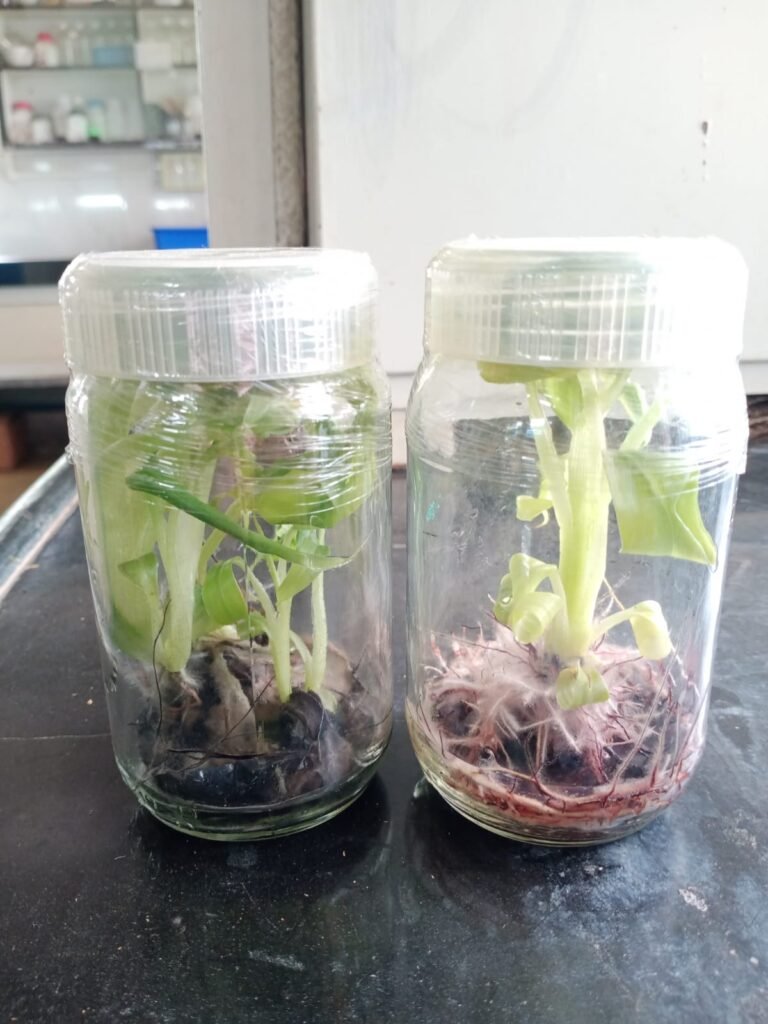
Explant in charcoal media
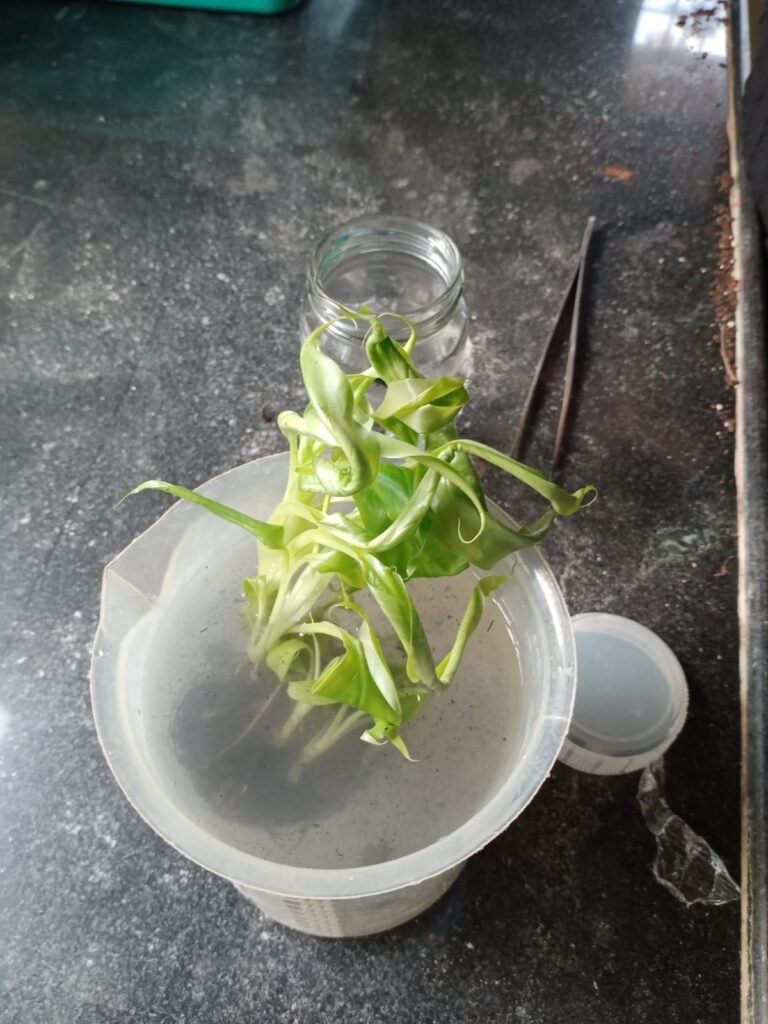
Dip in fungicide
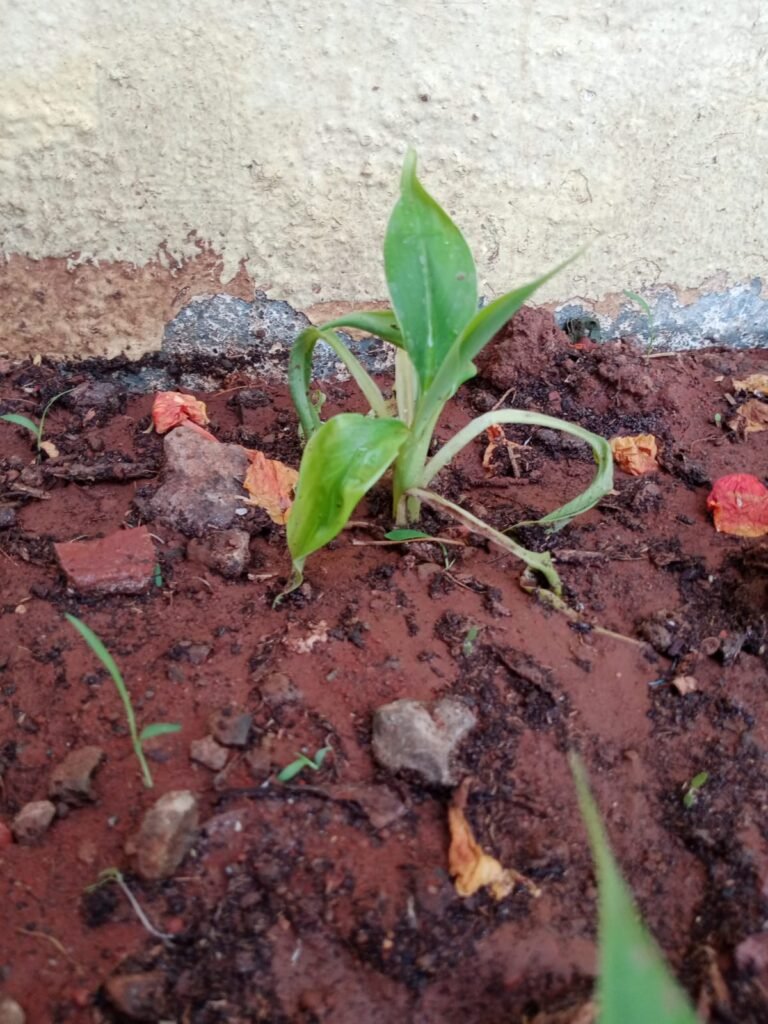
Planted into the soil