Introduction
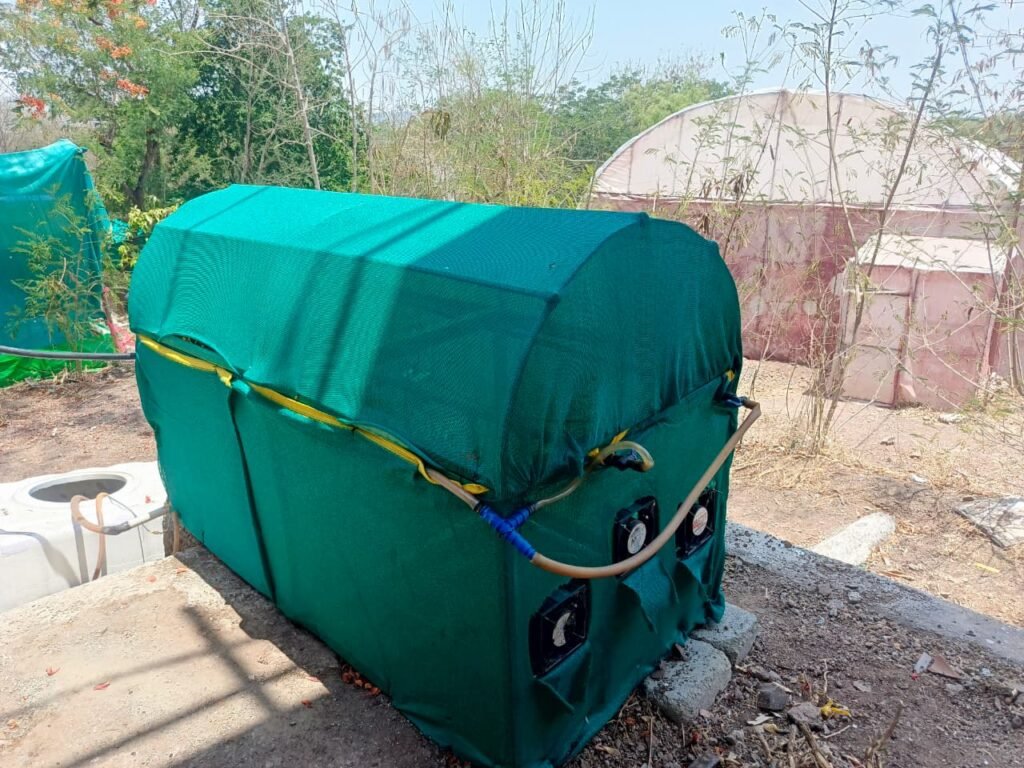
The main aim of this project is to develop a hardening chamber for the plants geminated in the tissue culture lab. The Small Poly-house Climate Control Structure is designed to maintain suitable environmental conditions for plant growth and protected cultivation. The structure helps control temperature, humidity, and airflow inside the chamber using cooling pads, exhaust fans, and proper ventilation systems.
Objectives
To create a controlled environment for plants by
maintaining the temperature between 25–27°C
maintaining humidity above 60 to75%
monitoring environmental conditions by manual data logging
Methodology
Shade-net material is used for the outer covering: This is to restrict the amount of solar energy entering the polyhouse
Cooling pads are used for temperature reduction and also for increasing humidity by evaporative cooling.
Three exhaust fans are used to accelerate evaporative cooling
Water circulation to keep pads wet
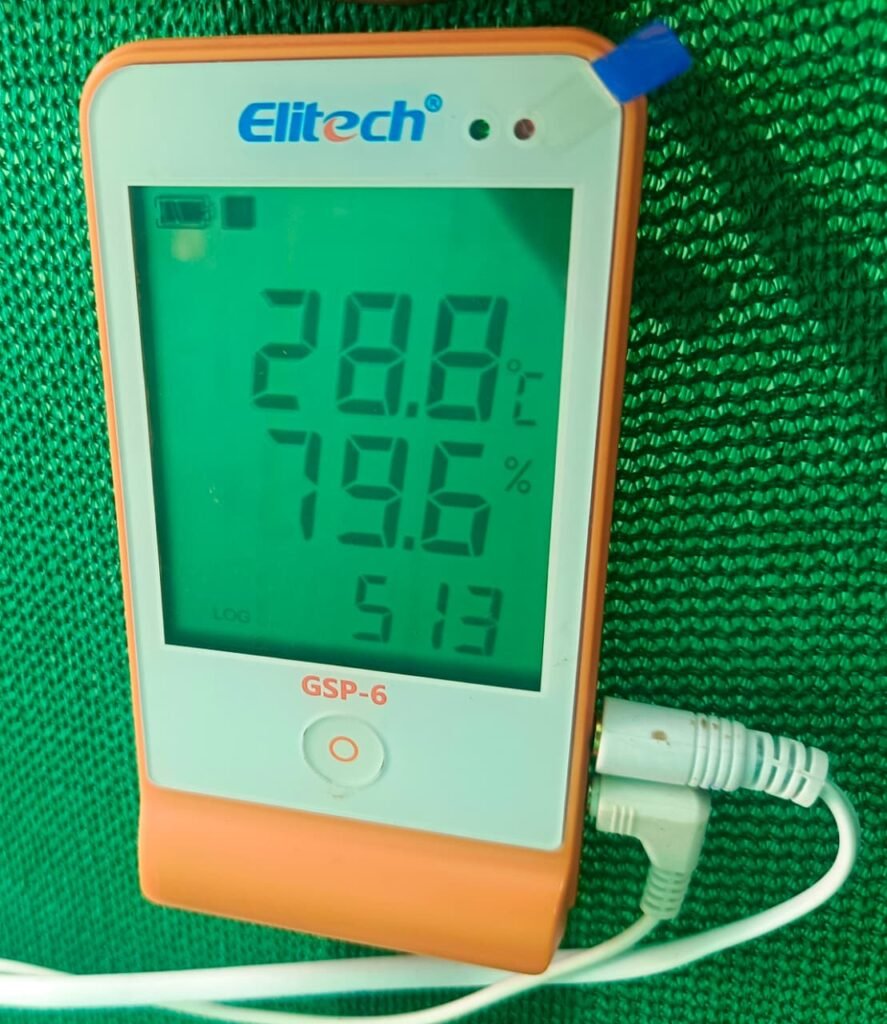
A digital humidity Temperature meter is used for temperature and humidity monitoring
Working Components of the Small Polyhouse Climate Control Structure
- Base Structure Preparation
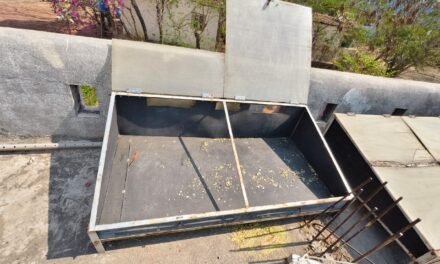
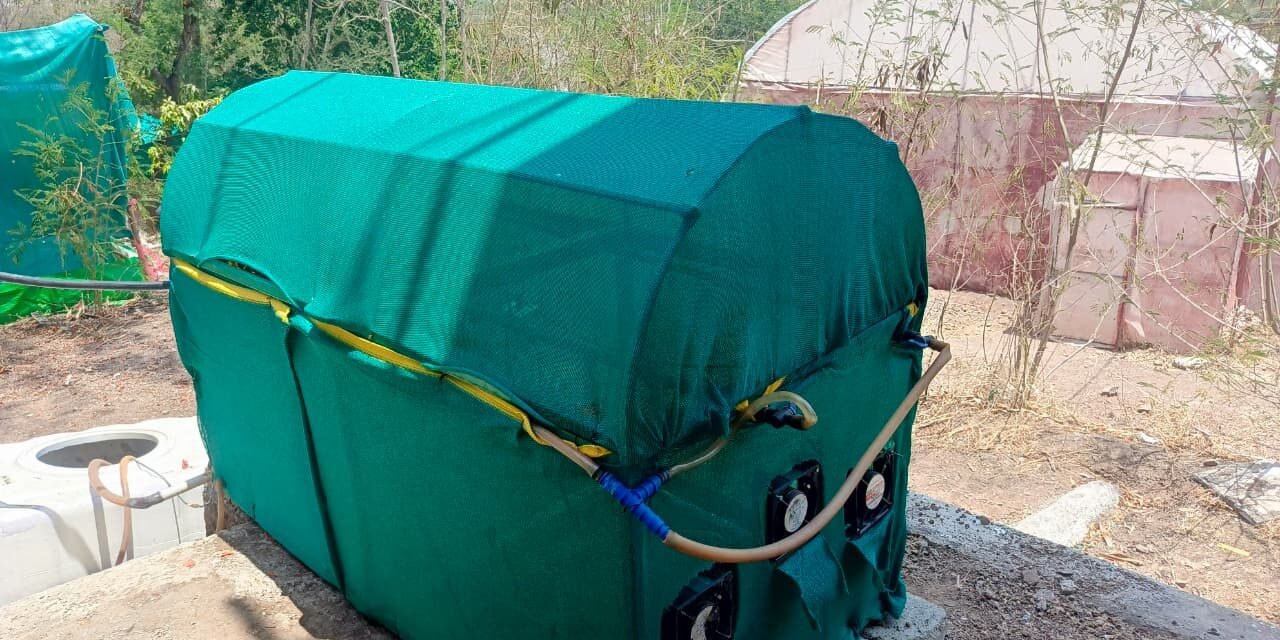
A compact polyhouse-type structure was prepared using a strong support frame and covered with green shade-net material. The tunnel-shaped design helps reduce direct sunlight and improve internal climate management. - Cooling Pad Installation
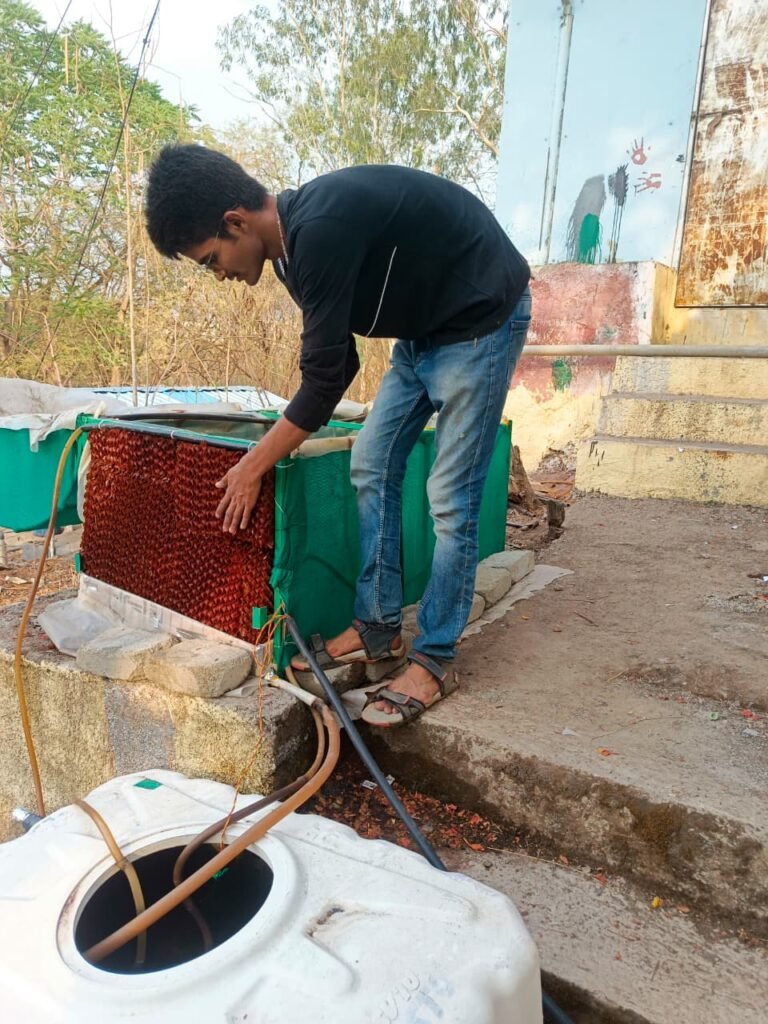
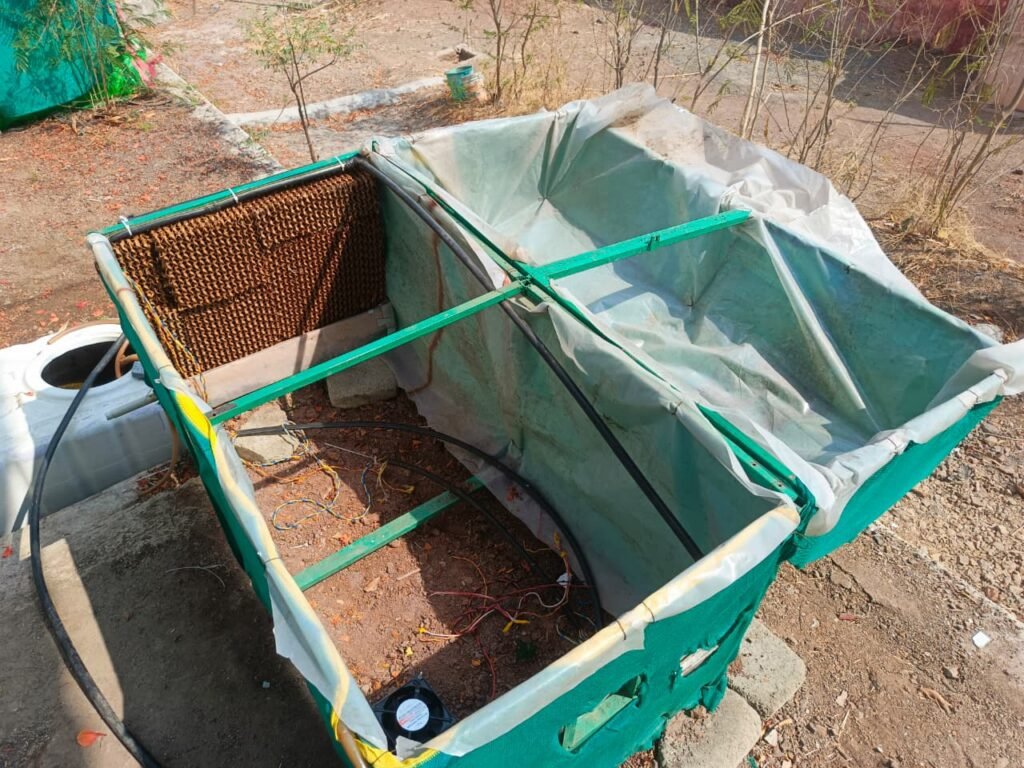
Cooling pads were installed on the sides of the structure to reduce internal temperature and increase humidity levels. Water passes through the cooling pads, and air moving through them becomes cooler and more humid.
2.Cooling Pad Information :
Type = Evaporative Cooling Pad
Width = 145 cm (1.45 m)
Height = 45 cm (0.45 m).
Area Formula : Lenght * width
Calculation : A = 1.45 * 0.45 = 0.6525 m²
Area :
Cooling Pad Area = 0.65 m²
3.Exhaust Fan Working :
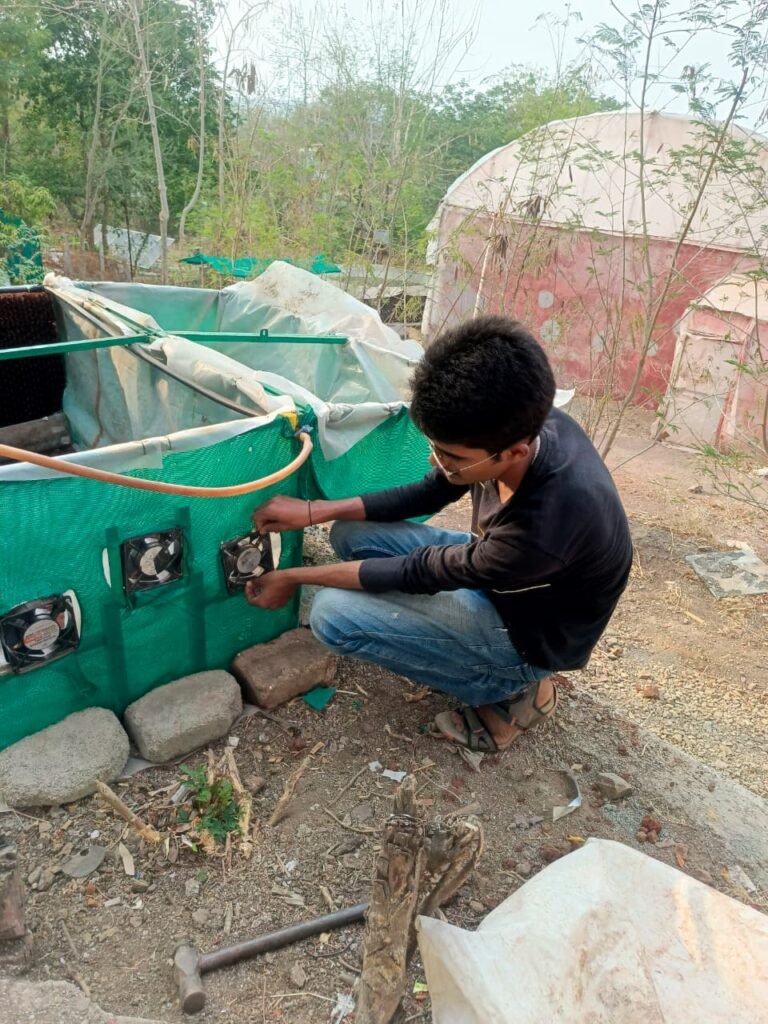
The exhaust fans pull hot air out of the polyhouse and create continuous air circulation. Cool air enters through the wet cooling pad, helping maintain proper temperature and humidity inside the structure.
4.Exhaust Fan Details :
Type: Axial Exhaust Fan
Quantity: 3 Fans
Air Flow Capacity: 300 CFM
Size: 120 × 120 × 38 mm
Voltage: 220–240 VAC
Power: 33 W
Each exhaust fan has an airflow capacity of 300 CFM (Cubic Feet per Minute).
5.Data Logger Working
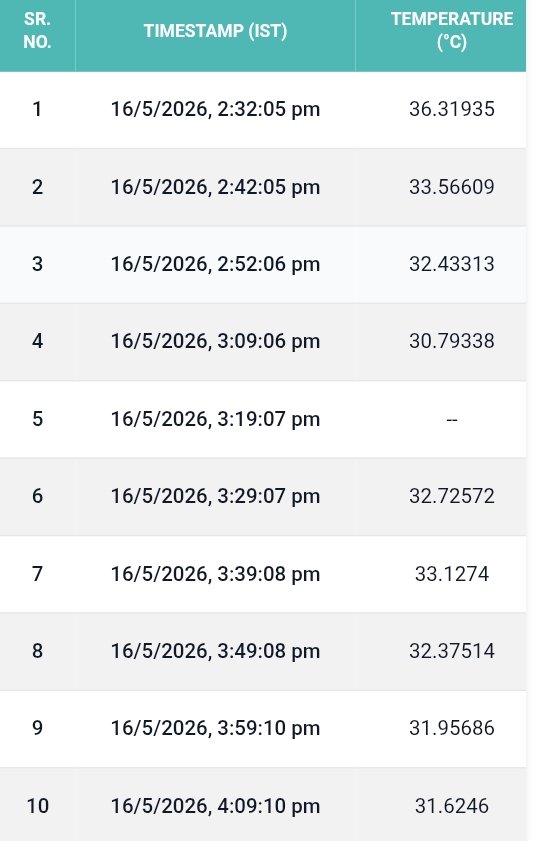
The data logger continuously records and displays temperature and humidity values in real time. It helps monitor the performance of the cooling and ventilation system inside the polyhouse.
Data Logger Details :
Type: Digital Temperature and Humidity Data Logger
Function: Used for continuous monitoring of environmental conditions inside the poly-house.
Parameters Measured: Temperature and Humidity
Polyhouse Climate Control Project Planing Timeline :
| Date | Work Completed |
| 26 Apr | Project planning and material collection Base preparation and structure measurement |
| 27-28 Apr | Frame assembly and Coling pad installation |
| 29-30 Apr | Ventilation Cooling and humidity improvement work planning to Yashvant sir |
| 1-2 May | Cooling pad and water circulation installation |
| 3-4 May | Exhaust fan installation and electrical wiring Initial testing, airflow checking, and repairs |
| 5-6 May | Data logger and sensor installation |
| 7-9 May | Sensor calibration and monitoring start |
| 10-11 May | Sensor calibration and monitoring start |
| 12-13 May | Add foggers Cooling and humidity improvement work |
| 14-16 May | Cooling and humidity improvement work |
| 17 May | Final environmental testing |
Status 0n 18th May 2026
The structure preparation, cooling pad setup, exhaust fan installation, and data logger setup have been completed successfully. Environmental testing is currently in progress to achieve stable temperature and humidity conditions inside the polyhouse.
Current readings recorded by the data logger:
Temperature: The system maintains an internal temperature of 30–32°C, while the outside temperature remains around 39–40°C
The present temperature is within the target range of 25–27°C, but the humidity is still below the desired level of 75%+. Further improvements in cooling pad efficiency, water circulation, and airflow management are being carried out to increase humidity and stabilize the internal climate conditions of the polyhouse.
Problem Identification
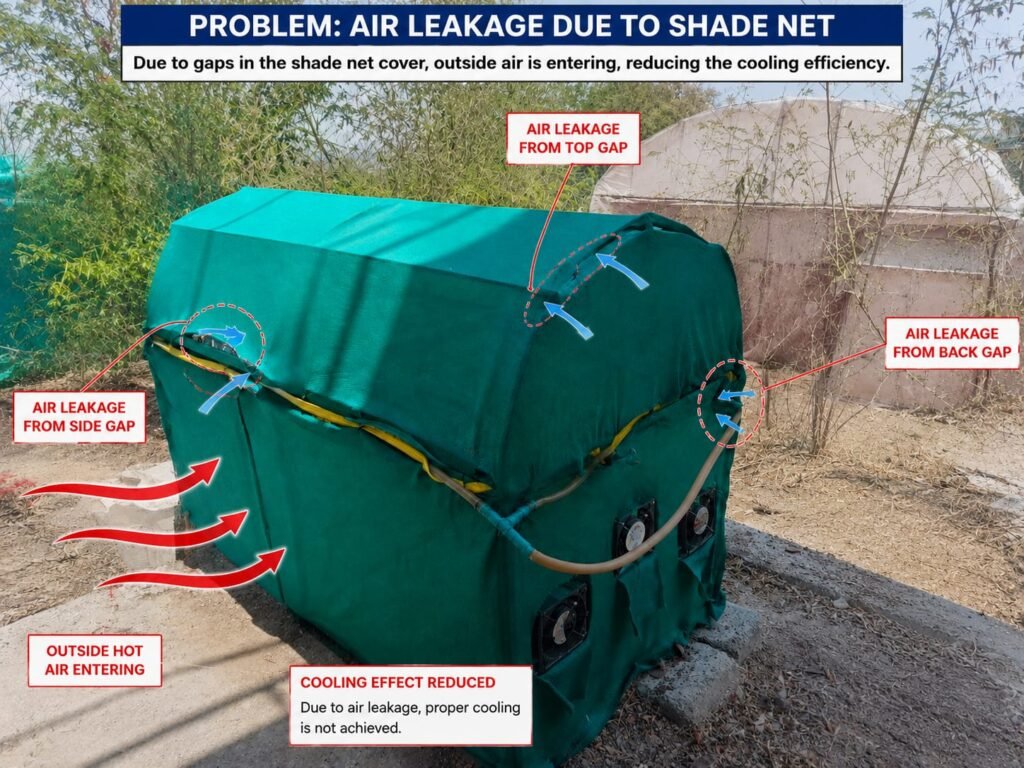
The cooling efficiency of the polyhouse is reduced because outside hot air enters through gaps in the shade net covering. Due to air leakage, proper cooling and humidity conditions are not maintained inside the structure.
Cause of Problem :
Loose shade net covering
Open gaps on the sides and the top
Uncontrolled outside airflow
Effect :
Cooling effect decreases
Internal temperature increases
Humidity becomes unstable
Discussion and Solution :
On Wednesday, 19 May, the problem was discussed with Dr. Dixit and Mr. Abhijeet After discussion, the solution was finalized to reduce air leakage and improve the cooling effect.
Final Solution
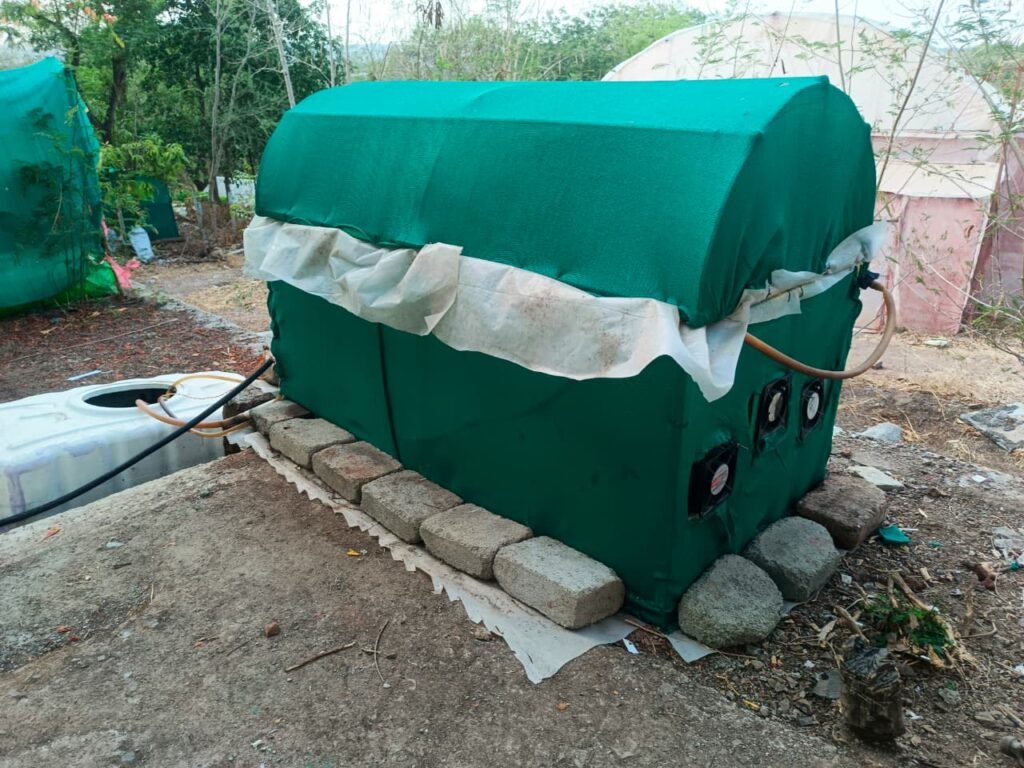
First, a polythene sheet will be installed over the structure.
After that, the shade net will be placed above the polythene layer.
Improvement Work :
After the discussion and final solution, a polythene sheet was installed over the structure. The entire polyhouse was properly sealed and packed from all sides to reduce air leakage and improve the cooling efficiency inside the structure.
Conclusion :
On 22 May, the poly-house structure was successfully completed after implementing the required modifications. The target conditions of 27°C temperature and above 70% humidity were achieved. The recorded readings were 28.8°C temperature and 79.6% humidity, indicating that the climate control system is working effectively.