Survey data, burning incidents, route mapping, and a new plan to make segregation stick — one card at a time.
Sawardari Waste Management Project · VADIC / Vigyan Ashram · June 2026
Sawardari is a dense, fast-growing semi-urban settlement on the edge of Pune’s MIDC industrial belt. It has roughly 35,000 total population— mostly migrant workers living in multi-room buildings — alongside a permanent local population of about 2,000. Waste collection runs six days a week with two vehicles and a small team of workers starting at 8 a.m.
In June 2026, we ran a survey, mapped collection routes for the first time, documented three open burning incidents, and sat with residents to understand why segregation isn’t happening. This post is a full account of what we found — and what we’re going to try next.
The dump yard, when we looked at it carefully, visually it is about 38% plastic by weight, 25% biodegradable, 13% metal and scrap, and 24% textile and mixed waste. Hotels and restaurants contribute roughly 80% of all the bio-waste that arrives at the yard. That’s an important number — a handful of establishments, not thousands of households, drive most of the wet waste volume.
A Timeline of What Happened This Month
12–15 Jun 2026
Household and business survey — 22 responses
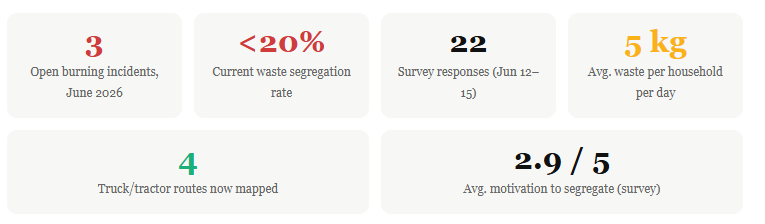
We surveyed 22 residents and building owners across Sawardari (17 residents/tenants, 5 building owners). The finding that stood out most: 59% of respondents said they currently do little or no segregation (Level 1 on a 1–5 scale). Only 18% qualified as active segregators. When asked what they would do if they had the wrong type of waste on a dry-waste day, 8 out of 22 said they would dump it in an open area or burn it.
15 Jun 2026
Open burning incident — Dadimchi Punyai area
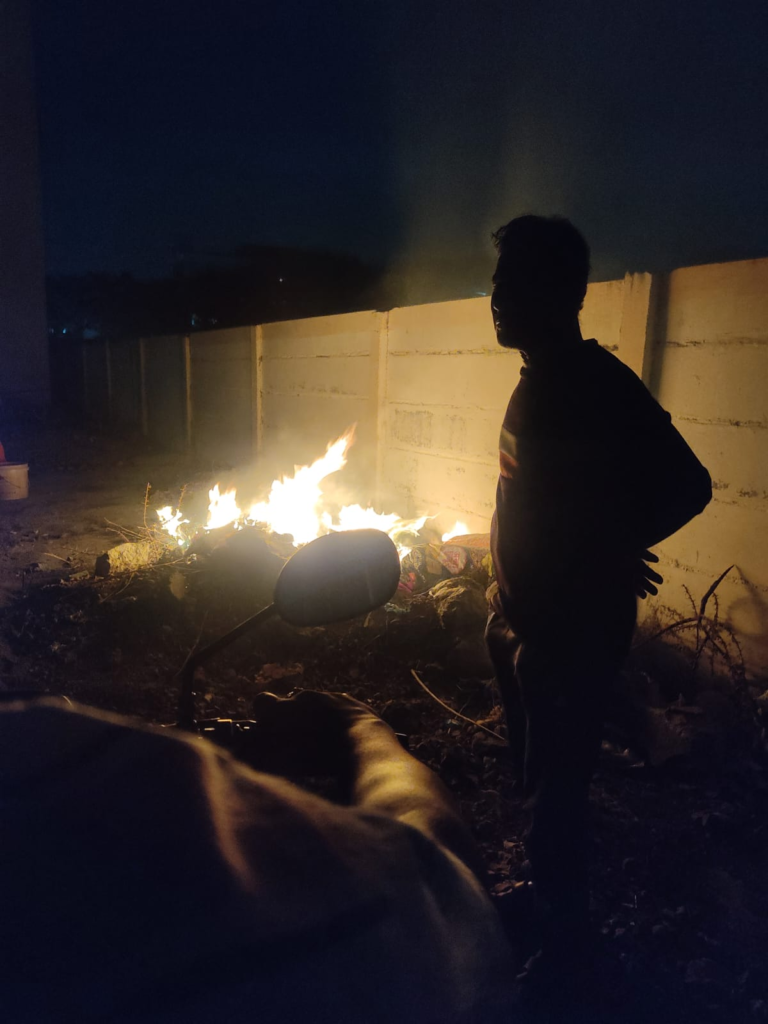
Two burning sites documented near the Dadimchi Punyai area. Mixed waste. GPS coordinates logged (18.7682, 73.7810) and photos taken.
20 Jun 2026
Large-scale company plastic burning — Sai Deep Hotel, Sawardari
Three vehicle loads of company plastic waste from Yogi Kripa were burnt in front of Sai Deep Hotel. Vehicle: MH14EM2230. Worker: Teerath (84258 47002). Supervisor: Ambadas. This was not a household — it was an industrial-scale disposal violation by a registered company. Reported by Deepanshu Gupta.
21 Jun 2026
Burning at Shiv Samarth building — root cause identified
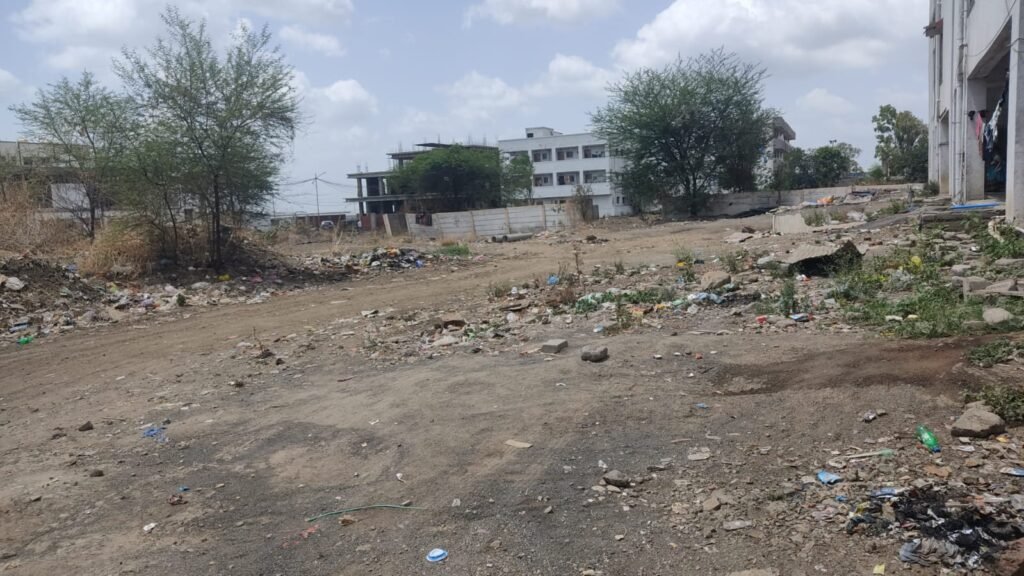
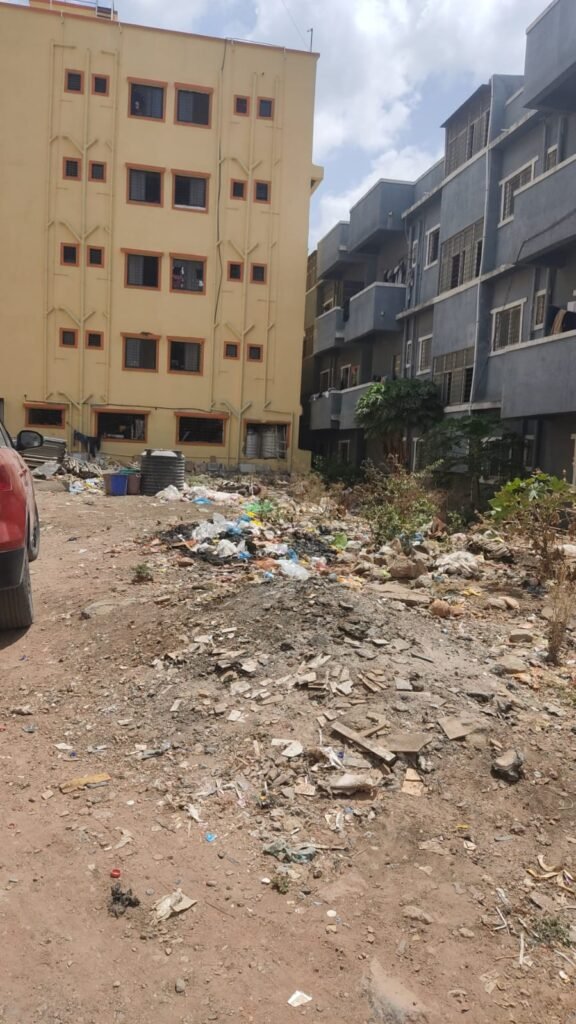
Waste burnt opposite Kedarnath supermarket at Shiv Samarth building.
The chain: dustbins overflow → residents dump in open area → smell and spread cause burning as the only perceived solution. Manager Damodar Solanke (8605939950) and canteen owner Siddheshwar Solanke both contacted. Root cause here is under-provisioned bin infrastructure, not pure behavioral failure.
23–24 Jun 2026
Route mapping completed — tractor and truck, 4 routes total
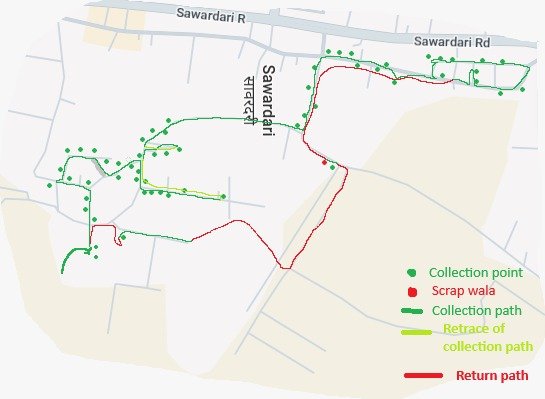
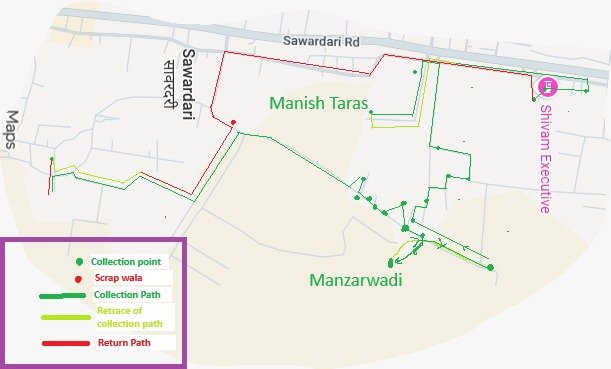
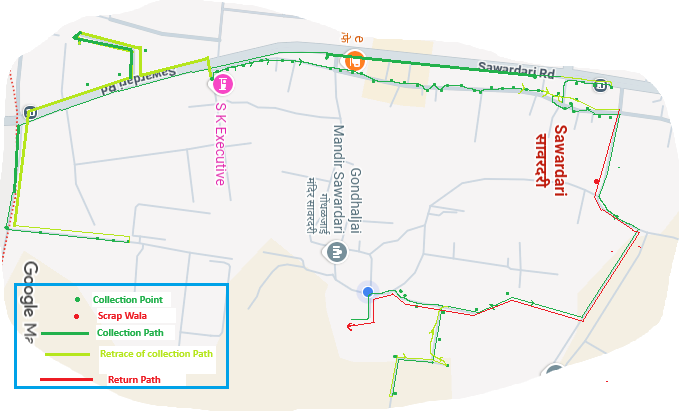
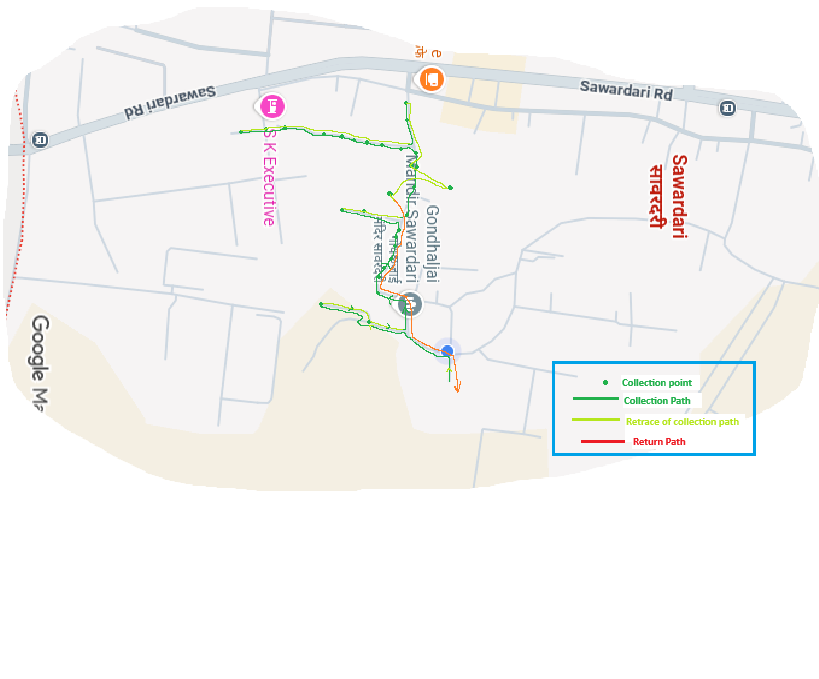
For the first time, we mapped all active collection routes. Each vehicle completes two rounds on normal weekdays (unaffected by Sundays). The two truck routes now cover the full settlement: Tractor goes through Sawardari Road west and the residential lanes including Manish Taras and Manzarwadi; Truck covers the eastern stretch and the Gondhaljai / Mandir Sawardari area with SK Executive as a depot reference point. Collection points (~155) are now identified — the shift is from tracking individual buildings to anchoring the route at fixed lane-level collection points, as suggested by Shreyas.
27 Jun 2026
Three buildings flagged — notices required
Completed giving info about collection of segregated waste on both route of Tractor. Navnath Complex (owner: 9011836318), Sakore Patil Complex (Nana Ganpat Sakore, 9552740946), and a third building near coordinates 18.7684, 73.7782 all need formal notices at every door with recyclable waste posters. Navnath Complex owner has also requested separate bins from the Gram Panchayat.
What the Survey Told Us About Barriers
We asked people directly: what stops you from segregating? The top answers were practical, not moral:
- No separate bins — the most common barrier (6 respondents). People aren’t refusing to segregate; they have nowhere to put things separately.
- “Too much work” — 5 respondents. This is a behavioral cue: the process isn’t simple enough yet.
- No clear instructions — 2 respondents didn’t know what went where.
- “The system mixes it anyway” — 1 respondent. This one matters. If people watch a worker dump their carefully separated wet and dry waste into the same trolley compartment, they stop segregating. The vehicle design undermines household behavior.
On storing waste between collections: 54% of respondents said they cannot store waste for 48 hours. This has direct implications for any alternate-day wet/dry collection model — people will find workarounds, including dumping.
On willingness to pay: only 27% of respondents said yes to a monthly user fee, with most comfortable at ₹50–100/month. At 10% adoption across the 35,000-person area at ₹75 average, the theoretical monthly revenue is around ₹26 lakh — but adoption is the hard part, and the survey makes clear that trust in the system has to come first.
Infrastructure Problems We Found on the Ground
Trolley design: Waste blows out of open trolleys in transit due to wind. An enclosure with a loading opening is needed — not expensive, but currently absent.
Lack of community bin at hotspot of open air burning of waste.
Before:
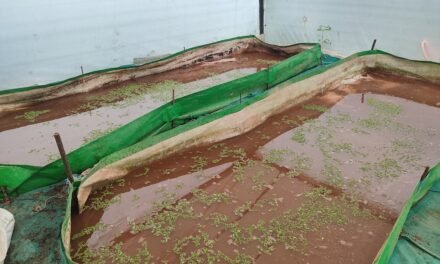
No separate compartments on the collection vehicle resulted in segregated waste being mixed during collection, discouraging source segregation.
After:
Separate compartments have been introduced on the collection vehicle, and the community has been informed to hand over wet and dry waste separately on both routes of tractor and Truck is pending.
The Plan We Discussed
We discussed this with Shreyas and Deepanshu and came up with a multi-part engagement approach combining awareness, behavioral nudges, and accountability. Here’s what we’re proposing to test:
1. Vehicle banner (Gaadi pe banner)
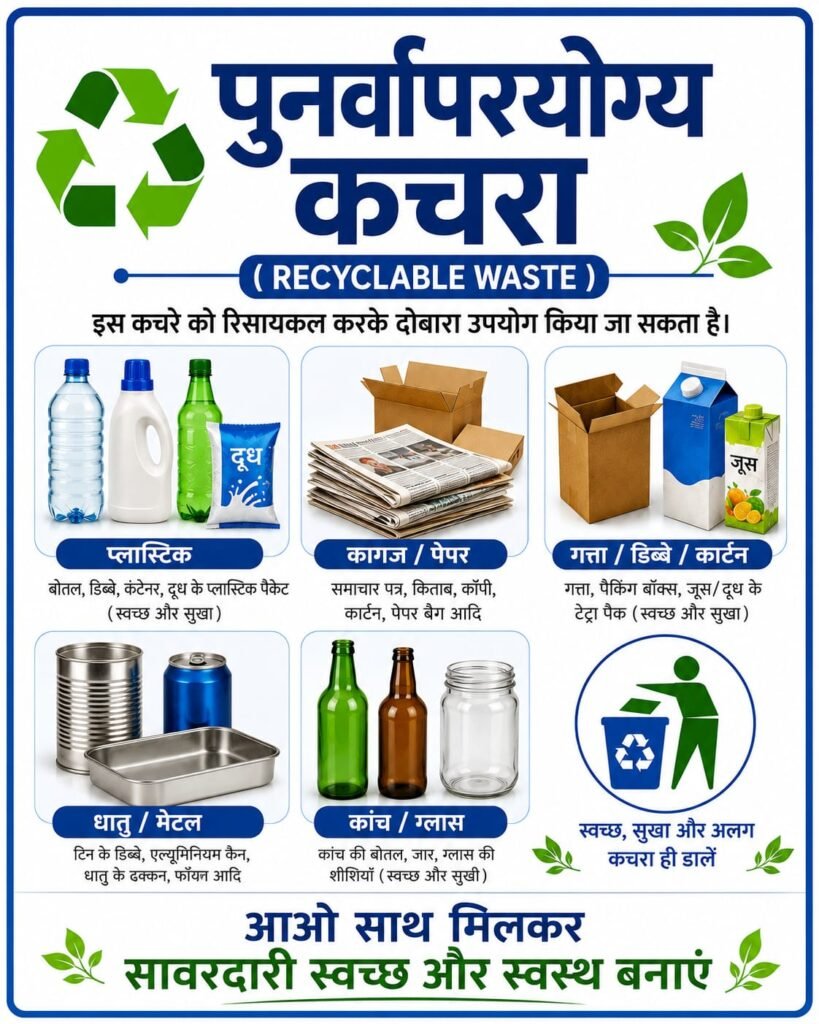
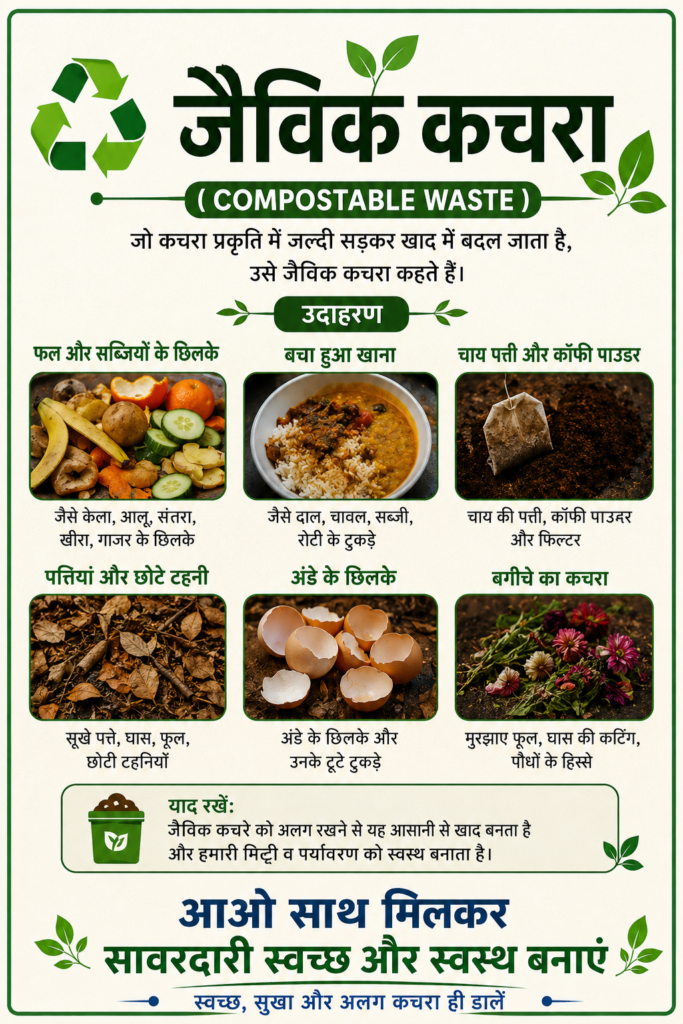
A visible banner on the collection vehicle with clear, simple instructions in Marathi and Hindi about wet/dry segregation. The vehicle moves through every lane every day — it’s free advertising space for behavior change. This also builds identity around the program.
2. 30-day stamp system
Every household gets a monthly card. Each collection day, the worker stamps the card at the door:

The month is divided into four week-long achievement tiers. Complete each one and you earn a card:

The cards are cumulative — you need Bronze before Silver, and so on. The intention is to create a visible, social record of progress. Neighbors see what card their building has. Children know what their family earned. It makes segregation feel like something you can succeed at, week by week.
3. Gram Panchayat notice after 6+ red stamps in a month
If a household accumulates more than 6 red stamps in a single month or more than 12 yellow stamps, a formal notice goes out from the Gram Panchayat. This creates a real, proportionate consequence without being punitive from day one — people get four weeks and chances before any official action is triggered.
Note: This is planned to run for 2 weeks
The card and stamp system starts to address this by making the collection point — not the individual household — the unit of accountability. But the deeper lever is building-owner accountability: if owners with 20–100 rooms become responsible for their tenants’ collective stamp record, behavior change could scale fast