Introduction
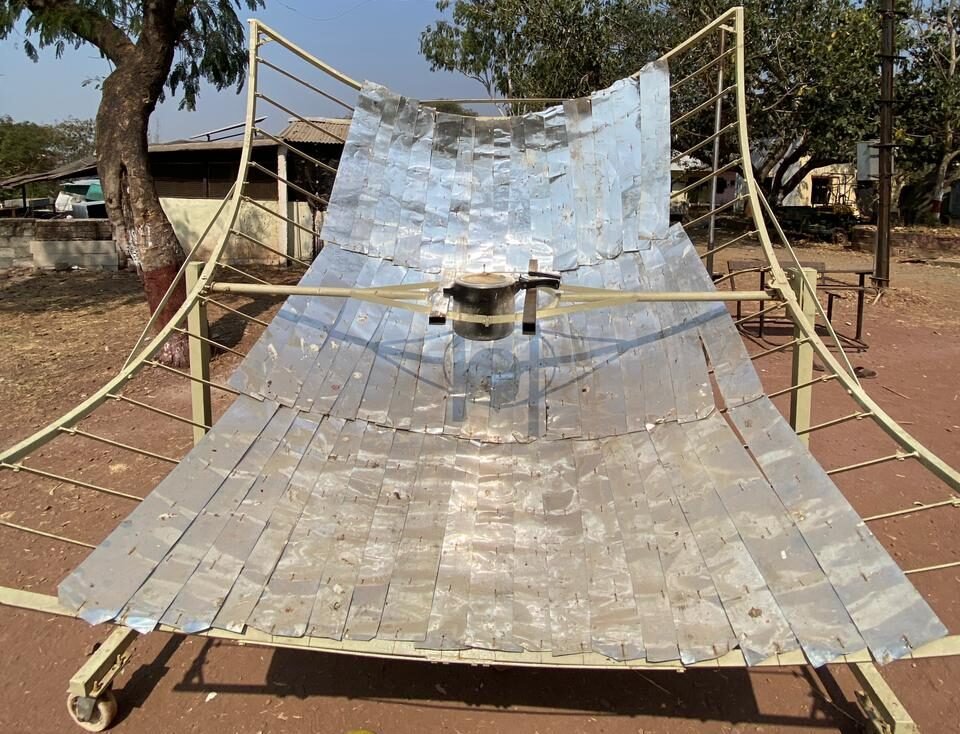
This project explores how concentrated solar energy can be used to distill water. A parabolic solar cooker is used as the heat source to boil water, generate steam, and condense it into distilled water, Can also be sued to make food from it, etc. The system works without electricity or fuel and demonstrates practical solar thermal energy use.
Background
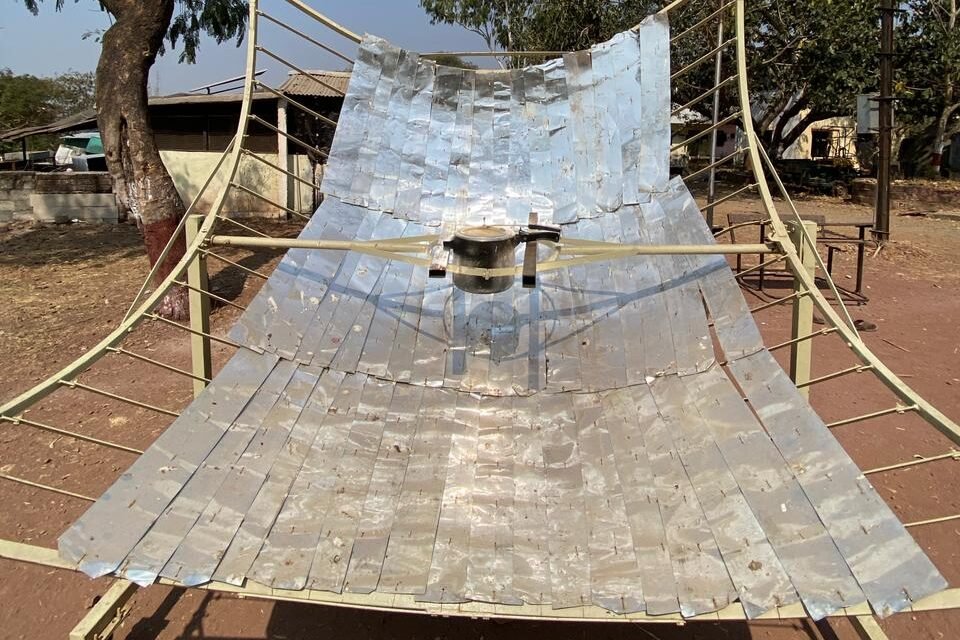
- Parabolic solar cookers use reflective surfaces to focus sunlight onto a small area, producing high temperatures. These systems are used in community cooking, research, and renewable energy demonstrations. Using such a cooker for distillation shows how solar heat can purify water.
Objective
- The objective of this project is to build and test a solar-powered water distillation setup using a PRINCE-40 cooker and verify whether if distilled water can be produced using only sunlight.
Working principle
- Sunlight is reflected by the parabolic dish and concentrated at the focal point.
- A black painted Pressure Cooker is placed at the focus absorbs heat and boils water.
- Boiling produces steam while impurities remain in the vessel.
Additional Note on Cooking Capability
Apart from distillation trials, the solar cooker is also suitable for regular cooking. Since it can bring water to boiling temperature, it can be used to cook foods like rice, lentils, and vegetables under good sunlight conditions. Parabolic solar cookers are commonly used for boiling, steaming, and frying in community and rural settings.
This confirms that the cooker is effective as a solar thermal device for cooking, even though the current setup produced limited steam for distillation.
Current Aim
At the present stage, the goal was to check two things:
• Whether the cooker can reach boiling temperature
• Whether it can generate enough steam for distillation
Setup Used
A metal vessel with water was placed at the focal point of the solar cooker. The cooker was aligned with the sun and manually tracked to maintain focus on the vessel.
Observations
• The cooker successfully heated the vessel
• Water reached boiling temperature
• Steam was produced
• However, the steam output was low and not continuous
• The steam quantity was not sufficient for effective distillation.
Analysis
On the test day, the setup was started at 11:28 am with the vessel placed at the focal point of the solar cooker. The cooker was aligned with the sun and periodically adjusted for tracking.
Steam formation was first observed at 12:47 pm, meaning it took about 1 hour 19 minutes to reach noticeable boiling and steam generation.
The steam produced was somewhat continuous but very low in quantity. The flow was not strong enough to support effective water distillation.
This observation shows that the cooker can achieve boiling, but the rate of steam production is limited under the current setup and conditions. It suggests heat losses, limited heat absorption, or minor tracking/sealing issues affecting performance.