Polyhouse Optimization and Data Logging
20 SEPTEMBER 2026
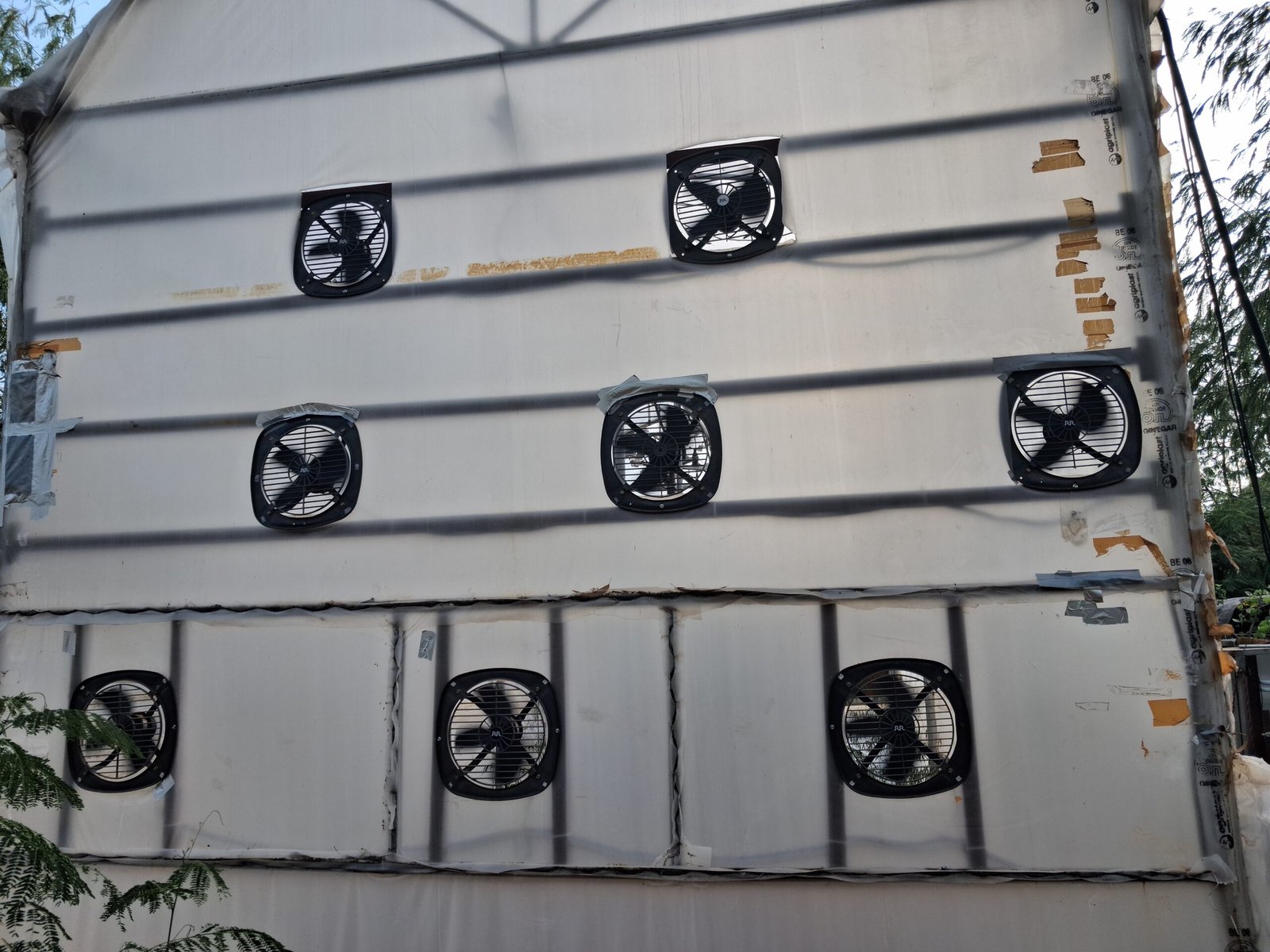
On Sunday, I worked on the ventilation and data-monitoring setup of the large polyhouse at Vigyan Ashram. There are seven fans installed inside the polyhouse, which need to operate at regular intervals so that the readings from the data loggers inside the polyhouse can be compared with the readings from the external weather station and the outdoor data logger.
DISCUSSION REGARDING DATA COLLECTION
Earlier, Hemansh was working on the data collection and comparison of the polyhouse. I discussed the remaining work with him and understood the requirements of the project. He informed me that he would complete the remaining part of his project and provide the required work and data for further comparison and analysis.
DIGITAL TIMER INSTALLATION
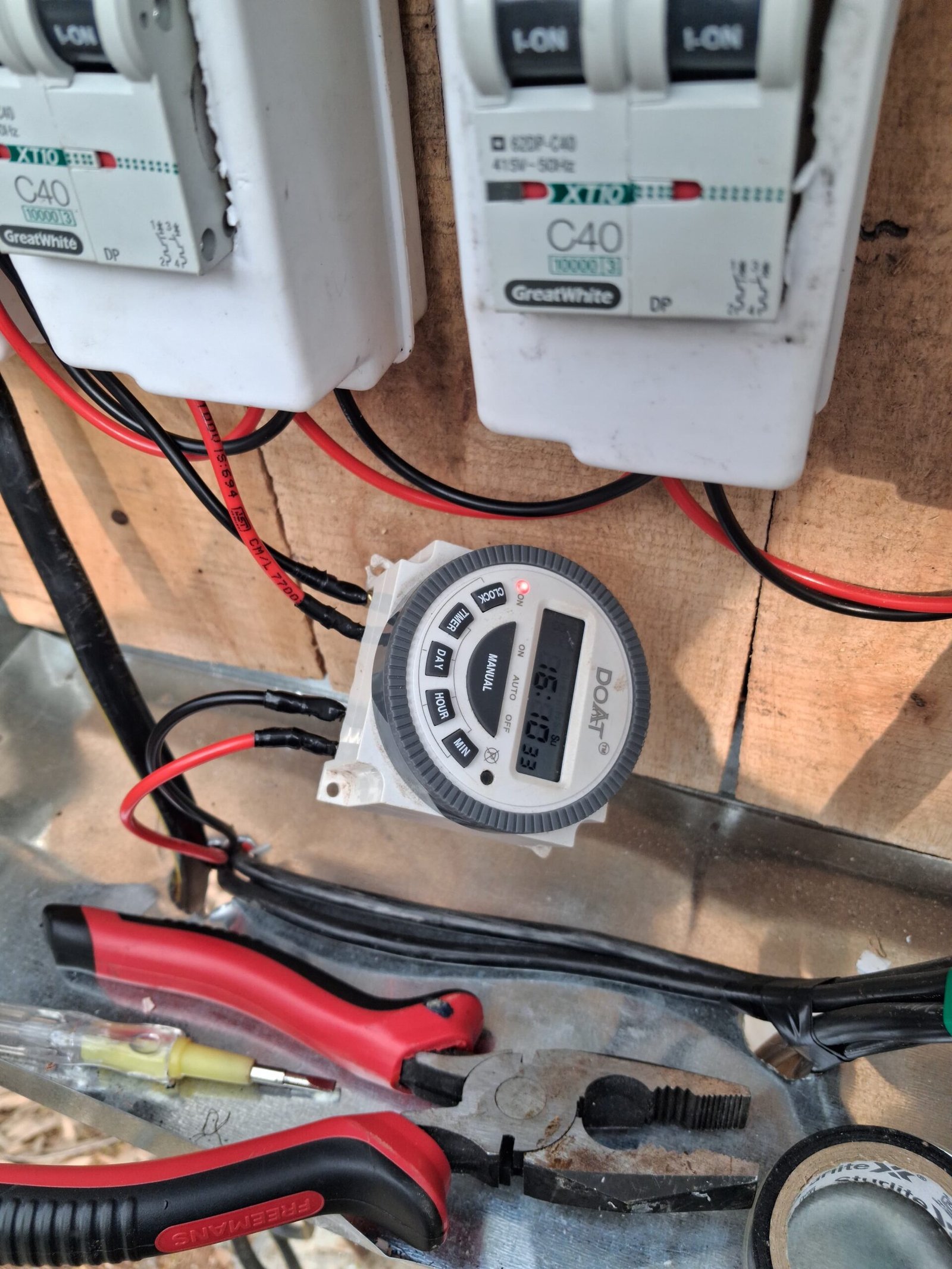
My main task for the day was to install a digital timer for automatically controlling the seven polyhouse fans. I referred to the manufacturer’s manual and successfully installed and programmed the timer according to the required operating schedule.
The timer has been programmed to operate the fans from 7:00 AM to 7:30 PM, with a 30-minute ON/OFF interval. The fans will operate automatically throughout this period. For example, the fans will turn ON at 7:00 AM and turn OFF at 7:30 AM, then turn ON again at 8:00 AM and continue the same cycle throughout the scheduled period.
PURPOSE OF THE TIMER SETUP
The automated timer will ensure that all seven fans operate at regular intervals without requiring manual switching. This will provide consistent ventilation conditions inside the polyhouse and help in collecting comparable data from the internal data loggers, the external weather station, and the outdoor data logger.
The successful installation of the digital timer completes the automation of the fan operating schedule and will support the upcoming data collection and comparison work.
Large Polyhouse: Fan Automation, Voltage Troubleshooting and Environmental Data Monitoring
: 21–27 September 2026
1. Introduction
During the week of 21–27 September, the major focus of the large polyhouse project was testing the automated fan-control system and developing a system for analysing the environmental data generated from the polyhouse.
After installing the digital timer for automatic fan operation, an operational issue was observed in which all the fans were not starting consistently. At one point, approximately four out of the eight fans were operating while the remaining four fans were not running. This issue was investigated to identify the possible cause and to improve the reliability of the automated system.
2. Fan Automation Testing and Troubleshooting
The automated fan system was designed to operate the polyhouse fans at regular intervals. During testing, it was observed that some fans did not start automatically even though the control system was giving the ON command.
As an initial troubleshooting step, the non-running fans were manually rotated. After manually moving the fan blades, the fans started operating normally. This indicated that the problem was not simply related to the ON/OFF command from the timer and required further investigation.
The issue was discussed with Shire Sir. Based on the discussion, voltage variation was considered as one of the possible reasons for the inconsistent starting of the fans.
3. Voltage Measurement and Observation
To investigate the voltage-related issue, the supply voltage was measured using a digital meter and clamp-meter setup.
The digital timer and fan system require a supply close to the normal operating voltage of approximately 230 V. During one of the instances when a fan was not operating, the measured voltage was approximately 225 V.
The observed difference was therefore:
230 V − 225 V = 5 V
This represented a voltage reduction of approximately:
(5 ÷ 230) × 100 ≈ 2.17%
Although the measured voltage difference was relatively small, the observation suggested that supply-voltage variation could contribute to the difficulty experienced by some fans while starting. Further monitoring is required to establish whether voltage variation is consistently associated with fan-starting failures.
The troubleshooting therefore helped identify a possible electrical factor affecting the reliability of the automated fan system. Continuous observation of the supply voltage and fan operation will be useful for confirming the cause.
4. Environmental Data Monitoring
Along with testing the fan automation system, another important task was to establish a method for comparing the environmental conditions inside the large polyhouse with the outdoor conditions.
Data loggers installed inside the polyhouse provide information about the internal environmental conditions, particularly the inside temperature. The outdoor data logger provides corresponding outdoor temperature information.
In addition, the nearby weather station provides other environmental parameters such as:
- Wind speed
- Solar radiation
- Outdoor temperature
By combining these datasets, it becomes possible to study the relationship between fan operation and the environmental conditions inside and outside the polyhouse.
5. Fan ON/OFF Interval and Data Correlation
The fans were programmed to operate automatically at regular intervals, with the fan status changing approximately every 30 minutes during the testing arrangement.
Because the fan status changes at a known interval, the environmental data can be compared with the corresponding fan ON and OFF periods.
The objective is to develop a dataset containing parameters such as:
- Time / IST
- Fan Status
- Inside Temperature
- Outside Temperature
- Solar Radiation
- Wind Speed
This combined dataset will help analyse how changes in fan operation are related to the temperature difference between the inside and outside of the polyhouse.
6. Development of the Monitoring Spreadsheet
To organise and compare the readings from different sources, a monitoring spreadsheet was developed in collaboration with Ashwini.
The spreadsheet was designed to bring together the readings from the indoor data loggers, outdoor data logger and weather station. This provides a common format for analysing the relationship between fan operation and environmental conditions.
The spreadsheet can be accessed here:
Large Polyhouse Environmental Monitoring Spreadsheet
The organised data will later be used to analyse temperature variation during fan ON and OFF periods and to understand the effect of outdoor environmental parameters such as solar radiation and wind speed.
7. Importance of Combining the Data
Monitoring only the inside temperature would not provide enough information to understand the actual performance of the fan system because outdoor weather conditions continuously change.
For example, an increase in solar radiation can increase the temperature inside the polyhouse even when the fans are operating. Similarly, higher wind speed can improve natural air movement and influence the cooling performance.
Therefore, combining inside temperature, outside temperature, solar radiation, wind speed and fan status provides a more complete picture of the polyhouse environment.
8. Work Completed During 21–27 September
- Tested the automated operation of the large polyhouse fans.
- Observed inconsistent starting of the fans.
- Identified that approximately four of the eight fans were sometimes not operating.
- Manually rotated the affected fans and observed that they subsequently started operating.
- Discussed the issue with Shire Sir.
- Investigated supply voltage as a possible reason for the inconsistent fan starting.
- Measured approximately 225 V during one observed non-starting condition against a nominal 230 V supply.
- Established a system for combining indoor, outdoor and weather-station data.
- Worked with Ashwini to develop the environmental monitoring spreadsheet.
- Prepared the dataset structure for correlating fan status with inside temperature, outside temperature, solar radiation and wind speed.
9. Next Steps
The next stage will involve collecting sufficient data from the polyhouse and analysing the relationship between fan operation and environmental conditions.
The voltage supply will also be monitored further to determine whether voltage variation is consistently associated with fan-starting problems. If required, the electrical supply and fan-starting behaviour will be investigated in greater detail.
The environmental dataset will be used to compare fan ON and OFF periods and determine how effectively the automated ventilation system influences the internal polyhouse temperature under different outdoor conditions.
10. Conclusion
During 21–27 September, the large polyhouse project focused mainly on testing and troubleshooting the automated fan system and establishing a structured environmental monitoring system.
Inconsistent fan starting was observed during testing, with approximately four of the eight fans sometimes failing to start automatically. After manual rotation, the affected fans began operating, and a possible voltage-related issue was investigated. A supply voltage of approximately 225 V was observed during one such condition compared with the nominal 230 V supply.
In parallel, an environmental monitoring spreadsheet was developed with Ashwini to combine fan status, inside temperature, outside temperature, solar radiation and wind-speed data. This dataset will provide the basis for evaluating the performance of the automated ventilation system and understanding how fan operation affects the large polyhouse environment.