Introduction
The increasing demand for clean and safe drinking water has created a need for sustainable and energy-efficient water purification technologies. Conventional water purification methods often require significant electrical or thermal energy, which increases operating costs and environmental impact. Solar energy, being abundant and renewable, can be effectively utilized for thermal applications such as water purification and desalination. A solar-based distillation system utilizes solar thermal energy to heat water, generate vapour, and subsequently condense it to obtain purified water. The performance of such a system is influenced by factors such as solar radiation intensity, water temperature, ambient temperature, and condensation conditions. Therefore, monitoring these parameters is essential to evaluate the system performance and understand the relationship between solar energy availability and freshwater production.
Concept/Methodology-
- Utilization of solar thermal energy for water purification.
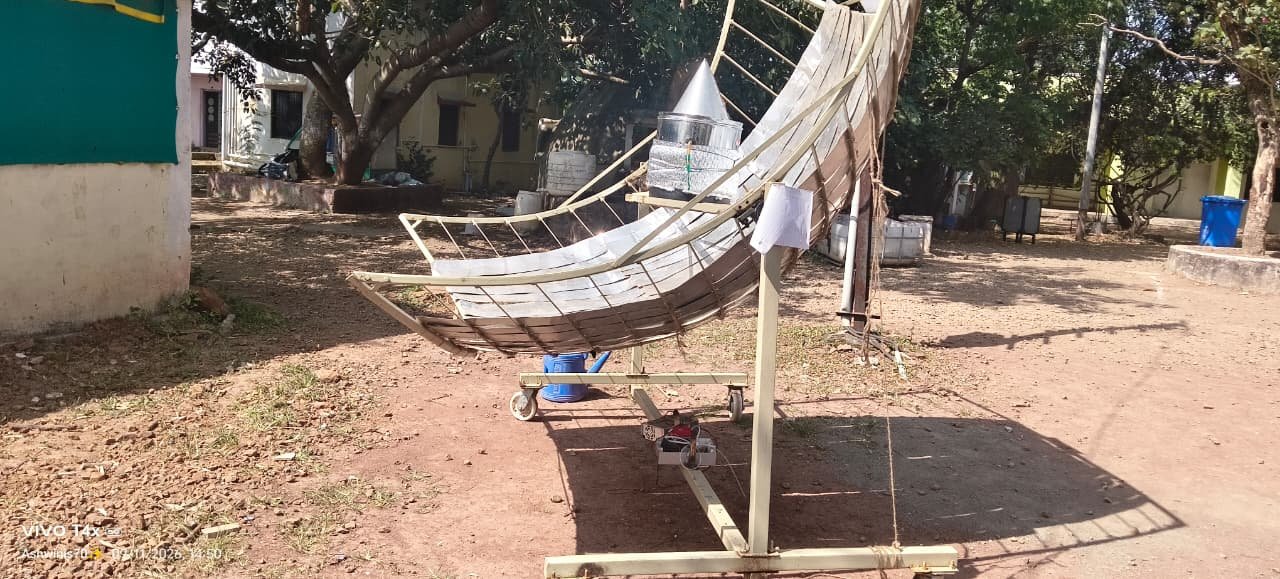
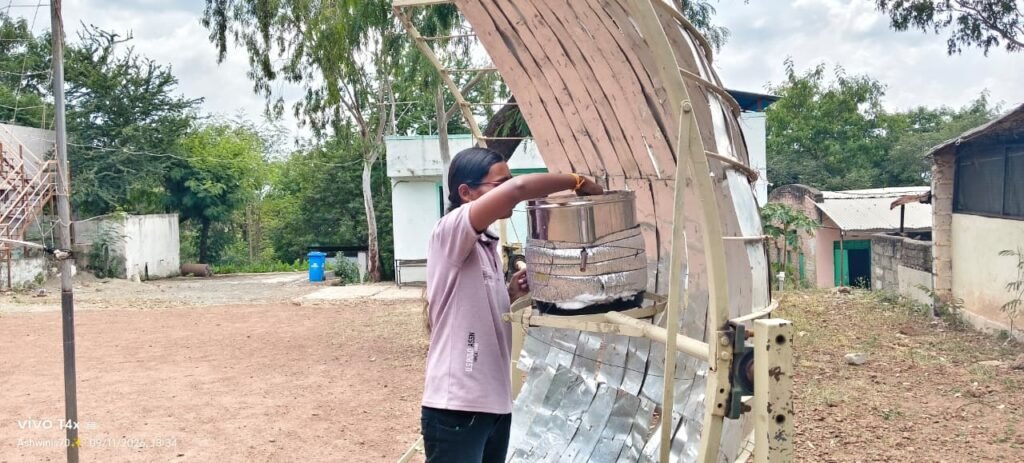
- A parabolic solar collector concentrates sunlight at the focal region.
- Concentrated solar energy generates heat and increases the water temperature.
- Increased water temperature promotes evaporation.
- Water vapour condenses on a relatively cooler surface.
- The condensed water is collected as distilled water.
- The study focuses on the relationship between:
- Solar radiation / light intensity
- Water temperature
- Distilled water output
- Readings are recorded at regular time intervals to evaluate system performance under varying solar conditions.
11/09/2026 to 15/09/2026
| Time | Temperature in Degree Celcius |
| 10:07 AM | 25.5 |
| 10:26 AM | 38.5 |
| 10:50 AM | 52.1 |
| 11:20 AM | 60.7 |
| 11:50 AM | 60.2 |
| 12:20 PM | 59.2 |
| 12:50 PM | 56.4 |
| 1:30 PM | 51 |
| 2:10 PM | 52 |
| 2:40 PM | 53.5 |
| 3:10 PM | 57 |
| 3:50 PM | 65 |
Discussion with Dixit Sir-
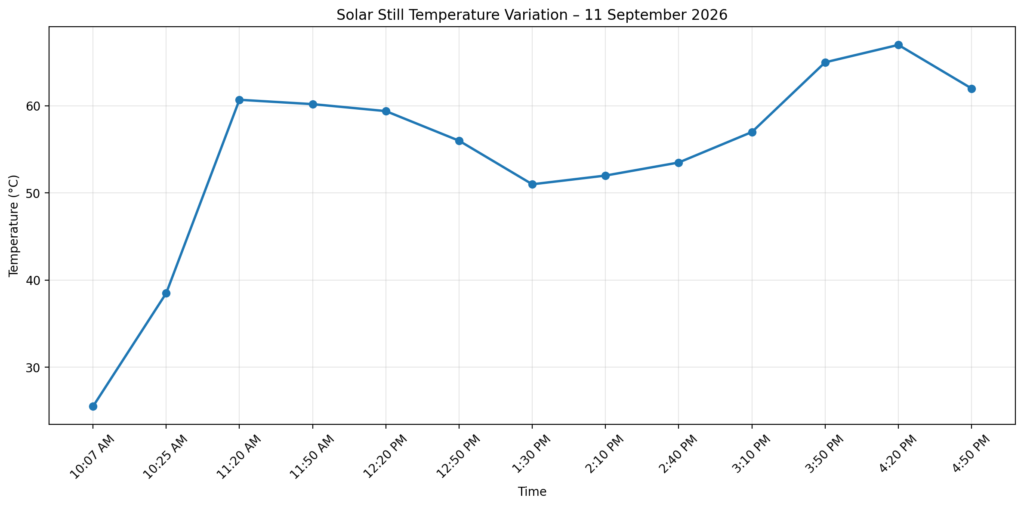
On 11 September 2026, temperature readings of the solar still were recorded at regular time intervals. The initial temperature at 10:07 AM was 25.5°C, and the temperature increased with solar heating, reaching a maximum of approximately 67°C at 4:20 PM.
After recording the temperature data, the readings were discussed with Dixit Sir. During the discussion, Sir asked an important question: “How much water was evaporated during the experiment?” At that stage, the amount of evaporated water had not been measured.
Based on this observation, the following parameters were suggested for recording during the next solar still experiment:
- Initial quantity of water added to the solar still
- Final quantity of water remaining after the experiment
- Amount of water evaporated, calculated as:
Water evaporated = Initial water quantity − Final water quantity - Light intensity (Lux) during each observation
- Cloudy/clear weather conditions
- Temperature of the solar still at regular time intervals
These additional parameters will help in establishing a better relationship between temperature, light intensity, weather conditions, and water evaporation, and will provide more meaningful data for evaluating the performance of the solar still.