11/08/2025
Introduction
Tea is one of the most consumed beverages across the world and a part of India’s daily life. Over the years, consumer preference has shifted from plain tea to flavored and wellness teas — such as ginger, tulsi, cardamom, rose, and ashwagandha blends.
To meet this demand, industries use natural flavoring substances like oleoresins and essential oils to enhance taste, aroma, and health benefits.
This project focuses on comparing oleoresin and essential oil as natural flavoring ingredients for tea powder and studying their market feasibility, safety, and business potential for small-scale entrepreneurs.
What are Oleoresins and Essential Oils?
| Parameter | Oleoresin | Essential Oil |
|---|---|---|
| Definition | Concentrated, semi-solid extract obtained from spices or herbs using solvents. Contains both volatile oils and non-volatile flavor compounds. | Volatile aromatic oil obtained from plants by steam distillation. Contains only aroma compounds. |
| Flavor Intensity | Rich and full-bodied, provides taste + aroma. | Light and aromatic, provides aroma only. |
| Stability | More stable and long-lasting during storage. | More volatile and less stable. |
| Cost | Slightly higher initially, but very economical due to small dosage. | Cheaper but needs higher quantity for the same flavor strength. |
| Best Use | Ideal for strong flavored teas like ginger, cardamom, tulsi, ashwagandha. | Ideal for mild aroma teas like rose or lavender. |
Why Choose Oleoresin for Flavored Tea Powder?
After comparison, oleoresin proves to be the most efficient for tea flavoring because:
- It provides both taste and aroma, unlike essential oil which only gives aroma.
- It is more heat-stable during drying and packaging.
- Very small amounts (0.1–0.5%) can flavor large batches.
- It gives uniform flavor distribution and longer shelf life.
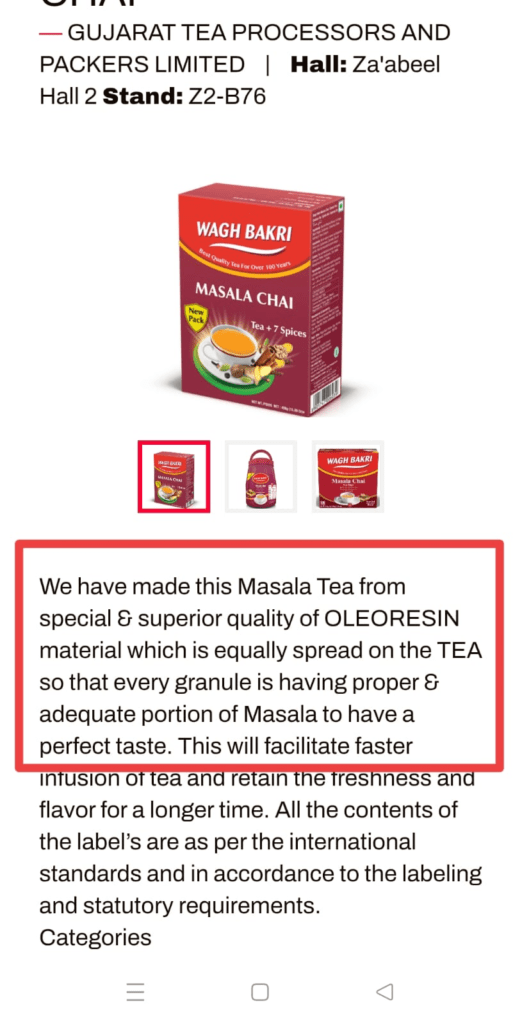
- It is already used by big tea brands like Wagh Bakri for their Masala Chai.
https://www.gulfood.com/gulfood-2025-products/wagh-bakri-masala-chai
Regulatory & Safety Approvals
Tea Board of India
- Permits only natural flavoring substances derived from plants by physical means.
- Artificial or synthetic flavors are not allowed.
- Manufacturers must be registered with the Tea Board before selling flavored tea.
FSSAI (Food Safety and Standards Authority of India)
- Allows use of oleoresins, essential oils, and food-grade ethanol as natural flavor carriers.
- Certain food-grade emulsifiers (like lecithin) are also approved but must stay within limits.
- Alcohol use is permitted as long as it is food-grade ethanol that evaporates before packaging.
Market Study and Industrial Practices
- Leading brands like Wagh Bakri, Girnar, and Tata Tea Premium Masala use oleoresins or essential oils for uniform, long-lasting flavors.
- Oleoresin is preferred because of its low dosage requirement and consistency in every batch.
- Alcohol is widely used in flavor houses globally to prepare flavor concentrates before blending.
Entrepreneurial Scope
For small-scale or rural entrepreneurs, this idea offers a low-investment, high-value opportunity:
- Simple processing setup (mixer, drying tray, sealing machine).
- Raw materials like tea dust and oleoresins are easily available.
- Each batch can be customized with local herbal combinations for unique taste profiles.
- High market demand for natural, healthy, herbal flavored teas.
Conclusion
From all technical, regulatory, and economic viewpoints, oleoresin-based flavoring is the most reliable, stable, and approved method for preparing flavored tea powder.
Using food-grade ethanol as a solvent instead of emulsifier is a safe and efficient approach — supported by FSSAI guidelines.
This approach ensures:
✅ Natural and authentic flavor
✅ Safety and regulatory compliance
✅ Cost-effectiveness for entrepreneurs
✅ Market acceptability and consumer trust
Hence, this research provides a scientifically valid and entrepreneur-friendly solution for developing high-quality, natural flavored teas suitable for commercialization.
This study aims to promote value addition in tea using safe and sustainable natural extracts, encouraging small-scale industries and young entrepreneurs to innovate with indigenous herbal flavors of India.
https://drive.google.com/file/d/1ZfC-Uc5orNoP5-7eHsfoqw2f4_C_5xU7/view?usp=drivesdk
These is the link for document shows difference between oleoresins and oil for tea flavouring