Introduction
The need for an onion storage unit arises because onions are highly sensitive to environmental conditions like temperature, humidity, and air circulation. After harvesting, onions continue to respire and release moisture, which can lead to sprouting, rotting, fungal growth, and weight loss if not stored properly. Traditional storage methods often fail to maintain the right conditions, resulting in significant post-harvest losses and reduced market value for farmers. A well-designed onion storage unit helps in maintaining a controlled environment with proper ventilation, allowing excess moisture and heat to escape while keeping the onions dry and cool. This extends the shelf life of onions, reduces spoilage, and allows farmers to store produce for longer periods and sell when market prices are favorable.
Approach
To tackle the problem of onion storage losses, the approach begins with a detailed study of onion behavior after harvesting. Onions are living biological materials, so they continue respiration, release moisture, and are highly affected by temperature and humidity. Understanding factors like optimum storage temperature, safe humidity range (generally around 65–75%), airflow requirements, and causes of spoilage such as microbial growth and sprouting is the first step. This study also includes observing how onions behave in local conditions (like Maharashtra climate), seasonal variations, and how long they can be safely stored under different environments.
Most conventional onion storage structures rely only on natural ventilation, which is not always sufficient. They often lack proper airflow distribution, leading to uneven conditions inside the storage unit. There is no real-time monitoring, so farmers cannot detect when humidity rises or temperature increases, which eventually causes rotting. Also, there is no early warning system for spoilage, meaning losses are noticed only after damage has already occurred. Structural issues like improper stacking, poor design of vents, and exposure to external weather conditions further reduce efficiency.
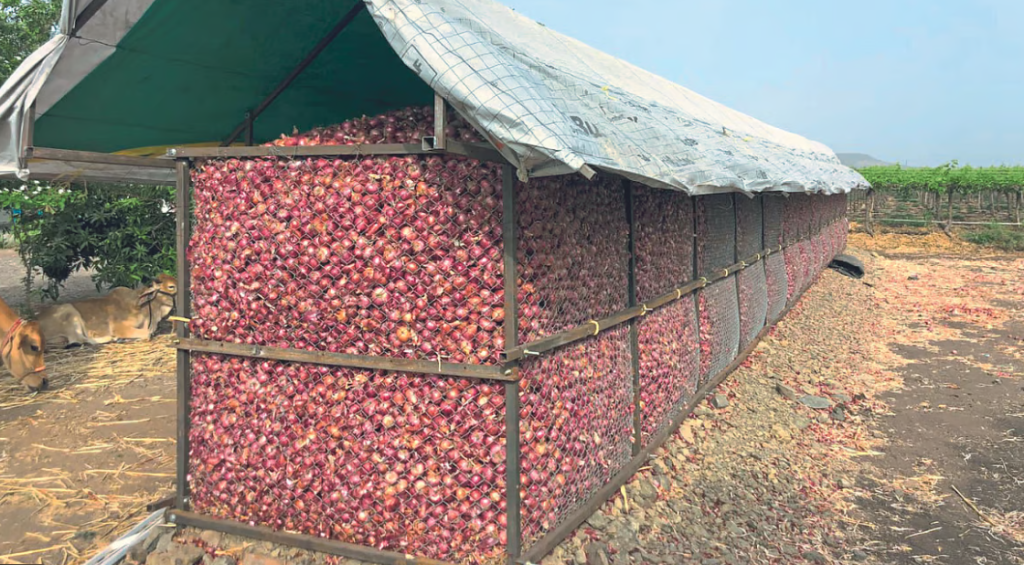
Prototype
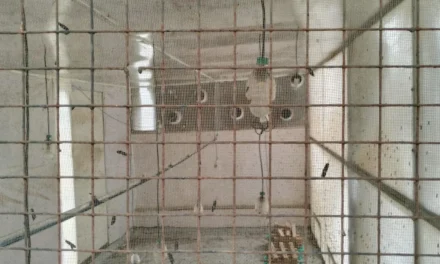
To overcome the problems in traditional onion storage systems, we developed a prototype that focuses on improving ventilation and extending the shelf life of onions. The design consists of a cylindrical structure made using wire mesh, placed on an elevated platform to allow proper airflow from all sides. At the center of the structure, an air duct is installed and connected to a blower. This blower pushes air from inside the storage unit to the outside, ensuring continuous and uniform ventilation throughout the structure. This arrangement helps maintain suitable storage conditions and reduces the chances of spoilage.
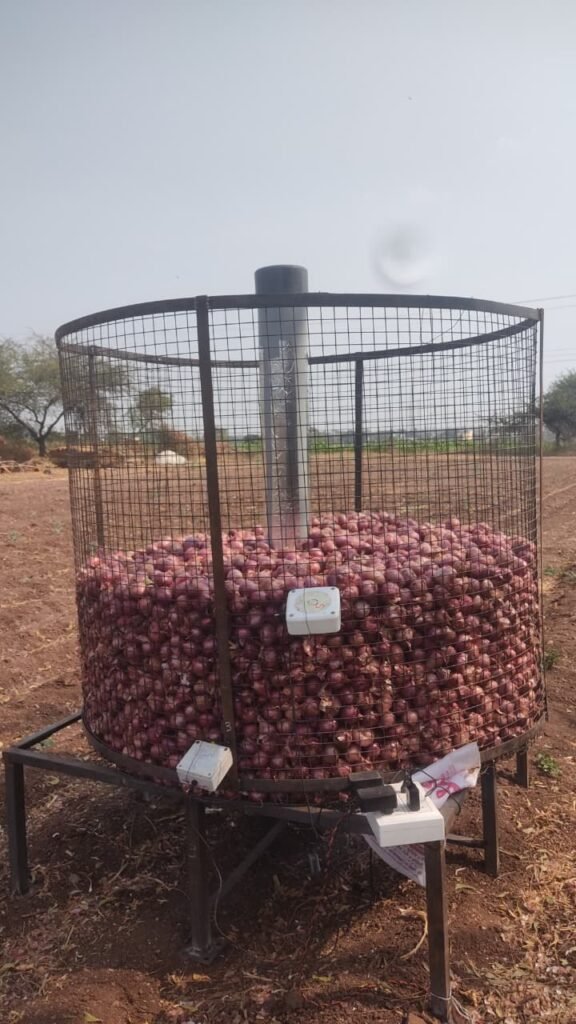
Initially in this prototype we only measure temperature and humidity data , But after some discussion and literature study we decided to measure other parameters like CO2 gas, H2S gas , and O2 gas accumulation in certain regions.
Use of Sensors
Sensor integration plays a very important role in making the storage unit smart and efficient. By using sensors like temperature, humidity, and gas sensors, the internal conditions of the storage unit can be continuously monitored in real time. For example, humidity sensors help ensure that moisture levels do not rise above safe limits, while temperature sensors help prevent overheating. Gas sensors can detect early signs of onion spoilage by identifying gases released during rotting. These sensors can be connected to a controller (like ESP32), which can automatically adjust fan speed or ventilation systems to maintain optimal conditions. Additionally, data from sensors can be sent to the cloud for remote monitoring and analysis, helping in early detection of problems and better decision-making. Overall, sensor integration improves storage efficiency, reduces losses, and supports modern, data-driven agriculture.
Why Monitoring These Parameters is Important in Onion Storage
- Temperature Monitoring
- High temperature increases the respiration rate of onions.
- Leads to faster moisture loss, sprouting, and spoilage.
- Maintaining optimal temperature helps extend shelf life.
- Humidity Monitoring
- High humidity promotes fungal and microbial growth.
- Excess moisture leads to rotting and quality degradation.
- Controlled humidity keeps onions dry and safe for longer storage.
- CO₂ (Carbon Dioxide) Monitoring
- CO₂ is released during onion respiration.
- Increase in CO₂ indicates higher biological or microbial activity.
- Acts as an early warning sign of spoilage or poor ventilation.
- O₂ (Oxygen) Monitoring
- O₂ is consumed during respiration.
- Decrease in O₂ level indicates increased respiration or microbial growth.
- When O₂ drops and CO₂ rises together, it signals developing spoilage conditions.
- H₂S (Hydrogen Sulfide) Monitoring
- Released when onions start decomposing.
- Indicates breakdown of sulfur compounds due to microbial action.
- Acts as a late-stage indicator — shows that spoilage has already started.
Sensors Used
For this system i used followig sensors-
- Temperature / Humidity – AHT2415C
- CO2 – MHZ19B
- H2S – MQ136
- O2 – AO-03
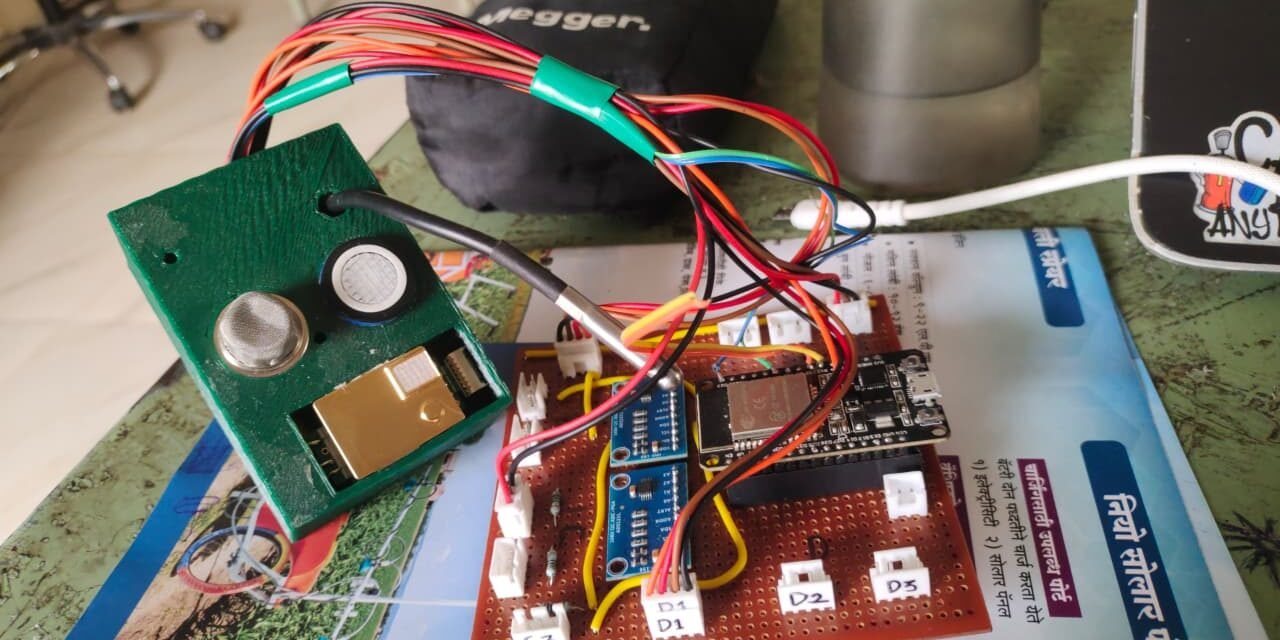
Using this i developed one circuit board along with the firebase console to monitor and log data with help of Siddhart.
The circuit board consists of 3 Tem/Humi sensors, 3 O2 sensor, 3 H2s sensors and 3 CO2 sensors all this was connected to ESP32 Dev board and since including all these sensors was not possible for single ESP one I/O expander was used. All this was hand soldered on a Zero PCB to make a circuit board.
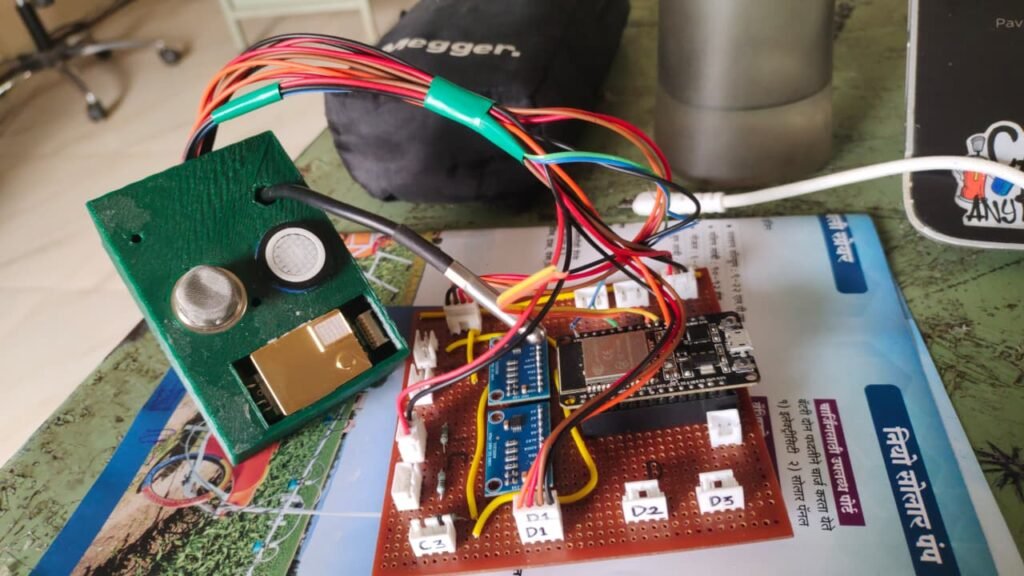
To house all those sensors and Controller board a custom 3D printed housing was designed and developed. The sensors housing consists of holes for all 4 sensors and harness . Where as the housing for controller consists of mounting hole for controller , harness input holes and power jack mounting.
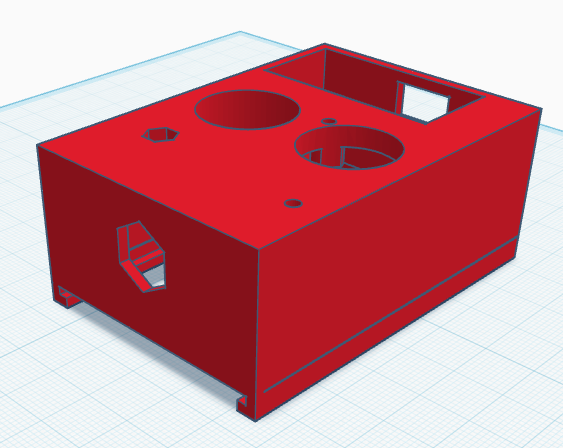
Issues Faced
With this prototype i faced several issues –
1. First issue was related to use of sensors with testing I realized that O2 sensor is not necessary if I’m using CO2 sensor. So for my next prototype i removed O2 sensor.
2. Second issue was related to wire harness length, since the sensors were places at different location in storage unit the harness length was getting over a meter long and that create interference between the line and controller leading to signal loss and data losses. To rectify this issue i reduce number of sensors to be used per unit and kept it to only one so that accurate data can be measured.
3. Third issue was related to Software where in my firebase console i was getting inconsistent data because of factor like power cut and unreliable network connection so to tackle this issue i put up a WIFI router separate for my unit and connect my system to reliable power source with backup available.